
What President Ilham Aliyev’s Peace Award says about changing global priorities

AzerNEWS Staff
Read moreCurrent global processes clearly demonstrate a simple but powerful truth: societies distant from prolonged conflicts enjoy higher prosperity, stronger institutions, and better quality of life. For decades, however, the Azerbaijani people lived under the heavy burden of war and occupation. Achieving peace was neither easy nor immediate, but through decisive military action, diplomatic persistence, and strategic leadership, Azerbaijan has entered a fundamentally new stage of development. Today, the country stands at a crossroads where post-conflict recovery is being transformed into a long-term peace and development strategy.
The meeting between the leaders of Azerbaijan and Armenia in Washington in August last year, held with the participation of U.S. President Donald Trump, was a visible indication that peace is no longer theoretical - it is tangible and approaching finalization. This political momentum has since been reinforced by practical steps that would have been unthinkable only a few years ago.
One of the most telling indicators of this new reality is the restoration of transit and logistical cooperation between Azerbaijan and Armenia after decades of interruption. The recent transit of 25 grain wagons carrying 1,746 tonnes of cargo through Azerbaijani territory to Armenia is not an isolated event, but part of a broader and steadily expanding process. Nearly 20,000 tonnes of grain have already passed through the same route, alongside fuel shipments - including AI-92, AI-95, and diesel - moving from Azerbaijan toward Armenia via Georgia. The first such fuel delivery in December 2025 marked a symbolic turning point: Azerbaijan transitioned from being perceived solely as a former adversary to becoming an essential economic and energy partner. In post-conflict environments, such practical cooperation often speaks louder than diplomatic statements.
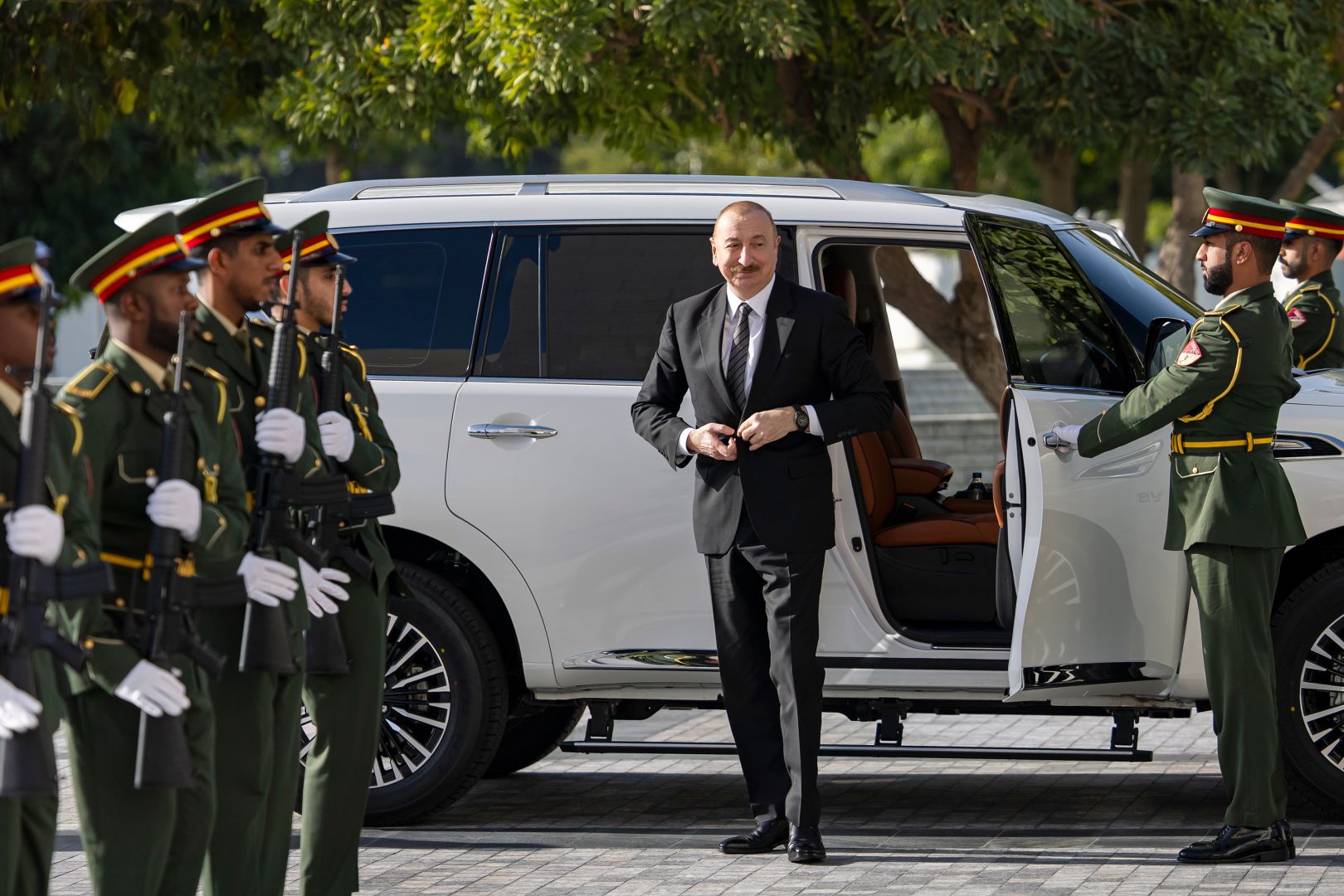
Against this backdrop, President of the Republic of Azerbaijan Ilham Aliyev’s working visit to Abu Dhabi on February 2-4, and his participation in the presentation ceremony of the Zayed Human Brotherhood Award, carry significance far beyond protocol.
A global award with strategic meaning
The Zayed Human Brotherhood Award is one of the world’s most respected international honors dedicated to promoting peace, coexistence, tolerance, and solidarity. Independent in nature and global in scope, the award recognizes individuals and organizations that have made concrete, selfless contributions to human fraternity. The scale of interest alone - thousands of nominations from more than 75 countries for the 2026 edition - underscores its credibility and prestige.
The 2026 laureates include President Ilham Aliyev, Afghan education advocate Zarqa Yaftali, the Palestinian humanitarian organization Taawon, and Armenian Prime Minister Nikol Pashinyan. This composition itself reflects the award’s core philosophy: acknowledging leaders and institutions that contribute to peace across political, cultural, and regional divides. Laureates are selected by an independent jury of globally respected figures, based on criteria such as measurable contributions to peace, international recognition, and innovative approaches to reconciliation and cooperation.
From military victory to political responsibility
Azerbaijan’s absolute Victory in the 44-day Patriotic War and the 2023 anti-terrorist measures was firmly grounded in international law. Yet its true historical importance lies not only in military success, but in the political and diplomatic outcomes that followed. Azerbaijan did not merely end occupation, it reshaped the geopolitical landscape of the South Caucasus.
Crucially, as a victorious state, Azerbaijan chose not the path of revenge or isolation, but the far more complex and demanding path of peace-building and regional integration. Transforming military success into sustainable peace is one of the most difficult tasks in international politics. It requires restraint, strategic vision, and confidence in one’s legitimacy. President Ilham Aliyev’s leadership during this phase has demonstrated that genuine strength lies not only in winning wars, but in preventing their recurrence.
It is precisely this approach that distinguishes Azerbaijan’s post-war strategy and elevates it to the level of an international model. In an era marked by deepening global instability, unresolved conflicts, and leadership crises, the world increasingly values leaders who deliver results rather than rhetoric.
The awarding of the Zayed Human Brotherhood Award to President Ilham Aliyev is therefore not symbolic - it is analytical and results-driven. As the President himself stated in an interview with Euronews during the World Economic Forum in Davos in January 2026, receiving an award named after the founder of the UAE, Sheikh Zayed, is a profound honor. More importantly, it reflects international acknowledgment of Azerbaijan’s peace agenda.
This decision sends a clear message to the global community: the era of declarative diplomacy is giving way to the era of responsible leadership and practical solutions. The award evaluates tangible outcomes, not intentions, and Azerbaijan’s outcomes are already visible on the ground.
Beyond recognizing the President personally, the award represents trust in the Azerbaijani people and respect for the country’s strategic direction. It reinforces the reality that Azerbaijan is not a source of instability, but an emerging center for dialogue, connectivity, and regional development.
Moreover, when examining conflict-resolution efforts globally, Azerbaijan’s post-conflict trajectory stands out against the mixed and often fragile outcomes seen in other regions.
In the Balkans, the Dayton Agreement ended large-scale hostilities in Bosnia and Herzegovina, but it institutionalized ethnic divisions rather than resolving them. Nearly three decades later, the region continues to face political paralysis, externally imposed governance mechanisms, and unresolved sovereignty disputes. Peace was achieved, but without a unified political vision or economic integration strategy capable of producing long-term stability. This experience illustrates that freezing conflicts without addressing core political realities often leads to prolonged stagnation rather than reconciliation.
The Middle East offers an even more cautionary example. Numerous ceasefires, peace initiatives, and international mediation efforts - from Syria to Yemen and the Israeli-Palestinian conflict - have failed to produce a durable peace. A key reason lies in the absence of decisive outcomes and enforceable frameworks. Conflicts remain trapped between incomplete military results and fragmented political authority, allowing violence to resurface repeatedly. In this context, Azerbaijan’s experience demonstrates a critical principle: sustainable peace becomes possible only when territorial integrity, sovereignty, and security realities are clearly established and internationally recognized.
In Africa, peace processes have often struggled due to weak state institutions and the overreliance on external mediation. In countries such as South Sudan, Libya, and parts of the Sahel, peace agreements collapsed because local ownership was insufficient and post-conflict development strategies were either delayed or poorly implemented. By contrast, Azerbaijan pursued a state-centered approach, combining military resolution with immediate reconstruction, reintegration, and regional economic planning - thereby preventing a power vacuum in liberated territories.
A notable feature of Azerbaijan’s post-conflict approach is the sequencing of its actions: the restoration of sovereignty within the framework of international law was followed by the initiation of peace talks, and subsequently by efforts to link reconciliation with regional connectivity and economic cooperation. In contrast to some externally mediated or prolonged negotiation processes observed in other regions, the Azerbaijan-Armenia dialogue has increasingly focused on practical issues, such as transport, trade, and security arrangements, alongside clearly articulated political objectives.
From this comparative perspective, the decision by the jury of the Zayed Human Brotherhood Award to highlight the Azerbaijan-Armenia peace model as applicable to other conflict zones gains particular relevance. It suggests that the international community increasingly values results-based peace-building, where leadership, accountability, and development are integrated into a single strategic vision.
In a world where many conflicts remain unresolved despite decades of diplomatic engagement, Azerbaijan’s experience challenges conventional assumptions. It shows that peace is not merely the absence of war, but the product of decisive leadership, legal legitimacy, and the political courage to replace confrontation with cooperation.
At the same time, international experience shows that even the most structured peace models face inherent risks during the negotiation phase. These include fragile public trust after prolonged conflict, the challenge of translating political agreements into effective implementation mechanisms, and the potential influence of broader geopolitical dynamics. Technical issues such as border delimitation, security coordination, and infrastructure rehabilitation can also slow progress if not carefully managed. Recognizing these risks is essential, as durable peace depends not on the absence of challenges, but on the capacity of institutions and leadership to address them consistently and pragmatically.
Here we are to serve you with news right now. It does not cost much, but worth your attention.
Choose to support open, independent, quality journalism and subscribe on a monthly basis.
By subscribing to our online newspaper, you can have full digital access to all news, analysis, and much more.
You can also follow AzerNEWS on Twitter @AzerNewsAz or Facebook @AzerNewsNewspaper
Thank you!