
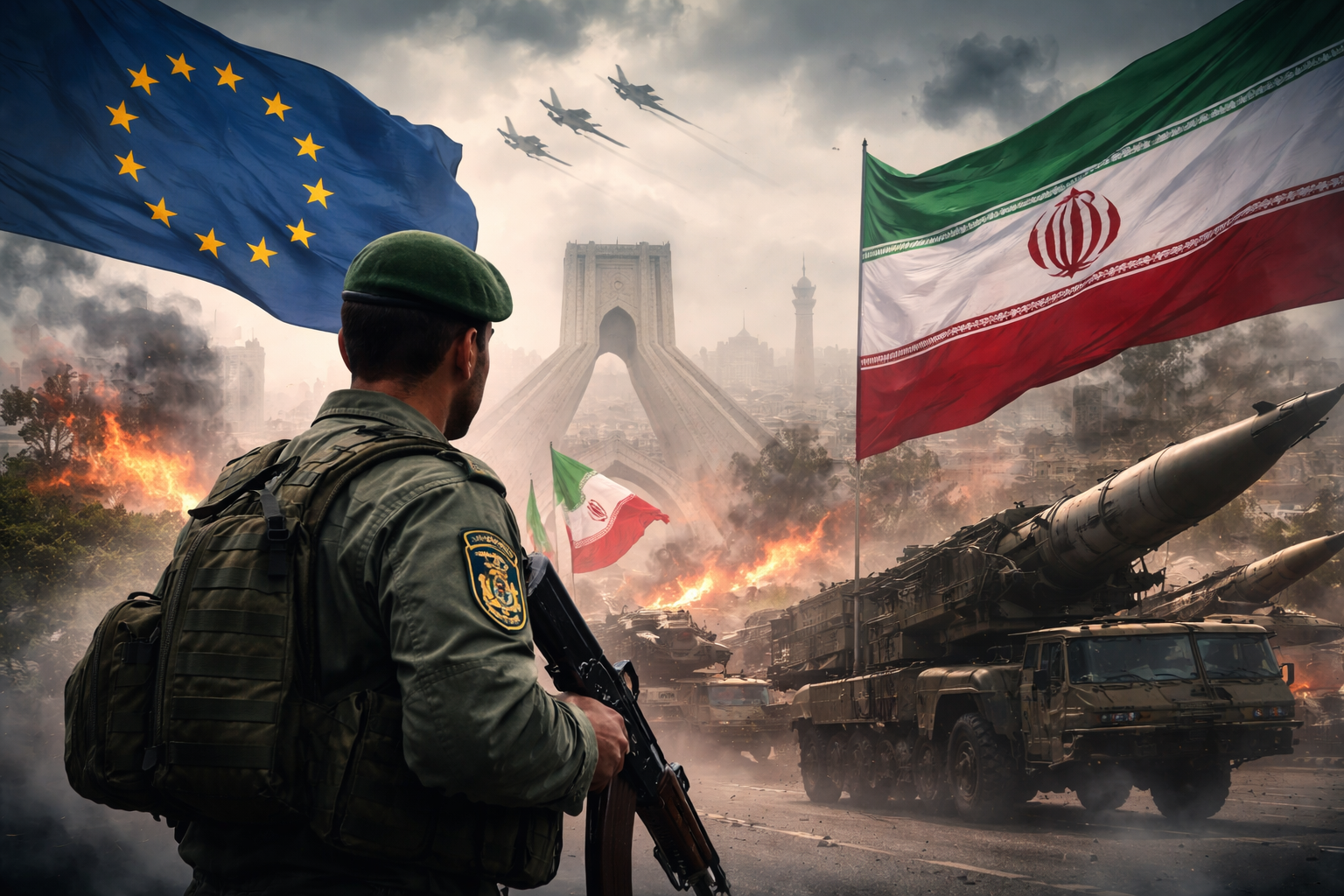
From sanctions to strategy: Europe joins Washington in confronting Iran

Qabil Ashirov
Read moreAt a time when the United States is cornering Iran and the world is discussing whether Iran will be struck any day now, the European Union’s designation of the IRGC as a terrorist organization was received as a meaningful move.
Figuratively speaking, as the Iranian “knot” becomes increasingly tangled, reminding a Gordian knot, the EU’s “step” provides a hint about what may come in the future.
As is known, US President Donald Trump delivers anti-Iran statements across all platforms and positions military fleets in areas close to Iran. Israel, the United States’ closest regional ally, almost daily reports on Iran being targeted, trying to specify the date of any possible strike. Against this backdrop, regional states and Europe raised alarms regarding the potential migrant crisis that any confrontation in Iran might trigger. The world is not yet fully prepared for a second wave of migrants, while the problems caused by the Syrian crisis remain unresolved. Moreover, it should not be forgotten that Iran is demographically much larger than Syria, and therefore any potential migration from Iran would have a far greater impact.
However, the EU’s recent move against Iran was not interpreted unambiguously. EU High Representative for Foreign Affairs and Security Policy and Vice-President of the European Commission Kaja Kallas tweeted:
“Repression cannot go unanswered. EU Foreign Ministers just took the decisive step of designating Iran’s Revolutionary Guard as a terrorist organisation. Any regime that kills thousands of its own people is working toward its own demise.”
In the modern world, there are three centers of power: the United States, the EU, and China. US relations with Iran have remained unchanged since the Islamic Revolution. Immediately after the revolution, the US imposed strict sanctions on Iran. Since the 1990s, these sanctions have become extraterritorial — meaning they also apply to companies and countries cooperating with Iran.
China’s stance on Iran is clear: it imposes no sanctions and even supports Iran. The EU’s position lies between the two; it is neither as multifaceted as China nor as strict as the US.
However, after 2000, relations between the EU and Iran began to tighten. Initially, the EU applied selective sanctions over Iran’s nuclear policy. Later, these sanctions were partially eased. Since 2022, sanctions have been imposed on Iranian military technology companies for supporting Russia in the Ukraine war, and on Iranian security forces and individuals for their harsh responses to the Mahsa Amini protests.
Many experts interpret the EU’s decision as pushing Iran into China’s embrace. They assume that the EU’s anti-Iran measures will not stop there.
However, the Iranian “knot” will resolve itself in the near future. Considering that the US is deploying equipment rather than troops to the region, a scenario like the US invasion of Iraq or Afghanistan is unlikely. With the forces currently in place, the US could at best carry out airstrikes in Iran.
Thus, Iran will either comply with the demands of the West led by the US or undergo a regime change. Using migration flows to blackmail regional countries and Europe will not work. Currently cornered, Iran has long pursued a policy of eliminating Israel from the political map and exporting its regime to other countries. Saudi Arabia, Iraq, Azerbaijan, and others have suffered from this foreign policy. Even Turkey, for a time, saw some religious groups financed by Tehran. Therefore, any crisis in Iran, while threatening regional countries, is also a continuation of Iran’s foreign policy since the Islamic Revolution.
On the other hand, the current government in Iran is not only pressured from outside but also cannot act freely inside the country. After the fall of the Shah, the clerics took full control following a bloody purge of the leftist faction. At that time, there was no second political leader challenging them.
However, recent demonstrations have shown that such a leader now exists — the son of the deposed Shah. Whether the Iranian population will accept him as a political leader remains debatable, but it is important to remember: desperate times call for desperate measures.
Consequently, the US and the EU are now acting on the same front against Iran, making the idea that Iran will fall entirely into China’s embrace unlikely. A softening of the regime and the pursuit of constructive domestic and foreign policies in Iran are expected. The pragmatic behavior of the current government strengthens this expectation. Otherwise, a regime change in Iran seems probable.
Here we are to serve you with news right now. It does not cost much, but worth your attention.
Choose to support open, independent, quality journalism and subscribe on a monthly basis.
By subscribing to our online newspaper, you can have full digital access to all news, analysis, and much more.
You can also follow AzerNEWS on Twitter @AzerNewsAz or Facebook @AzerNewsNewspaper
Thank you!