
Gaza, Davos and diplomacy: Azerbaijan’s growing role in global peace-building
Elnur Enveroglu
Read moreAt a time when the world is increasingly defined by conflict, the gathering of a group of world leaders, heads of governments and representatives comprising 20 countries in Davos, Switzerland, served as a powerful reminder that peace remains a matter of vital importance. As the renowned philosopher Baruch Spinoza observed, “Peace is not the absence of conflict, but the ability to cope with conflict by peaceful means.”
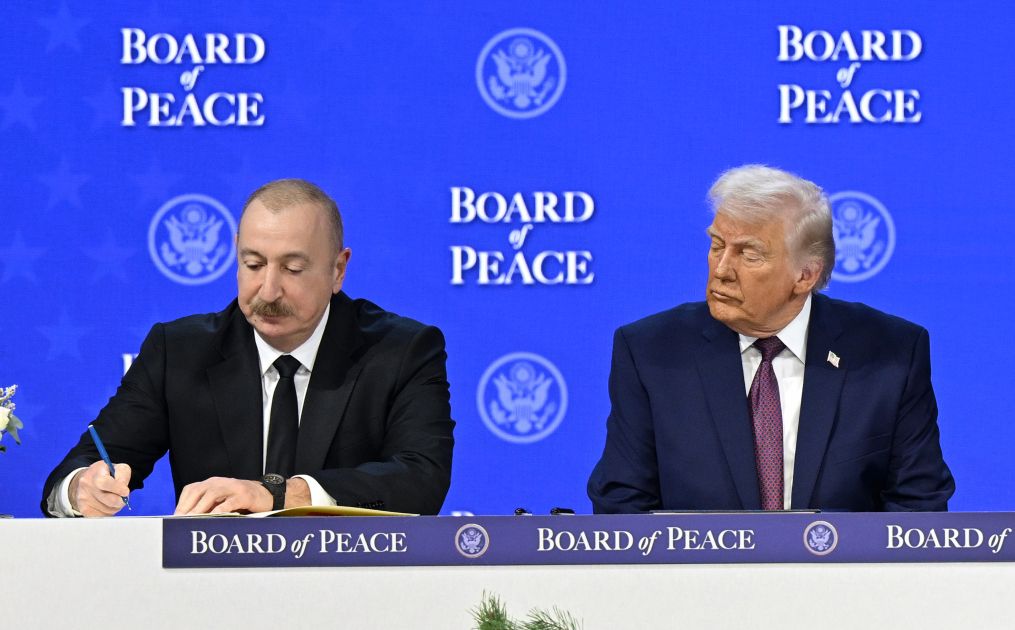
On 22 January in Davos, heads of state, including President of Azerbaijan Ilham Aliyev, came together to sign a significant document, pledging to do everything within their power to heal one of the most devastating conflict wounds in the Middle East, a crisis that has shaken the world by the scale of death and destruction it has caused. Above all, the agreement underscored a shared commitment to ensuring the sustainability of peace. One of the most notable and consequential aspects of the event was the collective confidence and shared vision for peace-building demonstrated by the initiative’s leader, US President Donald Trump, alongside the heads of state and government and official representatives of the countries supporting this effort. It is therefore no coincidence that Azerbaijan - long recognised as one of the proponents of peace preservation and security - has assumed a leading role within the Board.
Azerbaijan’s accession to the Board of Peace on Gaza represents a strategic and timely development in international diplomacy. By joining this multilateral initiative, the country is messaging its commitment to constructive engagement in one of the world’s most intractable conflicts. The event, attended by US President Donald Trump, once again highlighted Azerbaijan’s growing influence and the significance of its bilateral relations with Washington, while positioning Baku as an emerging actor in global peace-building.
The Board of Peace on Gaza convenes a coalition of states aimed at facilitating dialogue, promoting humanitarian support, and establishing frameworks for sustainable development in the region. Membership includes both regional powers and global stakeholders, such as the United States, Turkiye, Egypt, the United Arab Emirates, and Qatar. Azerbaijan’s inclusion reflects the recognition of its diplomatic credibility and its capacity to contribute meaningfully to post-conflict reconstruction and stabilisation efforts.
The signing ceremony in Washington marked a formal endorsement of Azerbaijan’s role, with the presence of Donald Trump amplifying the symbolic and strategic significance of the occasion. Trump publicly acknowledged President Ilham Aliyev’s leadership and Azerbaijan’s contribution to regional peace, reinforcing the perception of Baku as a trusted partner in international conflict resolution.
Azerbaijan’s participation in the Board is underpinned by a substantive record of peace-building and regional stabilisation. Most notably, Baku has successfully navigated the resolution of the decades-long conflict with Armenia in the South Caucasus. The 30-year dispute had paralysed regional economic development and constrained integration within the South Caucasus. Azerbaijan’s diplomatic efforts, coupled with strategic negotiation and reconstruction, restored territorial integrity while enabling renewed economic activity and regional connectivity.
This practical experience positions Azerbaijan as a credible contributor to Gaza’s complex peace environment. Baku’s approach emphasises dialogue, reconstruction, and long-term stability, providing a model for other states seeking to mediate entrenched conflicts. As a board member, Azerbaijan is expected to leverage its expertise in post-conflict recovery, humanitarian coordination, and institution-building, skills that are honed in the South Caucasus but applicable to Gaza’s humanitarian and political challenges.
President Ilham Aliyev’s engagement
President Ilham Aliyev’s presence at the signing ceremony reaffirmed the strategic priority Azerbaijan attaches to multilateral peace initiatives. His engagement signals that Azerbaijan’s contribution is not merely symbolic but operational and forward-looking. By participating directly, Aliyev demonstrates a willingness to take responsibility for shaping international outcomes, highlighting Baku’s proactive stance in global diplomacy.
Donald Trump’s recognition of Aliyev’s leadership further consolidates Azerbaijan’s standing in Washington. The US President emphasised Azerbaijan’s practical role as a peace-maker, strengthening bilateral ties and creating avenues for collaborative projects in Gaza. This endorsement enhances Baku’s legitimacy, projecting the country as a reliable interlocutor capable of bridging regional divides and supporting US-led initiatives.
But what are the strategic benefits and prospects of being a member state for Azerbaijan?
Although membership of the Board of Peace may at times appear obscure or insignificant to many, its true substance in fact carries far greater depth and importance than is often assumed. While its core essence remains unchanged, its strategic significance can vary considerably from one state to another.
Membership in the Board of Peace offers Azerbaijan multiple strategic advantages. It provides a platform for diplomatic visibility, elevating Baku’s influence in Middle Eastern and global affairs. It also facilitates knowledge transfer, allowing Azerbaijan to share lessons from its South Caucasus experience in post-conflict recovery and socio-economic revitalisation.
Azerbaijan’s engagement can directly benefit Gaza, where governance, infrastructure, and humanitarian needs remain acute. By applying models of dialogue, reconstruction, and regional cooperation, Baku can contribute tangible solutions while reinforcing its international reputation as a pragmatic and constructive peace actor.
The partnership with the United States adds an additional layer of influence. Strong bilateral relations, validated by Trump’s commendation, ensure that Azerbaijan is recognised as a trusted partner in shaping multilateral approaches to peace, providing a channel for expertise, resources, and diplomatic coordination that strengthens both regional and global peace-building mechanisms.
Regionally, Azerbaijan’s participation demonstrates the role of middle powers in conflict resolution. Its engagement provides a blueprint for pragmatic diplomacy and multilateral cooperation, encouraging other states to contribute constructively. Globally, Baku’s accession demonstrates that effective peace-building relies on practical experience and strategic partnerships, not merely political rhetoric. By leveraging its South Caucasus achievements, Azerbaijan can influence broader peace initiatives, from the Middle East to post-conflict zones worldwide.
Thus, in a global context marked by persistent crises, Azerbaijan’s example reinforces the principle that peace is both achievable and transformative. Effective conflict resolution, anchored in experience, partnership, and reconstruction, provides not only humanitarian relief but also long-term stability and economic opportunity, lessons that resonate far beyond the South Caucasus and the Gaza Strip.
Here we are to serve you with news right now. It does not cost much, but worth your attention.
Choose to support open, independent, quality journalism and subscribe on a monthly basis.
By subscribing to our online newspaper, you can have full digital access to all news, analysis, and much more.
You can also follow AzerNEWS on Twitter @AzerNewsAz or Facebook @AzerNewsNewspaper
Thank you!