
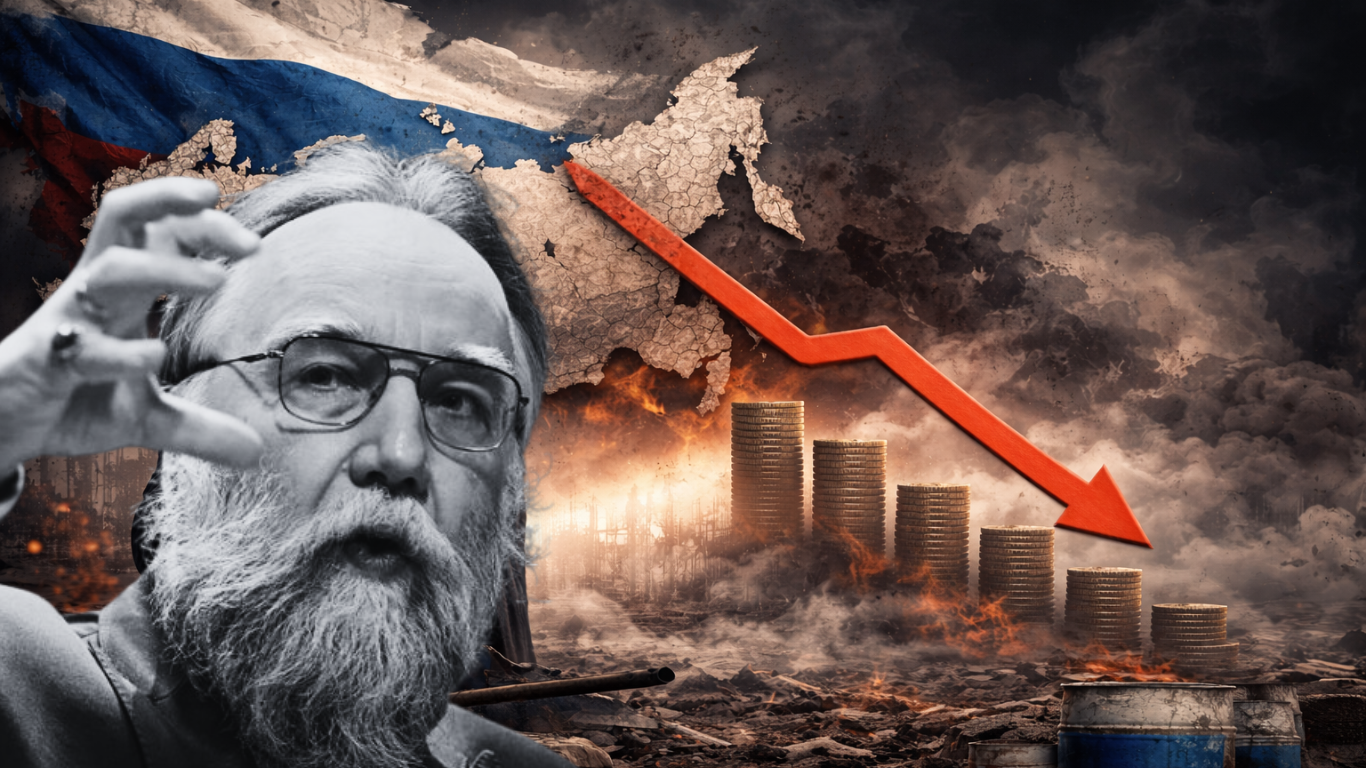
Great power rhetoric, weak economy: contradictions of Dugin’s Russia

Qabil Ashirov
Read moreRussian philosopher Aleksandr Dugin has sparked outrage across the South Caucasus and Central Asia with his recent interview advocating the annihilation of national sovereignties in these regions. Frankly speaking, one can hear similar “philosophical” monologues in almost any chaykhana across the South Caucasus. To give credit where it is due, however, Dugin at least attempts to support his arguments with historical references and data—something local armchair philosophers rarely bother with. The accuracy of his facts, however, remains highly questionable.
Dugin, for instance, blames “corrupt Soviet politicians” for the collapse of the Soviet Union while simultaneously praising Vladimir Putin’s leadership—an obvious contradiction. To tell the truth, the USSR did not disintegrate primarily because of corruption, but because of an outdated and inefficient governance model. A state that failed to provide its citizens with basic consumer goods, such as shoes, while allocating enormous resources to compete with the West in space exploration, was doomed to collapse.
Moreover, Russia’s decline did not end with the dissolution of the USSR. On the contrary, it continued under Vladimir Putin. The alienation of Georgia and its westward pivot, the war in Ukraine, political upheaval in Armenia, and the broader erosion of Russia’s influence across its former sphere all occurred during Putin’s rule. Even developments beyond the post-Soviet space, such as the overthrow of Saddam Hussein and Muammar Gaddafi or the detention of Nicolás Maduro in Caracas, highlight the shrinking global leverage of Moscow in an increasingly multipolar world.
Economically, Russia’s relative decline is even more striking. In 1989, on the brink of collapse, the USSR ranked second in GDP per capita among socialist countries in Europe, behind only Czechoslovakia. Today, Russia ranks fourth among the former Soviet republics, behind the three Baltic states and Kazakhstan, and competing with Turkmenistan. This is without even mentioning former socialist countries in Europe, such as Poland and Romania, which have long surpassed Russia in per capita economic performance.
Despite these realities, Dugin proposes dividing the world into three “spheres of influence” dominated by the United States, Russia, and China. This vision ignores basic economic facts. China posted a trade surplus of around $1.2 trillion, nearly half of Russia’s entire GDP. Russia’s nominal GDP stands at roughly $2.5 trillion, while the United States produces about $30 trillion, the European Union $21 trillion, and China around $19 trillion. Growth figures further expose the imbalance: in 2025, the EU grew by about 1.5 percent, the U.S. by 2 percent, China by nearly 5 percent, while Russia managed barely 0.6 percent.
In other words, a citizen of a country economically comparable to Turkmenistan speaks as if Russia were an equal partner of the USA and China, while conveniently disregarding the European Union, an economy nearly ten times larger than Russia’s.
Dugin’s rhetoric recalls the classic allegory of the mice who propose tying a bell around the cat’s neck. The allegory goes, “Once upon a time, the mice gathered together to hold a council. They were terrified of the cat and wanted to find a way to protect themselves.
One mouse proposed, ‘Let us tie a bell around the cat’s neck. Then, whenever it comes near, the sound will warn us, and we can run away.’
All the mice applauded this clever idea. But then one of them asked, ‘Yes, but how are we going to tie the bell around the cat’s neck?’”
Who, exactly, will enforce Russia’s vision of global division? Will rising powers such as Türkiye or Saudi Arabia accept it? Will Kazakhstan, which now surpasses Russia in GDP per capita, consent to Moscow’s dominance? And would China, keenly attentive to Siberia and Central Asia, treat Russia as an equal partner rather than a junior one?
More troublingly, Dugin’s remarks offer insight into Kremlin thinking. He argues that countries in the South Caucasus and Central Asia must be eliminated or they will become outposts of China or the United States. Implicitly, this signals Moscow’s acceptance of its losses in Europe—most notably Ukraine and Moldova—and a desire to compensate by tightening its grip in the mentioned regions. Such rhetoric unmistakably hints at future conflicts.
This is not unprecedented. Before Dugin, Kremlin propagandist Vladimir Solovyov openly suggested conducting “special military operations” in Armenia and Kazakhstan. Although Russia’s Foreign Ministry spokesperson Maria Zakharova dismissed these comments as the opinions of an “independent journalist,” Dugin’s repetition of the same ideas exposes the hollowness of that claim. These are not isolated provocations; they reflect a broader strategic mindset in Moscow.
Yet the critical question remains: can Russia actually impose such ambitions? Given the ongoing war in Ukraine—which shows no sign of ending soon—serious doubts are warranted. Rather than strengthening Russia, the war continues to drain its economic, military, and demographic resources.
Moreover, the countries Dugin targets are not as weak as he assumes. In 2022, Ukraine lacked a strong navy and had limited air capabilities. By contrast, Azerbaijan, Kazakhstan, and Turkmenistan possess more developed air forces and naval capacities. Any military escalation would bring devastation to the region—but it would hardly guarantee a favorable outcome for Russia.
Russia today is not a rising power but a withering one. The more it seeks to reclaim a sphere of influence without first rebuilding its economic foundations, the faster its decline will accelerate. In this sense, Dugin’s grand theories are not only dangerous—they are fundamentally detached from reality.
Here we are to serve you with news right now. It does not cost much, but worth your attention.
Choose to support open, independent, quality journalism and subscribe on a monthly basis.
By subscribing to our online newspaper, you can have full digital access to all news, analysis, and much more.
You can also follow AzerNEWS on Twitter @AzerNewsAz or Facebook @AzerNewsNewspaper
Thank you!