
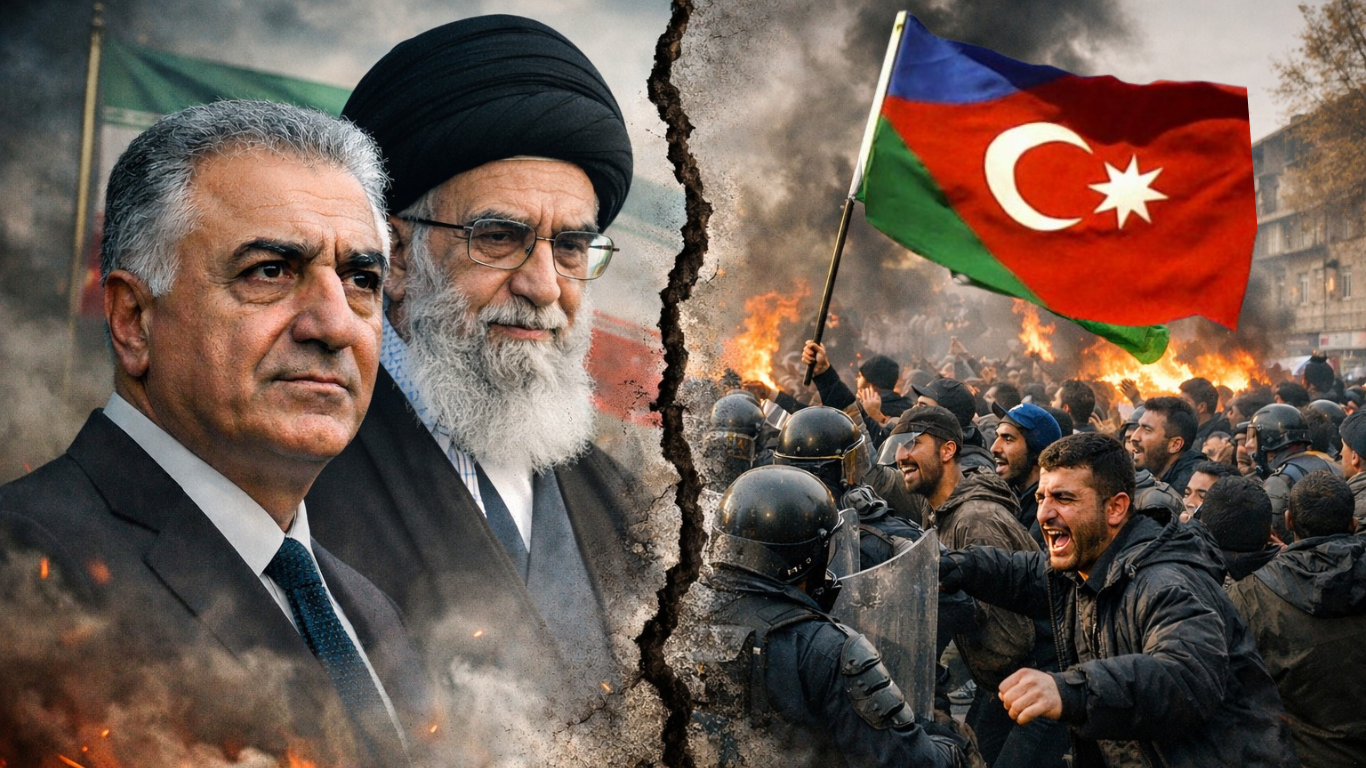
Raza Pahlavi: I would side with Khamenei against Azerbaijanis - shocking revelation
Qabil Ashirov
Read moreThe protests that began on December 28, 2025, and engulfed all of Iran, exposed many internal cracks within the country. While the global media and the media of neighbouring countries mostly highlighted fractures within the government, it was also noticeable that there were certain cracks among the protesters themselves.
One of these cracks was the limited or partial participation of Iranian Azerbaijanis in these protests. It should be noted that Azerbaijanis hold a unique place in Iran’s statehood and history. In detail, no ethnic group in Iran makes up 50% of the population. It is not clear whether the national ethnic majority belongs to the Persians or the Azerbaijanis. Additionally, with only minor interruptions from the Arab conquest until the rise of the Pahlavi dynasty in the 1920s, Iran was officially ruled by the Azerbaijani dynasties. In fact, even today, Iran’s highest-ranking religious leader, Khamenei, and the country’s president, Masoud Pezeshkian, are Azerbaijani.
Furthermore, the founder of the Safavid Empire, who is considered the founder of the modern Iranian state, was also Azerbaijani. Although from 1920 to the 1970s, Iranian governance linked state traditions to the Persian empires of the Medes and the Achaemenids, they were forced to share power with Azerbaijan and Azerbaijanis. More precisely, it is known from history that the state religion of both empires was Zoroastrianism, and when the shahs ascended the throne, they had to visit on food the centre of Zoroastrianism in Atropatene (Azerbaijan) from the capital. This legitimised their rule. In other words, Iranian Azerbaijan has been one of the state’s most dominant and active ethnic groups.
Despite all this, the fact that Azerbaijanis stayed away from the protests raises doubts about whether the protests could achieve their goals.
So, what is the reason for Azerbaijanis keeping their distance from these protests? Ahmad Obali, the founder of Günaz TV, an Azerbaijani activist and political émigré, expressed his view on the matter. Ahmed Obali noted that Southern Azerbaijanis initially did not join these protests. In fact, during the first week, they largely stayed away.
“First, our national activists, as well as Azerbaijanis active on social media, stated that they did not join the protests because they were called upon by Raza Pahlavi and the People’s Mojahedin Organisation. There is a sensitivity and resentment toward these two groups, especially toward the Pahlavi dynasty and its current heir. The response is that if they invite us, we do not join,” Ahmed Obali noted.
On the other hand, Obali emphasised that in several of his television appearances, he stressed that staying at home is not the solution. He warned that a vacuum cannot remain empty—if people do not act, others will step in to fill it.
“We must take the squares, the streets and protest locations, and express our national demands and grievances. Finally, organisations in Southern Azerbaijan also called people to the streets. Although the calls were formally made last Saturday, they began to circulate two days prior. Following these calls, seven cities in Southern Azerbaijan joined the protests on Thursday, and, if I am not mistaken, eleven cities participated on Saturday. Interestingly, videos emerged from the protests in Khoy on Thursday showing people chanting: ‘Azerbaijan is honour, Pahlavi is dishonour.’ At the same time, they also chanted Azerbaijani slogans such as ‘Neither Shahist nor Sheikhist, nationalist, nationalist.’ In Tabriz, Ardebil, Marand, and Maragha, essentially all cities where protests took place on Friday, there were anti-Pahlavi slogans alongside demands specific to Southern Azerbaijan, such as freedom, justice, and national governance. From this perspective, we can say that Azerbaijanis participated partially. However, they were expressing their own demands, not the ones coming from Tehran,” he opined.
Obali also reminded that most leaders of the Southern Azerbaijani national movement are imprisoned. He named the political figures like Alireza Farshid, Abbas Lisani, and Tahir. Obali underscored that the movement is, in a sense, leaderless.
“On the other hand, Azerbaijanis have historically been very active and have protested frequently. The most notable protests include reactions to the Iranian press calling Azerbaijanis cockroaches, the drying of Lake Urmia, and the lack of government response to the consequences of the earthquake in Karadag. These protests were never covered by the Persian-language press. Worse, some activists outside the press even protested against Azerbaijanis themselves—that is, they sided with the Iranian regime. I remember that Raza Pahlavi said at the time that if Azerbaijanis weakened and divided Iran by demanding their rights, he would stand with Khamenei and fight against Azerbaijanis. That was his statement. Now the nation says: when we raise our voice for our rights, they did not support us, so why should we support them now?” he opined.
Obali is sure that the Iranian government is actively using these factions to calm the demonstrations. However, Iranian Azerbaijanis declare on every platform that they oppose both the clerical regime and the Shah’s regime.
“Our nation has already awakened. The people understand that even though the clerical regime is called a religious regime, its ideology creates a synthesis of Persian nationalism and religion to shape Iran as a single nation, while openly trying to assimilate non-Persian nations and establishing internal colonialism in Iran. All of Iran’s non-Persian regions’ mines, economic resources, and even intellectual talent are drained into Persian regions. We can say that almost half or more of Southern Azerbaijan’s intellectuals have been forced to migrate to Persian-majority regions because that is where the work is. Of course, price increases are observed across Iran, and dictatorship dominates the entire country. However, in regions inhabited by Azerbaijanis and other non-Persian nations, in addition to price increases and dictatorship, additional oppression is observed, as I have noted. In short, Southern Azerbaijanis have not forgotten the cruelty and oppression of either the Shah or the clerical regime. Both regimes are dictatorships, and both have been directed against the Azerbaijani nation. The nation has now awakened and views both regimes equally,” Ahmed Obali concluded.
Here we are to serve you with news right now. It does not cost much, but worth your attention.
Choose to support open, independent, quality journalism and subscribe on a monthly basis.
By subscribing to our online newspaper, you can have full digital access to all news, analysis, and much more.
You can also follow AzerNEWS on Twitter @AzerNewsAz or Facebook @AzerNewsNewspaper
Thank you!