
Azerbaijan’s power sector enters green expansion phase [ANALYSIS]
![Azerbaijan’s power sector enters green expansion phase [ANALYSIS]](https://www.azernews.az/media/2026/01/08/1zjkfergqv3pwnbyqnusp4xgmcuvoaisxgxusads.png)

AzerNEWS Staff
Read moreAt a time when global energy markets are under increasing pressure from geopolitical tensions, climate commitments, and growing demand, Azerbaijan’s energy strategy stands out for its balance between reliability and transformation. While remaining a key supplier of traditional energy resources to international markets, the country is simultaneously accelerating its transition toward renewable energy, positioning “green energy” as both an economic driver and a pillar of long-term energy security.
This dual-track approach aligns with Azerbaijan’s broader socio-economic development strategy, its post-conflict reconstruction agenda, and its ambition to strengthen regional stability through sustainable infrastructure. In this context, the power sector has evolved from being merely a domestic utility backbone into a strategic instrument supporting green growth, export diversification, and investor confidence.
With the commissioning of new generation facilities, Azerbaijan’s total installed electricity capacity has reached 9,732.5 MW, marking an increase of 1,317 MW, or 15.6 percent, compared to 2024. This expansion is not only quantitative but structural, reflecting a shift toward cleaner and more diversified sources of energy.
According to 2025 data, Azerbaijan’s power system comprises:
• 24 thermal power plants (7,903 MW),
• 65 hydroelectric power plants (1,443.5 MW),
• 9 solar power plants (278.2 MW),
• 5 wind power plants (63.5 MW),
• 1 solid waste power plant (37 MW),
• 3 hybrid power plants (7.3 MW).
Renewable energy capacity, including hydropower, totals 1,829.6 MW, accounting for 18.8 percent of overall generation capacity. Importantly, parallel investments in grid infrastructure have increased transmission capacity to 29,714 MVA, ensuring system stability and integration of intermittent renewable sources. This growing capacity has already translated into tangible outcomes. In 2024, Azerbaijan produced 28.4 billion kWh of electricity, meeting domestic demand while exporting 1.4 billion kWh. In the first nine months of 2025 alone, exports approached 1 billion kWh, underlining Azerbaijan’s emerging role as a regional electricity supplier.
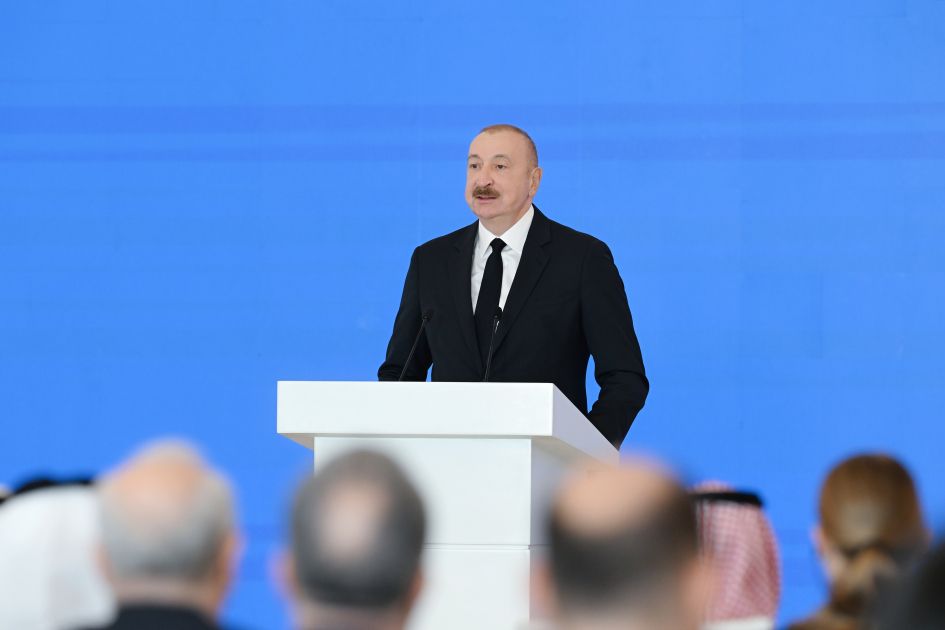
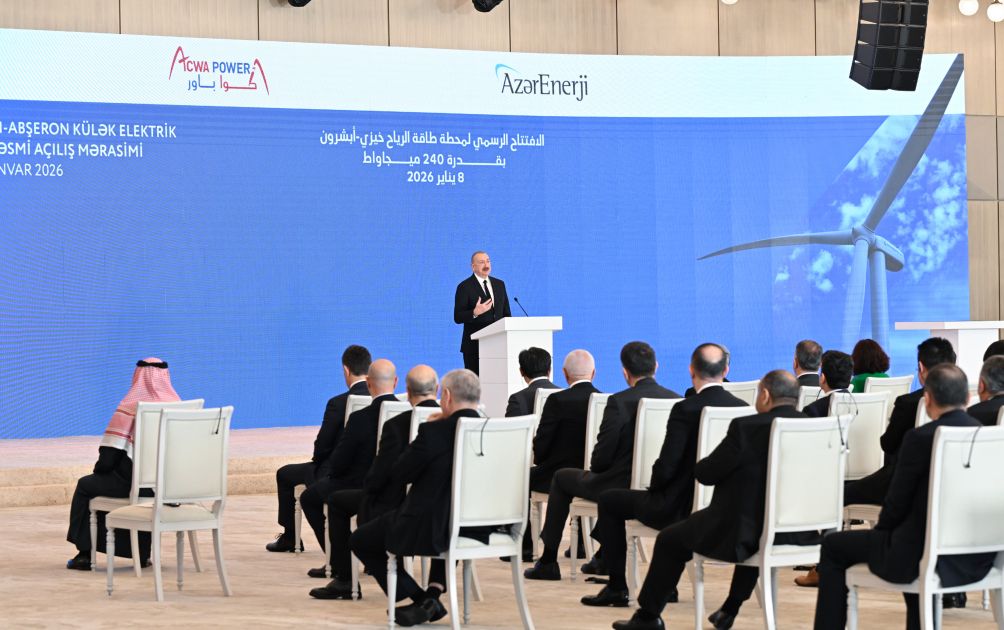
A symbolic and practical milestone in Azerbaijan’s green energy transition was marked on January 8 with the official opening of the 240 MW Khizi-Absheron Wind Power Plant, implemented by Saudi Arabia’s ACWA Power. This project represents the first renewable power facility built by ACWA Power in Azerbaijan and signals the deepening of strategic energy cooperation between Azerbaijan and leading global investors.
Speaking at the opening ceremony, President Ilham Aliyev described the project as “a very significant event” that strengthens Azerbaijan’s energy capacity and reflects the country’s openness to international partnerships in renewables. The President emphasized that this project is not an endpoint but part of a broader pipeline, noting that ACWA Power has “bigger plans” in Azerbaijan, including participation in the country’s first Caspian Sea desalination project.
The involvement of PowerChina as the general contractor further illustrates Azerbaijan’s ability to attract major global players across different segments of the energy value chain, such as construction, investment, and technology transfer. A key analytical takeaway from the President’s speech is Azerbaijan’s insistence on the parallel development of traditional and renewable generation capacities. As President Aliyev underlined, energy security can only be ensured by maintaining a reliable baseload through thermal generation while expanding renewable capacity.
The commissioning of a 2,000 MW traditional power plant in Mingachevir alongside new solar and wind facilities demonstrates this balanced model. This approach has enabled Azerbaijan to maintain energy self-sufficiency, avoid supply shocks, and create the flexibility needed to integrate variable renewable sources without compromising system reliability.
Renewable energy development is also closely linked to Azerbaijan’s post-conflict reconstruction policy. In the liberated territories of Garabagh and East Zangezur, three solar power plants with a combined capacity of 340 MW are under construction in Jabrayil, while around 40 small hydroelectric power plants with a total capacity exceeding 300 MW have already been built using public funds.
Plans indicate that small hydropower capacity in these regions alone could reach 500–600 MW, transforming them into green energy hubs and supporting sustainable resettlement, industrial activity, and infrastructure development.
One of the most strategic dimensions of Azerbaijan’s green agenda lies offshore. According to international estimates cited by President Aliyev, the wind energy potential of Azerbaijan’s sector of the Caspian Sea is around 157 GW - a figure that places the country among the most promising offshore wind markets globally.
Based on signed contracts, Azerbaijan plans to commission:
• 6 GW of wind and solar capacity by 2030, and
• 8 GW by 2032, excluding additional hydropower.
Such volumes would not only meet rising domestic demand but also significantly expand electricity exports, reinforcing Azerbaijan’s position as a regional energy hub.
A central message of the President’s speech was Azerbaijan’s investment credibility. The country has attracted over $300 billion in foreign investment, underpinned by political stability, a strong macroeconomic position, and a consistent contractual framework. With foreign debt slightly above 6 percent of GDP and foreign exchange reserves exceeding external debt by 16–17 times, Azerbaijan ranks among the world’s most financially resilient economies. Recent upgrades by international rating agencies to investment-grade status with a positive outlook further strengthen its appeal to long-term investors.
President Aliyev’s explicit assurance that contracts are inviolable - “our word is as valuable and legal as our signature” - addresses one of the most critical concerns for foreign investors, particularly in capital-intensive sectors such as renewable energy.
Looking ahead, Azerbaijan is also addressing the next structural challenge of renewable integration: energy storage. The country is launching its first 250 MW Battery Energy Storage System, implemented by AzerEnerji, and has invited foreign investors to participate in future projects.
At the same time, Azerbaijan is positioning itself to attract energy-intensive industries of the future, including data centers and artificial intelligence infrastructure, leveraging its growing clean energy base. Azerbaijan’s green energy policy is no longer a complementary agenda; it is becoming a central pillar of national development, regional cooperation, and investment strategy. By combining traditional energy strength with rapid renewable expansion, ensuring financial stability, and maintaining contractual reliability, Azerbaijan is redefining its role from a resource supplier to a strategic energy partner. As global energy security concerns intensify, Azerbaijan’s model - grounded in balance, diversification, and investor trust - offers a compelling case study for energy-producing countries navigating the transition to a low-carbon future.
Here we are to serve you with news right now. It does not cost much, but worth your attention.
Choose to support open, independent, quality journalism and subscribe on a monthly basis.
By subscribing to our online newspaper, you can have full digital access to all news, analysis, and much more.
You can also follow AzerNEWS on Twitter @AzerNewsAz or Facebook @AzerNewsNewspaper
Thank you!