
Post-war Garabagh as window into Azerbaijan’s centralised governance model [ANALYSIS]
![Post-war Garabagh as window into Azerbaijan’s centralised governance model [ANALYSIS]](https://www.azernews.az/media/2025/12/25/17665806573130459190.jpg)

AzerNEWS Staff
Read moreThe large-scale reconstruction and revitalization underway in Azerbaijan’s liberated territories vividly demonstrate the country’s growing state capacity, long-term strategic planning, and effective governance. What is unfolding in Garabagh and Eastern Zangazur today is not merely a construction campaign, but a comprehensive state-building process aimed at ensuring irreversible sovereignty, sustainable development, and social reintegration.
Following the full restoration of its territorial integrity, Azerbaijan rapidly transitioned from military victory to civilian reconstruction. Based on the direct instructions of President Ilham Aliyev, the revival of the liberated territories was designated a top national priority. The government has mobilized financial, institutional, and human resources to rebuild these regions according to the most modern urban, economic, and social standards. This approach reflects a clear political message: the liberated lands are not only restored, but transformed into zones of innovation, growth, and stability.
At present, extensive infrastructure projects are being implemented across the region. New highways and railways, airports, power lines, water supply systems, and digital infrastructure are being created in parallel with investments in education, healthcare, public services, and cultural heritage restoration. The integrated nature of these efforts illustrates a shift from ad hoc reconstruction to a holistic development model grounded in long-term sustainability.
On December 24, President Ilham Aliyev and First Lady Mehriban Aliyeva visited several liberated areas, a visit that carried both practical and symbolic significance. The opening of the Victory Park in Khankendi and the second residential complex in Aghdam marked another milestone in the normalization of civilian life in areas that for decades were deprived of lawful governance and development.
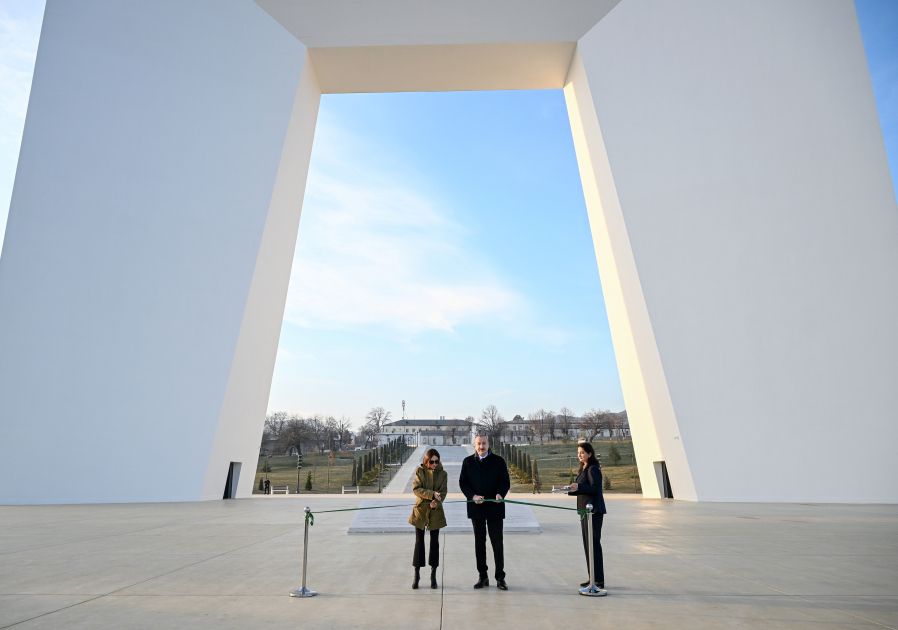
In Khankendi, Elchin Yusubov, the President’s Special Representative in the city and the Aghdara and Khojaly regions, briefed the head of state and the First Lady on the conditions created in Victory Park. The park, covering a total area of 9 hectares, was founded in February this year by President Aliyev himself, with progress reviewed during a previous visit in July. The continuity of presidential oversight underscores the leadership’s hands-on approach to post-conflict reconstruction.
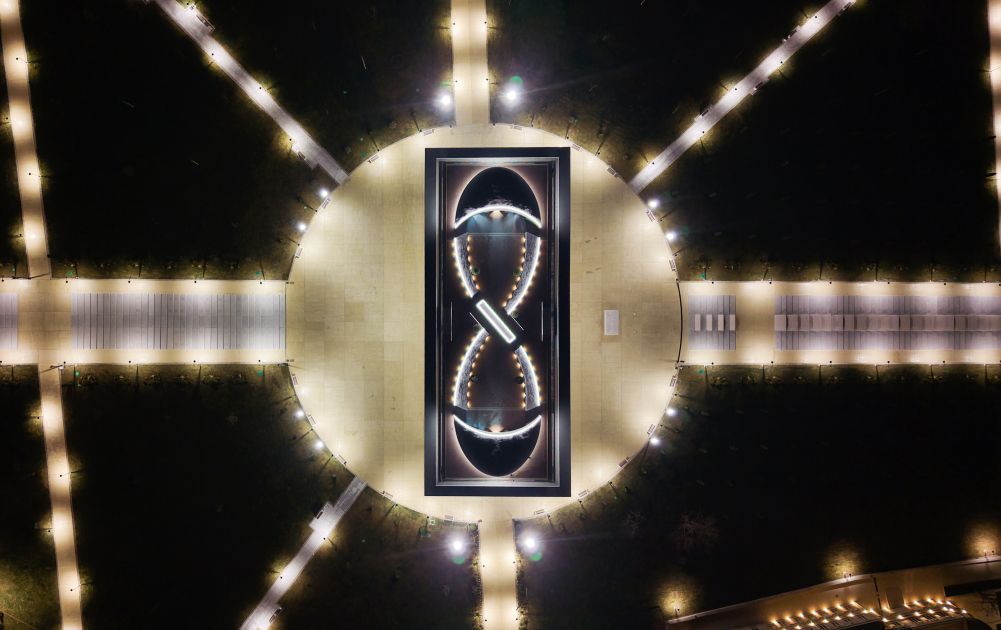
The Victory Park is rich in symbolism. The 44-meter-high Victory Arch, representing the 44 days of the Patriotic War, and the 44 steps leading to it, reflect the historic struggle for territorial integrity. The informational signs along the path document the liberation of settlements and the outcomes of the 2023 anti-terrorist operation, embedding recent history into the urban landscape. The ten-floor structure, terrace, and “Victory Gallery” exhibition hall further transform the park into a living memorial that connects memory, identity, and public space.
Beyond symbolism, the park serves a practical social function. Extensive landscaping, fountains, lighting, and music systems have turned it into a modern recreational area. The preservation of existing trees and the planting of more than 500 trees, over 11,000 bushes, and flowers demonstrate a conscious effort to balance development with environmental responsibility.
Parallel to symbolic projects, Azerbaijan has accelerated the restoration of essential social infrastructure. By mid-2024, repair and construction works were completed at a secondary school and kindergarten in the Karkijahan settlement of Khankendi. Medical centers were commissioned in several villages, including Ballıca, Hasanriz, Talısh, and Sugovushan, significantly improving access to healthcare in rural areas.
A particularly important institutional step was taken with the establishment of the “Garabagh University Clinic” by presidential decree on February 7, 2025. The transfer of the Khankendi hospital to the clinic’s balance and the completion of renovation works signal a strategic focus on building a regional healthcare and education hub. This move reinforces the idea that human capital development is central to the long-term reintegration of the liberated territories.
Transport infrastructure development further supports economic and social revival. Major highway reconstruction projects, such as the Sarsang reservoir–Umudlu road, the Sugovushan–Kalbajar routes, and the Askeran–Khojaly–Khankendi–Shusha corridor, are gradually reconnecting the region internally and with the rest of the country. Urban infrastructure in Khankendi has also improved, with temporary asphalt laid on inner-city roads and dozens of residential and non-residential buildings renovated.
A critical pillar of Azerbaijan’s post-conflict strategy is economic activation through strong state incentives. The government has introduced one of the most generous support packages in the region for entrepreneurs operating in the liberated territories.
Tax exemptions on income, property, land, and simplified taxes for ten years, full state subsidies for social insurance contributions, and utility cost compensation are designed to reduce risk and attract private investment. These mechanisms are already producing tangible results. As of July this year, 474 facilities were offered for lease, with 299 already operational. Investments totaling approximately 45.5 million manat have been made, creating around 1,900 jobs. With additional facilities expected to open, employment is projected to exceed 5,000 jobs. Moreover, housing solutions have been provided for over 13,000 people, including state employees, private sector workers, and returning residents.
An important component of President Ilham Aliyev and First Lady Mehriban Aliyeva’s December 24 visit was their participation in the opening of the second residential complex in Aghdam city and their meeting with residents who have begun returning to their native lands. This event once again highlighted that the reconstruction policy in the liberated territories is centered not only on infrastructure, but first and foremost on people.
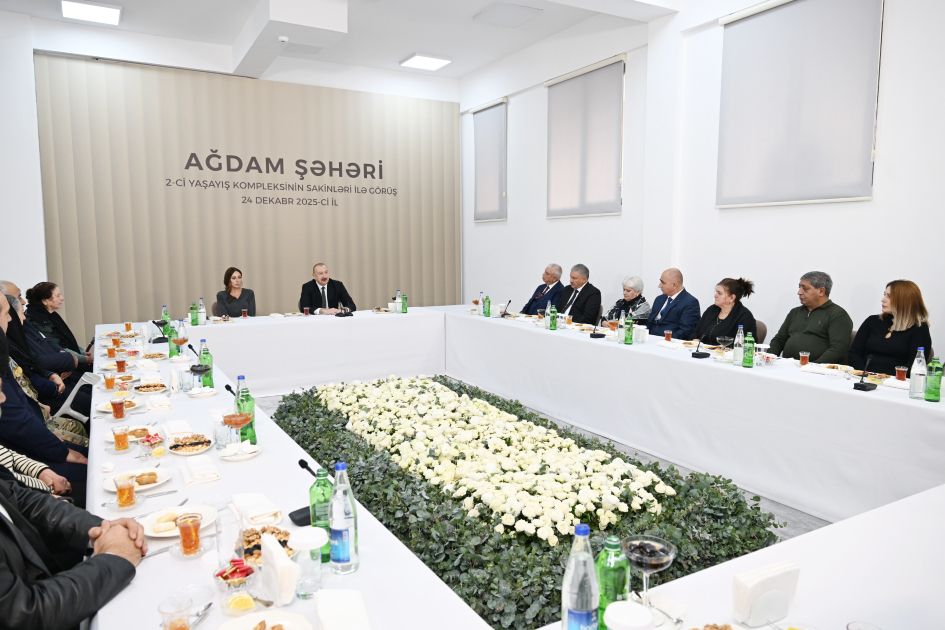
Emin Huseynov, the President’s Special Representative in the Aghdam, Fuzuli, and Khojavend regions, briefed the head of state on the conditions created in the new complex. Spanning more than 13 hectares, the residential area consists of 11 neighborhoods and 60 newly constructed apartment buildings. In total, the complex includes 1,268 modern apartments of various layouts, designed to meet the diverse needs of returning families.
The phased resettlement plan itself reflects a carefully calibrated approach. In December, 104 families comprising 426 people are scheduled to move into the complex, while another 1,164 families - nearly 4,800 people - are expected to relocate in January-February 2026. This gradual process allows for the smooth integration of residents into the urban environment and ensures that public services operate effectively from the first day.
From an analytical perspective, the technical and social infrastructure of the complex illustrates Azerbaijan’s broader reconstruction philosophy. All buildings are supplied with uninterrupted water and electricity, high-speed internet, heating, and hot water - standards that correspond to contemporary urban living. At the same time, extensive landscaping and urban planning have been carried out: nearly five kilometers of internal roads have been laid, sports and children’s playgrounds built, bicycle lanes established, and both underground and surface parking facilities created. This shows a deliberate shift away from temporary housing solutions toward permanent, high-quality urban settlements.
It is also significant that President Ilham Aliyev personally laid the foundation stone of this residential complex in 2023 and, together with First Lady Mehriban Aliyeva, reviewed construction progress earlier this year. Such continuity underscores the political importance attached to the resettlement process and reinforces public confidence in the state’s long-term commitments.
More broadly, the Aghdam project exemplifies the core principle guiding the restoration of Garabagh and Eastern Zangezur: ensuring a comfortable, dignified, and sustainable life for former internally displaced persons. Housing construction is being pursued in parallel with the creation of social and economic infrastructure. Modern schools, kindergartens, healthcare institutions, industrial parks, production facilities, and service centers are being established to guarantee employment opportunities and social stability.
This integrated model reveals that Azerbaijan’s post-conflict strategy is not limited to physical reconstruction. Instead, it aims to create self-sufficient urban and rural communities capable of supporting long-term population growth and economic activity. In this sense, the opening of the Aghdam residential complex is not merely a housing event - it is a tangible indicator of the transition from post-war recovery to sustainable regional development.
Collectively, these developments confirm that the state’s policy in the liberated territories is built on foresight, inclusivity, and strategic patience. By aligning infrastructure development with human needs, Azerbaijan is laying the foundations for the irreversible revival of Garabagh and Eastern Zangezur and transforming former zones of conflict into spaces of normalcy, productivity, and hope.
The recent visit of President Ilham Aliyev and First Lady Mehriban Aliyeva to the liberated areas once again demonstrated that Azerbaijan’s post-war policy is guided by consistency, strategic depth, and a clear vision of irreversibility. Reconstruction is not treated as a short-term response to conflict, but as a nation-building process that integrates memory, development, social justice, and economic resilience.
Through coordinated infrastructure development, symbolic state presence, and powerful economic incentives, Azerbaijan is reshaping the liberated territories into fully functional and vibrant regions. This model not only consolidates sovereignty on the ground but also sets a precedent for post-conflict recovery driven by strong political will and institutional capacity.
Here we are to serve you with news right now. It does not cost much, but worth your attention.
Choose to support open, independent, quality journalism and subscribe on a monthly basis.
By subscribing to our online newspaper, you can have full digital access to all news, analysis, and much more.
You can also follow AzerNEWS on Twitter @AzerNewsAz or Facebook @AzerNewsNewspaper
Thank you!