
Soccer diplomacy brings Turkey`s Gul to Armenia
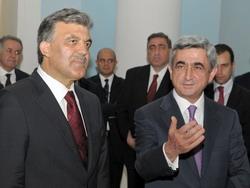
The presidents of Turkey and Armenia attended a soccer match
together on Saturday in what was seen as a landmark encounter in
Yerevan designed to help end almost a century of hostility and
enhance security in the Caucasus.
Abdullah Gul became the first Turkish leader to visit Armenia. The
neighboring countries have no diplomatic ties but, rather, a
relationship haunted by the question of whether huge numbers of
ethnic Armenians were killed by Ottoman Turks during World War I in
what Yerevan claims was systematic "genocide." Ankara also condemns
Armenia`s policy of occupying Azerbaijani land.
Attack helicopters escorted Gul`s jet on its arrival and police and
demonstrators lined the traffic-free streets as his motorcade sped
through downtown Yerevan.
The two presidents expressed hope that the 2010 World Cup
qualifier, the first match between the two national teams, would
help thaw relations and foster dialogue.
The initiative has gained new impetus since Russia`s war with
Georgia last month, which raised fears for the security of energy
supplies from the resource-rich Caspian basin to western
Europe.
"We hope we will be able to demonstrate goodwill to solve the
problems between our countries and not transfer them to future
generations," Armenian President Serzh Sarkisian said after hosting
Gul.
Sarkisian said Gul had invited him to the return match to be held
in October 2009.
Gul said he hoped the game -- which Turkey won 2-0 -- would aid
rapprochement and contribute to regional peace and security.
It is indicative that the alleged Armenian "genocide" was not
raised during the Gul-Sarkisian talks.
The Turkish leader told journalists, upon returning to Ankara, that
he considered his visit to Yerevan to have been fruitful.
"My visit broke the psychological barrier in the Caucasus.
Sarkisian took a very important step by inviting me to the match.
If I hadn`t accepted his invitation, the whole world would have
said I got scared," said Gul.
With regard to the Armenia-Azerbaijan Upper (Nagorno) Garabagh
conflict, he said Turkey could play an important role in settling
the dispute.
"Resolution of the Garabagh problem is the most important issue for
us in the South Caucasus," he said.
Gul said Sarkisian had brought up the Garabagh issue during the
talks first, which he did not expect.
"Quite frankly, I was not expecting such a comprehensive and
detailed discussion on the Garabagh conflict.
"This problem will be solved sooner or later, but 20 to 30 years
should not be wasted on that. The current situation in conducive
for finding a solution," the Turkish leader said.
Commenting on the exchange of views he had with Sarkisian on the
situation in Georgia, and the region as a whole, Gul said he had
managed to rally support for Ankara`s recent proposal to set up a
five-nation union, called the Caucasus Peace and Cooperation
Platform.
Gul also said prospects for Turkish-Armenian relations were a focal
point during his meeting in Yerevan. The two countries agreed to
continue discussions about improving bilateral relations, he told
the press.
Turkey has never opened an embassy in Armenia and, in 1993, Ankara
closed its common border with Armenia in a show of solidarity with
Azerbaijan, a Turkic-speaking ally then fighting Armenian-backed
separatists in the Upper Garabagh region.
Armenia continues to occupy Upper Garabagh and seven other
Azerbaijani districts, in defiance of international law. Peace
talks have, so far, made no progress in resolving the dispute.
Azerbaijan said it was not opposed to Gul`s visit to Armenia, as
Foreign Minister Elmar Mammadyarov said the decision was an
internal affair of Turkey and its president.
"Azerbaijan cannot, in any way, interfere with the passage of
Turkey`s decision in this regard," he said.
President Gul is scheduled to pay a short visit to Azerbaijan on
Wednesday during which he will meet with his counterpart Ilham
Aliyev. Further, Gul is to head to the United States on September
20, Turkish media reported.
Matthew Bryza, US Deputy Assistant Secretary of State, who
co-chairs the OSCE Minsk Group brokering a settlement to the
Garabagh conflict, said Gul`s visit to Armenia would assist in
finding a solution to the long-running dispute.
"The visit will promote a political settlement to maintain
Azerbaijan`s territorial integrity," Bryza added.
Yet, even as the two presidents sat together in Hrazdan stadium,
the challenges were obvious.
Armenian fans booed the Turkish national anthem and dozens of
demonstrators held torches and flowers in a silent vigil at an
imposing monument to the alleged genocide of Armenians on a
hillside behind the stadium.
Protesters in the streets held banners saying, "1915 - Never Again"
and "We Demand Justice."
Armenia insists that 1.5 million Armenians died at the hands of
Ottoman Turks, and Yerevan insists Ankara should recognize the
killings as an act of genocide. Turkey rejects the claims, saying
that 300,000 Armenians, along with at least as many Turks, died in
the civil strife that emerged when Armenians took up arms in a bid
for independence in eastern Anatolia.
Public surveys in Armenia have revealed opposition to the Turkish
president`s visit, which came following an invitation from the
Armenian president. Older Armenians are the most staunchly opposed
and claim that Turks have always been hostile to Armenians.
`Turks hate us. Now we are imploring them to come here. What do we
need them for?` is a commonly held view.
Further, a Turkish opposition leader has emphatically criticized
President Gul for visiting Armenia.
Deniz Baykal, who chairs Turkey`s Republican People`s Party (CHP),
suggested ironically, prior to the visit, that if Gul was heading
to Yerevan, he might as well lay a wreath at the monument to the
victims of the alleged genocide. "By doing so, he would make those
urging him to visit Yerevan even more happy." Baykal recalled that
Gul had spoken against a 1993 visit to Ankara by Armenian leader
Levon Ter-Petrosian at the invitation of then-Turkish President
Suleyman Demirel.
"President Gul`s words, 15 years ago, contradict what he says now
and his approaches today," the opposition leader said. "What has
changed since then? Has Armenia recognized Turkey`s borders and
relinquished its territorial claims against us, or has it given up
its `genocide` claims? Has it put an end to the occupation of Upper
Garabagh? None of this happened, hence, nothing has changed. The
only thing that has changed is that a person who has forgotten what
he said in the past is currently Turkey`s president."
But Russia`s decision last month to send its forces into Georgia,
an ex-Soviet state which borders both Armenia and Turkey, has
convinced many that it is time for Ankara and Yerevan to put their
differences aside.
Gul said these events made his trip "especially important."
Observers believe that normalizing relations could greatly enhance
Turkey`s role as a regional power, as energy flows from the Caspian
Sea, as well as to increase Western influence in the South
Caucasus.
Landlocked Armenia could also derive enormous benefits from the
opening of the frontier with its large neighbor and the restoration
of a key rail link.
Currently, western-backed pipelines shipping oil and gas from the
Caspian Sea to Turkey`s Mediterranean coast bypass Armenia and bend
north, instead, to travel through Georgia.
`Symbolic nature`
Azerbaijani analysts have commented on Ankara`s accepting Yerevan`s
invitation and analyst Rasim Musabayov said Gul`s visit was merely
of a symbolic nature.
"The Turkish side is trying to demonstrate that it is not holding a
grudge, that it is ready to solve outstanding issues through
dialogue. Nonetheless, those assuming that diplomatic relations
will be forged between the two countries at the conclusion of a
meeting lasting four to five hours are mistaken."
Rather, Musabayov said Gul`s visit was an indication of efforts to
move a Turkey-Armenia dialogue to a higher level. Thus, whereas
discussions have previously been held only between foreign
ministers, they are now being raised to the level of presidents.
"If dialogue continues on the presidential level, the opening of
the Turkish-Armenian border may become possible."
Another analyst, Rasim Aghayev, says the Turkish leader`s visit to
Yerevan was bad news for Azerbaijan.
"The visit will lead to the emergence of trade transactions between
Turkey and Armenia, which will ultimately bring about establishment
of broader economic and cultural relations," he said.
Aghayev predicts that, after Gul`s visit, Turkey will begin
pursuing a new policy toward Armenia, and Azerbaijan will have to
seek other means to settle the Garabagh conflict.
Tight security
Turkish media reported that President Gul wore a bulletproof vest
under his suit while visiting Armenia.
According to an agreement reached between the Turkish and Armenian
security agencies, security was heightened in Yerevan to protect
Gul during the visit. The car President Gul traveled in while in
Armenia was brought from Turkey and was equipped with specially
installed electronic and security enhancements. At the stadium, the
Turkish president`s bench was enclosed by four-sided bulletproof
glass to avert potential assassination attempts.
Under the agreement reached, Armenian Foreign Minister Eduard
Nalbandian greeted President Gul upon arrival. The Turkish
delegation headed to the Armenian President`s Palace through a
specially created, secure corridor. After a one-on-one meeting of
Presidents, Gul and Sarkisian, the two leaders, headed to the
soccer match. Gul returned home immediately following the
game.
Here we are to serve you with news right now. It does not cost much, but worth your attention.
Choose to support open, independent, quality journalism and subscribe on a monthly basis.
By subscribing to our online newspaper, you can have full digital access to all news, analysis, and much more.
You can also follow AzerNEWS on Twitter @AzerNewsAz or Facebook @AzerNewsNewspaper
Thank you!