
Pashinyan claims Armenian Church occupied by Karekin II
Akbar Novruz
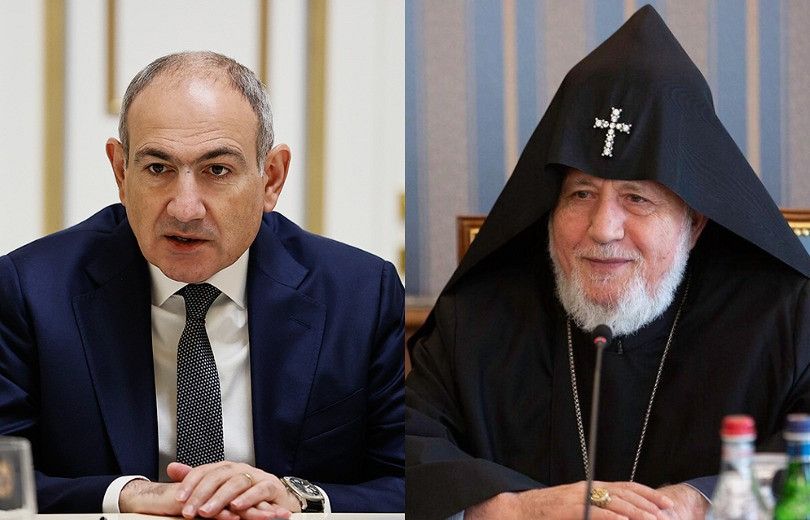
Read moreArmenian Prime Minister Nikol Pashinyan has suggested that the National Assembly could establish an investigative commission to examine what he described as a “crisis” in the Armenian Apostolic Church, potentially leading to legislative changes affecting the Church’s governance.
Pashinyan made the remarks in an interview with Boon TV published on September 19, amid an ongoing dispute between his government and the Armenian Apostolic Church.
The prime minister said that, at his instruction, the Public Relations and Information Center under the Prime Minister’s Office had prepared a report on the “crisis” in the Church and possible ways of resolving it. Pashinyan said he had reviewed the final draft, although the report had not yet been made public at the time of his remarks.
He described the situation in the Church as “terrible,” claiming that it had been “occupied” by Catholicos Karekin II, whom he referred to by his secular name, Ktrich Nersisyan.
Pashinyan said he had discussed the issue with the governing Civil Contract party’s board and did not rule out the creation of an investigative commission in parliament after the report is published.
“I do not rule out that, following the publication of the report, an investigative commission will also be created in the National Assembly, which will make proposals for legislative changes arising from the report,” Pashinyan said.
He did not directly answer a question about alleged Russian influence over the Church leadership, but said the issue was addressed in the report.
The remarks come amid criminal proceedings against Karekin II and six senior clergymen. The Catholicos and the bishops are accused of obstructing the enforcement of a court ruling concerning the reinstatement of former Bishop Gevorg Saroyan. The clergy members have denied wrongdoing and their defense has argued that the matter falls within the Church’s internal spiritual and canonical affairs.
The case has also gone through several changes of jurisdiction and judges. Judge Hakob Manukyan initially recused himself, while Judge Serzh Rushanyan subsequently transferred the case to a Yerevan court over jurisdictional questions. The case was later returned to the Armavir court, where preliminary hearings were scheduled for September 18.
Pashinyan also alleged that the Church had committed at least one electoral violation, arguing that religious organizations are prohibited from engaging in political campaigning. He said there should be consequences for such violations but did not elaborate.
The issue of the Church’s political role has become particularly contentious following the June 2026 parliamentary elections. Ahead of the vote, Karekin II met with opposition figure and businessman Samvel Karapetyan.
Pashinyan has also challenged arguments that proposed changes to the Church’s governance would be unconstitutional. Armenia’s Constitution defines the country as a sovereign, democratic and social state governed by the rule of law, while also providing for the Armenian Apostolic Holy Church’s historical mission and stating that relations between the state and the Church may be regulated by law.
In the same interview, Pashinyan argued that this provision gives parliament room to legislate on aspects of Church-state relations.
“The church is not the Catholicos; the church is the community of believers, which, moreover, according to the traditions of our church, participates in the governance of the church,” Pashinyan said.
He said parliament could introduce legislation giving members of the Church “genuine opportunities” to participate in its governance.
Among the possible mechanisms, Pashinyan mentioned establishing parish councils and allowing believers to participate in discussions concerning the nomination of Church leaders.
The Armenian Apostolic Church has meanwhile accused the government of interfering in its internal affairs. In a September 18 statement following a meeting of its Supreme Spiritual Council, the Church described the authorities’ actions as an ongoing policy of interference and said restrictions imposed through state mechanisms were unacceptable.
Here we are to serve you with news right now. It does not cost much, but worth your attention.
Choose to support open, independent, quality journalism and subscribe on a monthly basis.
By subscribing to our online newspaper, you can have full digital access to all news, analysis, and much more.
You can also follow AzerNEWS on Twitter @AzerNewsAz or Facebook @AzerNewsNewspaper
Thank you!