
Astronomers record first volcanic eruption on Venus
By Alimat Aliyeva
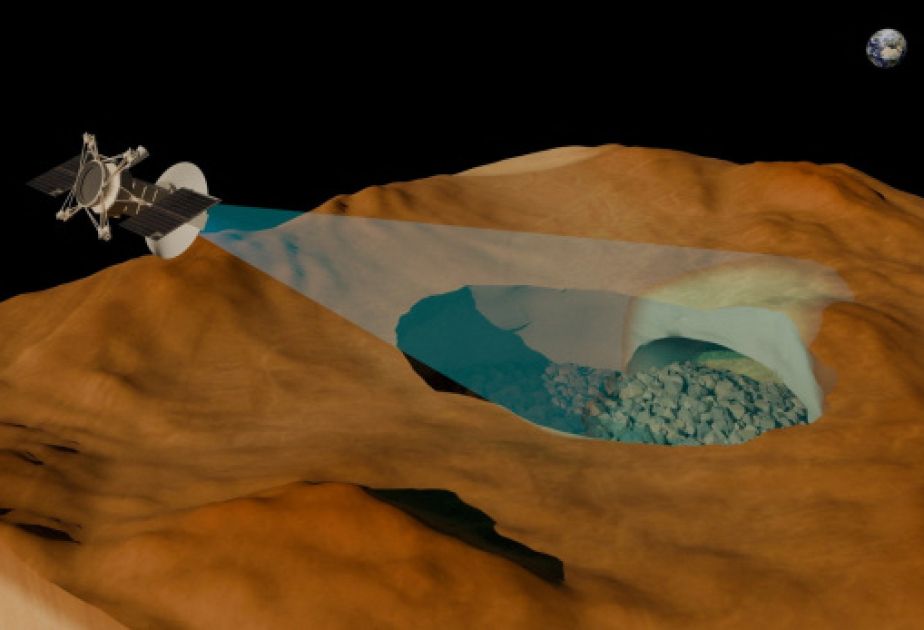
A renewed analysis of radar data from Venus, collected by NASA’s Magellan spacecraft in the early 1990s, has revealed evidence of a large underground cavity formed by ancient lava flows—the first subsurface structure of its kind ever identified on a neighboring planet, AzerNEWS reports.
According to the researchers, the radar signals are consistent with a geological feature known as a lava tube, a structure commonly found in volcanic regions on Earth. Lava tubes have also been detected on the Moon and are believed to exist on Mars, but this marks the first time such a formation has been directly identified on Venus.
Although Venus is concealed beneath thick, toxic clouds, radar imaging is able to penetrate this dense atmosphere. Given the planet’s long history of intense volcanic activity, scientists have long suspected the presence of lava tubes beneath its surface.
“Moving from theory to direct observation is a major step forward,” said Lorenzo Bruzzone, a radar and planetary scientist at the University of Trento in Italy and lead author of the study, published Monday in Nature Communications. “It opens new research directions and provides valuable information for future missions to explore Venus.”
The team analyzed remote sensing data collected by Magellan in 1990 and 1992, identifying surface features that suggest underground cavities beneath them. Using a newly developed data-analysis technique, the scientists were able to detect structures consistent with lava tubes.
The formation, interpreted as part of an empty lava tube, lies on the western slope of Nix Mons, a massive shield volcano about 362 kilometers wide located in Venus’s northern hemisphere. The surrounding terrain is scattered with craters formed by surface deposits.
“Our understanding of Venus remains limited, and until now we have lacked direct observations of processes occurring beneath its surface,” said Leonardo Carrer, a radar specialist at the University of Trento and co-author of the study.
Venus, with a diameter of roughly 12,000 kilometers, is slightly smaller than Earth. The Magellan mission mapped 98 percent of the planet’s surface, providing crucial insights into a world that hosts more volcanoes than any other planet in the Solar System and shows widespread evidence of ancient lava flows.
Based on the radar data, the visible portion of the lava tube has an estimated diameter of about one kilometer, with a roof thickness of at least 150 meters. Due to limitations in the Magellan dataset, only part of the structure can be directly observed, but researchers believe it likely extends for several kilometers. Its size suggests it may be larger and taller than any lava tube on Earth and even bigger than those predicted on Mars or observed on the Moon.
Lava tubes are considered promising locations for future space exploration. On Venus, such underground structures could potentially offer natural shielding from extreme surface temperatures and radiation, making them intriguing targets for future robotic—or even human—missions.
Here we are to serve you with news right now. It does not cost much, but worth your attention.
Choose to support open, independent, quality journalism and subscribe on a monthly basis.
By subscribing to our online newspaper, you can have full digital access to all news, analysis, and much more.
You can also follow AzerNEWS on Twitter @AzerNewsAz or Facebook @AzerNewsNewspaper
Thank you!