
President Ilham Aliyev interviewed by local TV channels [PHOTOS/VIDEO]
![President Ilham Aliyev interviewed by local TV channels [PHOTOS/VIDEO]](https://www.azernews.az/media/2026/01/05/ilhamaliyev_musahiba_1.jpg)
On January 5, President of the Republic of Azerbaijan Ilham Aliyev was interviewed by local TV channels.
Azernews presents the interview.
Mirshahin Aghayev from REAL Television: Good morning, Mr. President. We would like to thank you for the meeting today not only on behalf of our colleagues participating in this interview, but also on behalf of all Azerbaijani media.
President Ilham Aliyev: Thank you!
Mirshahin Aghayev: We do believe that, as always, the ideas you voice at today's meeting will create a strategic agenda and provide sufficient topics for the Azerbaijani media and the overall public environment.
In terms of achievements on the table in 2025, I think it can be described as “November 8” of years, and the culminating point of it is probably your historic visit to Washington at the invitation of the President of the United States of America, Donald Trump, in August and, without a doubt, your speech at the UN General Assembly. The documents signed between the United States of America and Azerbaijan, the agreements reached are important not only for Azerbaijan, but also for the entire region. In this regard, I would like to talk about your appeal to the world from the high UN podium, and also about the documents signed with the United States of America. So what are your reflections on the days at the White House on August 8 and at the UN on September 21?
President Ilham Aliyev: Thank you. Our meetings are traditional in nature. Such meetings at the beginning of each year both bring the people of Azerbaijan up to speed with the results of the year through you and also provide the opportunity to share our thoughts. As you noted, last year can indeed be viewed as historic. Because it was in 2025 that the Armenia-Azerbaijan war ended from a political point of view, and we have been living in peace for several months now. We are learning what it is like to live in peace since after gaining independence, and even before that, the people and the state of Azerbaijan lived in a state of war. There were different stages of the war. You remember that well. The active stage of the war, the stage of the ceasefire, the Second Karabakh War, the anti-terrorist operation, the period that followed it – all these events ended in August of last year. In other words, Azerbaijan has put a political seal on the brilliant Victory it achieved on the battlefield and, as I mentioned, we did it in the world's number one office. This, of course, will be one of the most memorable events in the history of our independence, perhaps among the first of them. From this point of view, the past year can be regarded as a very successful and historic year for our country, for our people, and I am sure that from now on the people of Azerbaijan will live in peace. Although we have been living in these conditions for only five months, we are already seeing the fruition of this – both on the political and economic planes. There is an upbeat mood in society, there is greater confidence in stability and security. All these factors, of course, have enabled us to successfully move forward and continue to address all the tasks facing the country.
In the context of US-Azerbaijan relations, 2025 can also be regarded as a historic year. It is no secret that after Azerbaijan gained its independence, the notorious Section 907 hovered over US- Azerbaijan relations like a black cloud. Despite being a newly independent country, Azerbaijan was unable to establish proper relations with America, the number one state in the world. This was the result of the activities of anti-Azerbaijan forces in America, the activities of the Armenian lobby. Azerbaijan repeatedly made such attempts. At certain stages, our relations developed in a positive direction, but the existing restrictions, especially the continuation of the Armenia-Azerbaijan war, did not allow those in power in America to establish comprehensive relations with Azerbaijan. This restriction no longer exists, and, of course, there are two main reasons for that: first, the official end of the Armenia-Azerbaijan war, and second, the fact that President Trump's administration is in power in America. This administration includes members who are very pragmatic and professional, and they know very well what America's national interests are, with the President in charge. Of course, cooperation with a country like Azerbaijan, which has strong potential and influence in the region, is also important for the United States of America. So is it for us. Therefore, from this point of view, last year can also be seen as a turning point. At the White House, President Trump put an end to Section 907 at a ceremony held with my participation there. He removed it. However, Congress has yet to lift it officially. But the step taken by the President, especially in my presence, , carries a symbolic meaning, of course.
In addition, a document was signed to establish a strategic working group between America and Azerbaijan. The main direction of activity for this working group will be the preparation of a strategic partnership charter, and active work in this direction has already begun. Of course, the establishment of a geographic connection between the main part of Azerbaijan and its Nakhchivan Autonomous Republic, which we have dreamed of for many years, also took place on that very day. In other words, the opening of the Zangezur Corridor has already been approved by the US President. I am now convinced that the people of Azerbaijan have no doubt that the Zangezur Corridor will be opened. It may have a different name, but that does not change the essence. So all the issues required within the framework of the normalization process with Armenia were resolved the way we wanted. Of course, the importance of the peace agreement initialed between Armenia and Azerbaijan, the joint Declaration we signed, are in plain sight. President Trump signed this Declaration as a witness. All these and other important events shed light on the issue you mentioned, perhaps from a broader perspective.
The issues I have mentioned are a chronology of events. This is the side that is open to the public. But at the same time, there is also a very active diplomatic movement today. The relations between Azerbaijan and America are developing in a very practical and result-oriented direction. Since October, I have dispatched four delegations to America – consisting of ministers, representatives of the private sector, and other senior officials. It is possible to say that the preparation of a strategic charter in the main directions and the organization of mutual investments, the coverage of the economic, trade, transport, and military-industrial directions of our relations are on the agenda. In other words, we have high hopes, and the results are fairly impressive. Therefore, from this point of view, 2025 can certainly be considered as a very successful and historic year.
Mumtaz Khalilzada from Azerbaijan Television: Mr. President, you spoke about that unfair Section 907, which was adopted back in 1992. Of course, after your historic visit to America, a decision was made to freeze it. I would like to learn your thoughts on the prospects for its permanent abolition. At the same time, how would you characterize its importance not only in terms of the economic aspects of Section 907 but also its political and strategic implications.
President Ilham Aliyev: Of course, when this section was applied to us, it was a huge injustice. At the same time, the then-Azerbaijani leadership was indifferent to it. Perhaps only Mirshahin will remember better than anyone else seated here the level of the Azerbaijani government and their diplomacy at the time. You were very young then, probably even kids. Of course, it was a shameful sight. The people in charge of Azerbaijan’s diplomacy could not speak any language. In fact, they could not even speak Azerbaijani fluently, and were appointed to these important positions without any experience, that is, from areas completely unrelated to diplomacy or politics. The then--Popular Front-Musavat government did not have any professionals at all. On the contrary, very random people had seized power and were actually leading Azerbaijan towards destruction. Just a year later, on popular demand, they were forced to shamefully give up power. Therefore, these two factors played an important role. If Azerbaijan had been able to say its rightful word to the American leadership at the time, if it had fought, then perhaps the American administration could have looked at the issue orchestrated by the Armenian lobby in Congress from a different perspective. In any case, although Congress is an independent body, it often discusses issues related to foreign policy with the Presidential Administration. According to the information I have, those in power in Azerbaijan at the time had no idea that such an issue was on the agenda, that such a law could be adopted, and that this unfair section would be applied to Azerbaijan.
The other side of the issue was that there was a great injustice against us. Because Section 907 was adopted in October 1992. At that time, our lands were already under occupation, Shusha and Lachin were under occupation. The Armenian state had committed the Khojaly genocide. A war crime had been committed against our people, and the fact that Azerbaijan's lands were under occupation naturally reduced the possibilities of placing Armenia under blockade to naught. In other words, what kind of blockade could there be? Considering the fact that Armenia's borders with Georgia and Iran were open. In fact, even the Türkiye-Armenia border was only closed in 1993. Therefore, there could be no question of any blockade. However, the Armenian lobby and the senators and congressmen within its circle adopted this unfair amendment.
I should also note that many of them are no longer alive, but there are some very interesting names among those who are alive. You can find them, but I will mention just one name: the former senator, then vice president and then president Joe Biden. Joe Biden was very active in the adoption of Section 907. This fact alone is enough for everyone to understand why our relations with both the Obama-Biden and Biden-Blinken administrations were not at the desired level. Our relations with the Obama-Biden administration were quite distant, while the Biden-Blinken administration actually brought our relations to a crisis.
At that time, this section was hugely important, of course. Because Azerbaijan was a very poor country, our coffers were empty, we had no foreign exchange reserves. Depriving us of aid was, of course, a huge blow to us. Considering the fact that thousands, tens of thousands of displaced persons were already living in difficult conditions at the time, this politically unfair step also had major practical implications. We tried to repeal this Section 907 for many years. But it was a very difficult process. After the events of September 11, 2001, the US President waived this amendment with his signature, and this continued until 2024. Because America needed Azerbaijan in its operations in Afghanistan – in terms of transport, logistics and other issues. Unfortunately, however, after the end of the American mission in Afghanistan – we all remember how it ended, and this can be regarded as yet another disgrace of the Biden-Blinken administration, their chaotic escape from Afghanistan and the fact that they left their close allies there to the mercy of fate – the Biden administration stopped waiving this section. In other words, they no longer needed Azerbaijan, the mission in Afghanistan was over, and so this section was reintroduced. Of course, this doesn’t and cannot have any impact on our economic development. But this goes to show again how ungrateful the Biden-Blinken administration was. During a conversation with senior US administration officials at the time, I said that the day would come when you would need us again, but don't knock on our doors again. If that administration and its representatives were still in power today, we would not fulfill a single request of theirs.
The Trump administration came to power and the situation has completely changed. Of course, as I mentioned, US-Azerbaijani relations have now risen to a new level, and of course, we expect that Congress will eliminate this unfair relic of the past, which is considered completely absurd today. Because there was no blockade then and there is no blockade today. On the contrary, cargo is transported from various places across the territory of Azerbaijan to Armenia, roads are opening, and even Azerbaijan’s oil products are exported to Armenia. What kind of blockade can we talk about? If the formal reason for Section 907 was the blockade, it does not exist today. Therefore, of course, we expect the Trump administration to be able to use its capabilities to convince members of Congress, especially members of the Republican Party, that this section should be completely removed, and we have enough reasons to hope for this. Although it is quite symbolic today, Congress should abolish it once and for all in order to completely clear the table of these remnants of the past.
Murad Huseynov from Public Television: Mr. President, you spoke about relations with the United States – you have already touched upon that – and about the successes achieved there. I would like to ask you to characterize other events and processes that brought Azerbaijan's foreign policy success in 2025.
President Ilham Aliyev: I believe that one of the events of great importance is our strategic partnership with China. Last year, during my state visit to China, a Joint Statement on Comprehensive Strategic Partnership was signed, and this can also be considered a great success. Because China is one of the leading countries in the world, and this political framework, political platform, of course, can be viewed as evidence of our successful diplomacy.
On the other hand, we became a member of the D-8 organization. I also consider this to be a great achievement. Because this organization has been there for almost 30 years and has not accepted a new member ever since its inception. That is why its name is still D-8. The only new member has been Azerbaijan. Considering that this organization brings together the largest countries of the Muslim world, inviting Azerbaijan and choosing us, if it is possible to say so, can certainly be considered a great success. Suffice it to say that the total population of the countries united in this organization exceeds one billion people, and their total economy is in excess of four trillion. Azerbaijan cannot be considered a large country in terms of population or economy. Our official participation there is, of course, a sign of respect for us and the result of our independent policy. And we began active work there immediately. On our initiative, several centers of the organization were created in Azerbaijan – media, climate, environment, energy, and transport. We, of course, will participate in this organization as an active member.
Another important achievement in foreign policy is our election as a full member of the Consultative Meeting of the Heads of State of Central Asia. I do believe that this can also be considered a fairly rare occasion. Because, from a geographical point of view, of course, we are not in Central Asia, we are in the South Caucasus. However, we have such close relations with countries of Central Asia, both in bilateral and multilateral formats. So many projects have been implemented in recent years that these countries have unanimously elected us as a full member. We can also consider this a great political and diplomatic success. As president, I have been invited to summits as a guest of honor for two years in a row. But at the third summit held with my participation, we were already elected as a fully-fledged member. Of course, the Central Asian-Azerbaijani union and the transformation of C5 into C6 today are of great importance not only for our region, but also for the world. Because connectivity, transport and logistics are of tremendous importance for many leading international actors today, and Azerbaijan is the only reliable country that can geographically connect Central Asia with the West today. Of course, from a geographical point of view, other routes can also be used. However, taking into account the current geopolitical situation, we can say with complete certainty that alternative routes for the West cannot be considered acceptable. Therefore, our role as a living bridge and a reliable partner, as a country that can already implement large projects, will naturally increase, and we are already seeing the fruition of this in practice. The number of cargoes passing through our territory is increasing. For the first time, 100,000 containers have already passed through the territory of Azerbaijan. This is just the beginning, their number will increase many more times, and we are currently actively working to expand our transport infrastructure. We had thought that the infrastructure we were creating would be sufficient for us for many years, but we see that it is not. Therefore, additional funds are and will be invested, and we are not talking only about cargoes. As you know, in November 2024, the presidents of Azerbaijan, Kazakhstan and Uzbekistan signed an agreement in Baku on the construction of an energy cable. So there will also be these connections – the laying of a fiber-optic cable along the Caspian seabed and many other projects. Therefore, by officially admitting Azerbaijan into this group, Central Asian countries and their leaders have both shown us great respect and demonstrated their foresight, because this completely changes the geopolitical situation in the region.
I have had a number of foreign visits, if I am not mistaken, about 20, perhaps even more. Many foreign heads of state and government have come to Azerbaijan. International events have been held in our country. Among them, of course, I should mention the ECO Summit held in Khankendi. The main event was held there in Khankendi, but three forums were held on our initiative in other cities liberated from occupation – in Shusha, Lachin and Aghdam: the Business Forum, the Youth Forum, and the Women's Forum. In other words, we wanted the guests to see if not all, then at least a large part of the liberated lands, and we were ready for this. We were ready to receive nine heads of state and government in Khankendi, Aghdam and Shusha. The existing infrastructure, conference halls, hotels and other necessary factors have created these opportunities for us.
I should also specifically mention the Summit of the Organization of Turkic States in Gabala. This was once again a Summit that reflected the unity of the Turkic world. As you know, informal summits have also been initiated by us. The first informal Summit was held in Shusha, the official summit in Gabala, and other countries are now continuing this tradition. The informal Summit has already been held in Hungary. It will probably be held this year as well. In other words, there is a lot to talk about in terms of foreign policy. The Minister of Foreign Affairs recently held a press conference and provided more detailed information. I simply wanted to highlight the points that I consider important.
Murad Huseynov: Let me ask another question. In your speech at the Summit of the Organization of Turkic States in Gabala, the undertone of military cooperation between Turkic states was quite noticeable. Was this your proposal?
President Ilham Aliyev: Yes.
Murad Huseynov: How would you assess the prospects for this cooperation in the era the modern world is going through?
President Ilham Aliyev: Yes, you are absolutely right. I did mention that. This is not the first time that I have touched upon this issue at these Summits. Because I know and see that the developments unfolding in the world are going in such a direction that each country should, first of all, strengthen its military potential and security. I even said in my New Year's address to the people of Azerbaijan that today's world is like this: might is right. My words are now getting confirmed almost every week in one region or another. At the Summit in Gabala, I went further than this thesis and proposed that joint military exercises of the member states be held in Azerbaijan this year. I do believe that this is also necessary. We conduct military exercises in a bilateral format with member countries – of course, most often with Türkiye, but also with other countries. However, there can be a great symbolic meaning in joint military exercises. At the same time, there is a need for this from a practical point of view. Because let me say this again – I have been saying this for several years now. Conducting my own analysis, I see that there is no such thing as international law in today's world. Everyone should forget about that. There is strength, there is cooperation, there is alliance, there is mutual support. Of course, you must be sure that you are on the right path. No country, no leader should do anything wrong, should not set their sights on the territorial integrity of any country, should not occupy any country. Our greatness and wisdom, as well as our responsibility, are in plain sight. We could have used force in 2020 and in 2023, and in the events that occurred between these years, and given Armenia the response it deserves. Just as our people lived in suffering, just as our territories were devastated, just as war crimes were committed against us, we could have put their cities in the same condition as Aghdam. I can say with full confidence and certainty that no one could have stopped us. We did not do this. Because, first of all, it would have been wrong. Secondly, I was absolutely sure and knew that sooner or later the war, the military conflict must be stopped, and if we did not stop it, it would not stop. The strong side must stop it, and this has already been reported in the media. President Trump's advisor, Mr. Witkoff, said in one of his interviews that President Trump had also asked me at the White House, “Why did you stop? You were the stronger side.” You have probably heard my answer. Therefore, despite this, you must have military power so that no one looks down on you, so that no one harms you. No one should even think of harming you and getting away with that.
That is why we are building up our power, including military. We cooperate with Türkiye in the format of an official alliance, including a military alliance and within the framework of military assistance to each other. However, it would be good if Turkic states, which are our family, also began to cooperate in this direction. By proposing this, I am not at all proposing the creation of some military organization. Some have interpreted it that way. No, this is completely unfounded. We are now simply cooperating in the energy sector, in the transport sector, in trade, in investment, and indeed in many areas. Why not cooperate in this area as well? Considering that this is the number one issue for all countries today, my proposal is valid. We are now sending our messages through various diplomatic channels. If there is a general agreement, then we will see these exercises this year. If we see that the exercises were not held, then we should ask the question “Who was not in favor of this?” But I do hope that all member states will support this.
Elmira Musazade from CBC Television: Mr. President, CBC is an international channel broadcasting in Russian. With your permission, I would like to ask my question in Russian.
President Ilham Aliyev: Please go ahead.
Elmira Musazade: Mr. President, speaking about foreign policy priorities, you have noted the importance of the People's Republic of China, and our bilateral relations have indeed significantly expanded in recent years. These include both high-level visits and agreements in various fields, in particular in the economy, transport, logistics, and technology sectors. How would you assess the significance of these agreements, and what impact will they have on Azerbaijan's role in regional and global developments?
President Ilham Aliyev: I believe that the important political documents signed between us—there were two, one of which I have already mentioned, on a comprehensive strategic partnership, and a year earlier, we had adopted a Joint Statement on Strategic Partnership—over the course of one year resulted in two documents on strategic and then comprehensive strategic partnership being adopted and signed, giving a significant boost to the development of bilateral economic ties. Both our side and the People's Republic of China have given a very strong impetus to businesses and government agencies to step up our contacts as much as possible, and we are seeing this even in the number of reciprocal visits by delegations and the contracts signed, including investment ones.
We are observing growth in turnover. It has reached a record high of 4 billion dollars—even more than 4 billion dollars—with growth of over 20 percent. This is probably the biggest increase in turnover we have had with any country. We are also seeing investment contracts being signed. Chinese companies have begun actively investing in Azerbaijan, something that had not happened before. There have been individual investment projects, but we have never seen them on such a large scale or so coordinated with government agencies. This goes to show that a very strong signal and impetus have been given for expanding cooperation.
Chinese companies are already investing in renewable energy. The construction of solar and wind power plants is starting, and there is demand for more.
The construction of a solar panel factory has begun, and so has the assembly of electric buses. In this case, I must say that this was a strategic decision by the Azerbaijani side because when we decided to develop not only green energy but also green transport, we had to choose a strategic partner, and the choice fell on Chinese companies.
This choice was made, in part, as a result of the agreements I have already mentioned. And, of course, the professionalism, quality, and speed of execution of these projects have confirmed the correctness of this choice. Therefore, we purchased the green buses we see in Baku—some of them. Assembly will begin this year, with increased localization in the future.
There is extensive cooperation in the transport sector, as I have already mentioned, and in this case, China will naturally be the main source of growth in freight traffic. The People's Republic of China is currently funding the construction of another railway to the Caspian Sea via Kyrgyzstan and Uzbekistan, investing billions. The terrain there is extremely complex, requiring the construction of a multitude of tunnels and bridges. This very fact suggests that since they have decided to finance this project, the railway will not stand idle. Freight traffic to the Caspian Sea, and therefore to Azerbaijan, will increase. Along with Central Asian countries, additional freight from China will naturally increase the demand for the East–West route, the Middle Corridor.
Of course, we expect cargo from China and Central Asian countries to travel along the Zangezur Corridor as well. We naturally view it primarily as a link with the Nakhchivan Autonomous Republic, but also as an international transport corridor. Currently, there is only one railway route from Azerbaijan westward. There will be two. Two are always better than one, especially when you have no access to the world ocean and have to go through neighboring countries. It is always better to have an alternative for volumes, to be competitive, to prevent monopolization of the transit route by anyone, and, of course, to ensure more competitive tariffs.
This is a very large sector of our interaction, and, of course, in this case, Azerbaijan is, I believe, a priority partner for the People's Republic of China in this region, both in terms of volumes of trade and potential, and also as a country distributing the flow from the South Caucasus to further destinations, so to speak. And these flows, as we all understand, can go in many directions. From here, they can go in two directions to the West, and then again in two directions through the Zangezur Corridor in the southern direction, towards the Middle East and the Persian Gulf, and, of course, in the northern direction, which will also be fully utilized.
Therefore, Azerbaijan should play the role of a facilitator, so to speak—a country that contributes to the increase in cargo flows, a country that invests in its infrastructure and in the infrastructure of neighboring countries, and a distributor of flows, based, of course, on commercial viability and many other factors. Therefore, Azerbaijan's role as a transport hub, especially one that has no access to the world ocean, will naturally grow.
And, of course, I cannot fail to mention a new area of cooperation—military-technical cooperation. It also began within the framework of the political agreements reached. This is a new area of interaction between China and Azerbaijan. Part of this cooperation was demonstrated at the military parade, but this is only the beginning.
In this case, too, we are seeing tremendous mutual interest. Furthermore, not limiting ourselves to the acquisition of military equipment, we are working on establishing joint ventures, and work in this area has already begun. It is generally hidden from public view, as it should be, but this is also a serious political and strategic decision by both countries, and it also has great potential. I am confident that we will see both new contracts in the near future and the implementation of projects that are already underway.
This, of course, will be of great benefit to Azerbaijan.
Nadia Gyane from AnewZ Television: Mr. President. I'm from AnewZ, a global international English-speaking channel, so I'll ask you this question in English. Can you talk to us about Azerbaijan's economic and regional development, especially off the back of the new peace treaty with Armenia? What does it mean for the country in the years to come? And can you list some of the achievements which have helped to place Azerbaijan as a key economic leader in the South Caucasus?
President Ilham Aliyev: Yes, the peace agreement, which was initialed in Washington last August, of course, opens great opportunities for investments, especially when we talk about investments coming from the United States. And we are actively working on that. At the same time, Azerbaijani investments in the United States already have a certain history. We mainly invested in Treasuries. But now, after this new phase of the relationship between the two countries, we are now considering different options to invest in projects of the real economy. At the same time, one of the aspirations of Azerbaijan is to become a regional AI hub, an IT hub, and I think we have the potential to do that. We are working now with partners with respect to the creation of data centers. As you know, data centers need a lot of energy. Today, the only country in the broader region which has extra capacity of electric power is Azerbaijan. Today, we have 2,000 megawatts or 2 gigawatts of extra capacity, which we do not use for our domestic purposes, and which can be exported or can be consumed here.
And our plans and already projects, which have been implemented with the creation of a cyber security center and the training of our specialists – we are sending many specialists to train abroad and also organizing training courses in Azerbaijan – so our target is, along with connectivity, to become a hub for AI and for IT. There is potential. There is a strong political will. And of course, we consider American companies as our main partners.
I'd like to say that after we signed a MoU with President Trump on establishing the strategic working group to elaborate a strategic partnership charter, we've been approached by several leading European countries to also establish a strategic partnership relationship. So, in some way, it was a kind of signal from Washington. Though, so far, we signed and adopted strategic partnership declarations and agreements with almost 30 countries – ten of them are members of the European Union – but this strong message from Washington was well received in the capitals of their allies.
With respect to economic performance, we can be satisfied with today's status when the country is absolutely economically independent and does not depend on any support, any loan or whatsoever. Several years ago, I put a target in front of the government to reduce our foreign debt, and that has been achieved. And we stopped borrowing completely and actually finished all the relationship, active relationships with international financial institutions. Now our foreign debt is down to a historically low level of six-plus percent of GDP. We started to borrow again in limited amounts, but we already decided to borrow again, maybe two-three, maybe four billion U.S. dollars just in order to support the projects, which need financing. We don't want to cut financing from the social sphere. We don't want to cut financing from defense, from reconstruction of Garabagh. But we need financing now for our transportation projects, for water, for sanitation, and mainly connectivity. For that, we will borrow. But today, our foreign debt is at historically low level, 6.3, 6.4, depending on calculations. And we can repay our foreign debt because the reserves exceed foreign debt 16 or 17 times. Why I don't put one figure is because last year, we also made a strategic decision to increase our gold reserves. We clearly could see the geopolitical developments, and I was absolutely sure that the price of gold would go up, and it skyrocketed. So it earned us a lot of money. By increasing our reserves of gold, our state oil fund earned more than 10 billion U.S. dollars only because of that. But if the price goes down, of course, our reserves will go down. So, now our reserves change every day. Today, probably, they're 84 or 83. Tomorrow, it will be 85. Nevertheless, this is one of the highest per capita reserves in the world, which any country can have, 83, 84 billion U.S. dollars.
And taking into account the huge investment projects and the reconstruction of Garabagh, this really demonstrates the strong resilience of our economy. Two major rating agencies upgraded our credit rating. There were Moody's and Fitch – upgraded to investment level, with a prognosis also upgraded from stable to positive. I am absolutely convinced that our credit rating is underappreciated, because large reserves, low foreign debt, self-sufficient economy, and many other factors, I think, allow us to have a higher rating. Our corresponding state institutions are working with these rating agencies in order to give them more information about our performance so that the true rating of Azerbaijan is duly reflected. Because it's not only a matter of prestige, though it is, it also allows us to borrow at a better rate, especially now when we decided to borrow. So when I instructed the government to stop borrowing, my target was to bring foreign debt to below 10% of GDP, and now it's 6.3, 6.4.
From this point of view, definitely more money will be allocated for regional development. Today we have two so-called investment programs, one traditional and another for Garabagh and East Zangezur, and both are being implemented successfully with high level of performance. We have to do a lot more now on connectivity, on transportation. As I already said, I thought that what has been done on seaports and on railroads would be enough for many years. Now I see it will not be enough because of the growing cargo.
Very soon we will adopt a large-scale program for water and sanitation for Baku and Sumgayit and Khirdalan, for the whole Absheron Peninsula, because there is a big demand. Many things have been done, but still there are shortages. Still, we face problems when we have heavy rains.
So, sanitation, water management and drinking water, including desalination plant – which will be the first in Azerbaijan and will cover a lot of the demand for drinking water – building new canals to provide more water for agriculture, and also, of course, Baku's transportation problems.
We all know that, maybe you know better than I do, that the traffic is really a headache. We did a lot in previous years. We built 50 tunnels, almost 50 bridges, expanded the roads. We built 2,500 kilometers of roads in Baku alone. Can you imagine? In the city, 2,500. We all – maybe not all of us – but Mirshahin and myself remember very well the road from here to Baku city. That was the only one. So, a lot will be done on that. We have already adopted a program for additional 10 metro stations in Baku. Seven have been built during my term, but it is not enough. So, 10 more will be built – more bridges, more tunnels. So, all that we need to borrow funds because that will save us a lot of money, which we need for Garabagh.
So, in general, I'm satisfied with economic development. Yes, we have one problem, which is the natural decline in oil production. That drags our GDP figures down. But if you look at the GDP in the non-oil and gas sector, over 11 months it grew 3.2%, which is not bad. It can be higher, and probably it will be higher. Also, we are working on stabilization of oil production – it is possible – and also increase of our production of natural gas. That will also add additional dynamism to our economy so it can grow. But the growth should be natural.
You know, on many occasions, when I meet a so-called group of countries' leaders, which strongly support Armenia, and always complain about how for Armenia it is difficult because of the geopolitics, how Armenia is vulnerable because some countries want to damage its interests, I always say, “look at the GDP and look at the trade turnover with Russia.” When the Russian-Ukrainian war started, the trade turnover between Armenia and Russia was about 2 billion US dollars. Two years ago, it was 12. So, it's obvious.
It's a sanction bypass. As they call it, parallel import or import in grey zone. But no one, neither in the European Commission, nor in the European Parliament, nor in the Parliament Assembly of the Council of Europe, no one even said a word or reprimanded Armenia or even not the sanctions, but even not anyone said. Because for them, to be a channel of bypassing sanctions is affordable. But, our GDP is growing not because we help someone to avoid sanctions, we do not. It's growing because of our economic performance.
Also one more thing about the figures. Figures are important, but the most important is the day-to-day life of the people and the economic capacity of the country. Also, it's obvious that the bigger your economy is, the bigger value every percentage carries. So, when your economy is about 70 or 80 billion dollars, every one percent is almost a billion dollars. And to get this billion dollars in one year is not an easy thing. But again, I think it can be better. But when oil production stabilizes, I think we will see higher figures of GDP. But again, for me it's not a competition, it's not a race, it's just our economy should allow us to develop, to provide better living conditions for people, and to rebuild the liberated territories, to invest in defense capacity, and to strengthen our economy.
Mumtaz Khalilzada: Thank you, Mr. President. You have shared your thoughts on Azerbaijan’s foreign policy, regional development and economic indicators. My next question will be related to the results of the government’s social policy. May I ask you to provide information on the results of the social policy in 2025, as well as on the projects planned for implementation from this year forward – in particular, to further improve the social well-being of our population.
President Ilham Aliyev: This is always the direction that determines the main course of our policies. I have been saying this for many years, and we see this in day-to-day work, that the people of Azerbaijan are at the center of our policy. This is not just a slogan. Our entire policy is both socially and investment-oriented. There must be a very delicate balance, an equilibrium between the two. If there isn’t, then no country can succeed, that is first. Secondly, I have always tried and still try today to stay away from populism, not to make impossible promises. I regularly inform the people of Azerbaijan about possible developments. If we look at the statistics of the last 20 years, it is enough to say that the minimum wage in Azerbaijan has increased more than 40 times. It is also true that the initial base was very low, but this increase was also possible due to the funds obtained. In other words, by carrying out economic reforms, implementing oil and gas projects, we primarily channeled the obtained revenues into the social sphere, and this is still the case today. During the occupation, our main expenses were associated with the military, then with education, then with the internally displaced persons. That is, during the occupation, we provided more than 300,000 internally displaced persons with new houses and apartments, more than 100 settlements were built. In other words, this clearly demonstrates our intentions, and more precise social policy is carried out today to improve the well-being of the people.
The violations that existed in this area in the past are being eliminated, injustices are being rectified, and a transparent mechanism is being put in place. This has given us the opportunity to implement several major social reform packages. To be more exact, five social reform packages have been implemented over the past seven years. These reforms have covered 4 million people, amounting to approximately 8 billion manats. Last year alone, 1.4 billion budget funds were spent on them. In other words, salaries, pensions and benefits are regularly increased, and pensions are indexed.
Of course, we would like the figures to be even higher. But there is a proverb, “You have to stretch your legs according to your blanket”. Let me repeat that we have never engaged in populism, we have never made promises that cannot be fulfilled, we have never borrowed a large sum of money from someone and distributed it in order not to put future generations in debt. We have a completely clear picture of strategic development. Therefore, as the country's economy develops, as the country's foreign exchange reserves increase, of course, even more funds will be allocated to the social sphere.
We have been engaged in a self-employment program for several years, if it is possible to say so. More than 100,000 people have benefited from this program. That is, there should be no dependency in society. Have we completely eliminated this? No, there are still some of it left. Jobs are being created, including those in Garabagh and East Zangezur, which are now reminiscent of a major construction site. In other words, anyone who wants to work can find a job in Azerbaijan – in construction, agriculture or another field. Unemployment is low, but there are still unemployed people, and this is the case in every country. In developed countries, there is unemployment measured at a higher percentage than in ours. But my point is that finding a job in a country like Azerbaijan, a country with wide opportunities, is not so difficult today. It is just that some people are not satisfied with the jobs offered to them, so they continue looking for other options. The self-employment program virtually eliminates most of the unemployment, and people can provide for their families with the means given to them.
In recent years, the government has provided apartments to 16,000 families of martyrs and those disabled in the war. There is no other country that pays so much attention to this area as Azerbaijan does. There have been wars, the Second World War, and the wars after that. I don't know of a country in which the government would provide apartments to martyrs. Maybe there are such countries, but I don't know and haven't heard of any. We provide cars. We have provided those disabled in the war with the most advanced prostheses. More than five hundred people have been provided with prostheses and have returned to normal life. These are the latest model prostheses. They should be regularly serviced and replaced. There is a need to change them from a physiological point of view. Of course, we are doing that, because it is our civic duty to these people.
In a nutshell, I am not even mentioning the social infrastructure projects in this direction. Over the past 20 years, 3,600 schools and hundreds of hospitals have been built and renovated in Azerbaijan. That is, this is an integral part of our policy, including economic policy, and let me say again that the more our economy grows, the more attention will be paid to social issues, and the more funding will be allocated.
Murad Huseynov: Mr. President, you have declared the restoration of Garabagh and East Zangezur as a top priority of the Azerbaijani state. How would you assess the implementation of the First State Program on the Great Return? Are there any institutional steps expected to involve the territories liberated from occupation in the economic chain of Azerbaijan?
President Ilham Aliyev: Yes, of course. First of all, we should have created connections between these regions. After all, during the occupation, the situation there was deplorable. All of you, the people of Azerbaijan visiting those regions, especially in the first months after their liberation from occupation, saw that the situation was completely deplorable. I myself, when traveling there many times, asked the question: where did all these millions, or hundreds of millions of dollars that the Armenians had raised in telethons every year go? I did not see it there. You can probably count the villas of the separatists there, but there are no public or residential buildings. As a matter of fact, life there seemed to have stopped in the 1970s. I had that impression. I visited the regions of Azerbaijan many times in the 1970s, and it was as if those memories were back.
Therefore, in order to revive these regions, we needed to create connectivity and supply energy. We did this and actually connected all the liberated regions with the center, with the central infrastructure. An energy system, a circular energy system, was put in place, and today energy flows from there to the center, not the other way around. We have created hydroelectric power stations with a capacity of 307 megawatts in five years, and of course, consumption in the liberated regions is much lower. Therefore, by creating this circular system, we can distribute the energy flow throughout the country at the appropriate level today.
No one will move or live there without a water supply. This issue is also being addressed. The reservoirs – we have rebuilt several reservoirs, and built some from scratch, for example, the Zabukhchay reservoir, Sarsang, Sugovushan, and three on the Kondalanchay and Khachinchay, which were overhauled. All this requires both large funds and manpower, and I must say that these works are, of course, carried out at our own expense. If there were funds but no manpower or trained personnel, we would not be able to do this work. Now, laying power lines through the Kalbajar mountains is a feat in itself. The roads and bridges, for example, the 70 km tunnels, are being built in severe weather conditions. The vast majority of them have been completed. First of all, this region should have been interconnected, including railways Barda-Aghdam, now Aghdam-Khankendi, as well as automobile roads and highways. In other words, the Zangezur Corridor is there too, but at the same time, there are also Jabrayil, Hadrut, Lachin, and Kalbajar. When I first went from Kalbajar to Lachin, I thought I had never seen such a dangerous road in my life. I have been driving for many years, including when I was in different countries and, of course, in every part of Azerbaijan, but I had never seen such a dangerous road before. Maybe the Goygol-Kalbajar road, the Murov pass – we used that road before the tunnel was built – could be somewhat similar. That is, these roads are now provided with four-lane bridges and tunnels. All this will allow people living in one place to work in another. For example, the distance from Khankendi to Shusha is not that great. And yet, in order to shorten this distance even more, we are building a tunnel along that road. Or the Shusha-Lachin road: that distance can now be covered in 40 minutes. But with new tunnels and the expansion of roads, it will be reduced to 20-25 minutes. In other words, it will enable greater mobility and allow people living in Aghdam to go to work in Shusha and vice versa.
Our main goal is to connect that entire region with itself and connect this region with other regions of Azerbaijan – the Ganja-West direction through Kalbajar, the Tartar-Barda-Baku direction, and the Fuzuli-Bilasuvar-South direction. Thus, connectivity in the country will be more reliable and the time spent on the road will be shorter. We all know very well that people usually work in the regions where they live. However, when these connections – railways and highways – are in place, with the use of airlines, people can also migrate within the country in the future. It is not a requirement for everyone to come to Baku. On the contrary, people come to a city like Khankendi from Baku, Nakhchivan, and other places these days. Khankendi and Aghdam will be the main cities of the liberated regions.
This mobility will bring a new culture to society. Especially in today's era of the Internet, wherever there is work, people will go there to work and live, so there should be conditions there. The conditions may not be exactly like those in Baku, but they should at least be close. So this is the goal. I can say that this is a side goal. Of course, the primary goal is to return former IDPs there. Today, 70,000 people already live there. Of course, not all of them are IDPs. Among those who work, the majority are not IDPs. In thirty-two cities and villages. This year we can increase the number of people living there several times. But I don't want to cite any figures yet, because it may be that the implementation of the work may be delayed in some cases. But I think that we can accommodate people in at least 30-50 villages, so 120,000, 130,000, or 140,000 people may live and work there by the end of this year.
As infrastructure projects are implemented, of course, more funds will be allocated for the construction of houses. But everything is done in sequence and based on the Master Plan. We are in a hurry, but we should not rush. Because if we allow haste, quality may be lost. Or those doing poor-quality work may say that they were in a hurry, that they should have handed over this job by such and such a date. I have always said and can also tell the public now that I have never set any date. I have not set any date for this year either. When it is ready, it will be ready. But everything must be of high quality and, of course, there must be public control.
Mirshahin Aghayev: Mr. President, I would like to move on to the topic of the Zangezur Corridor. Now, one of its names is the "Trump Route for International Peace and Prosperity" – an agreement between the United States and Armenia for the sake of international peace and prosperity. We have already started to air programs about the work done in the Nakhchivan direction. What is your position and attitude towards the work done in this direction, and what is there that we do not know yet?
President Ilham Aliyev: We actually started implementing this corridor a few months after the war – the Second Karabakh War. If I am not mistaken, the foundation of that railway was already laid at the beginning of 2021. So to be honest, I had no doubt that this road would be opened. If there had been any doubts, we probably would not have invested so much money. I even said in one of the interviews that it would be opened by all means. Sometimes such rhetoric is needed because it mildly encourages the other side, so to speak. But of course, the resolution of this issue in America with the participation of President Trump made this issue appear to be a completely resolved issue.
Our roads to the Armenian border – both the railway and the highway – will be ready soon. The highway is about 95 percent ready. The physical readiness of the railway is 70 percent. We can speed up the work. But since no work has been done on the territory of Armenia yet, we do not see a great need for that. Because a 42-km section of the road must be built on the territory of Armenia. In parallel, there is a large part of it in the territory of Nakhchivan – as you know, the length of the road is about 190 kilometers. It is also true that its condition is not so good, but that road is sufficient to carry the cargo that may be there today. There are also sections that are missing in both the Ordubad and Sadarak directions. Now we have started building the railways that are missing, and I think that they will also be completed in a year or two.
As for the rest of the road, here we also invite foreign investors, who wants to invest. We have also opened this area to foreign investment. Thus, after the full completion of this project, its cargo capacity will be 15 million tons, and as I just mentioned, it will be a branch of both the East-West and the East-South corridors, perhaps even the North-South road. Because today, when we talk about the North-South project, we primarily mean the Russia-Azerbaijan-Iran road, that is, the Rasht-Astara road. This road is also important. However, after the opening of the Zangezur Corridor, the Soviet Union-Iran road that existed during the Soviet era will be restored. That is, Russia-Baku-Aghband-Armenia-Nakhchivan-Julfa-Persian Gulf – this will be the second road of the North-South route. This will also be the second road of the Middle Corridor, and of course, the cargo capacity will increase. The road will continue from Nakhchivan in two directions. One direction is Türkiye-Europe and the other direction is Iran, the Persian Gulf and the Middle East. As I mentioned, we will be the guiding party in this, so to speak. Cargo will be concentrated in Azerbaijan and will proceed to various directions from here. Therefore, the implementation of the Zangezur Corridor should be considered a resolved issue. I do not believe that Armenia will be able to evade it, this would be tantamount to suicide, especially considering that US President Trump has given his name to this road, and this is already his road. News coming from Armenia also suggests that the physical construction of this road is planned for this year.
As you know, last year the Turkish side made a decision on the construction of the Kars-Nakhchivan railway. Thus, there will be a full connection from Nakhchivan to Kars and in fact to the railway network of Türkiye, and this should also be considered as a very important project. Because there must be a railway that can connect Nakhchivan with Türkiye, and all these projects, of course, should be carried out in a coordinated fashion. All these roads can be implemented faster on the territory of Azerbaijan, but when there is coordination, there will be savings in the funds spent. Because we also need to know when and which segment will be ready so that we can prepare our infrastructure for that by then. But let me say again that there are no more problems with the Zangezur Corridor in our territory.
I should also note that, on our initiative, a bridge over the Araz is under construction in the Aghband settlement. So we will actually have two roads from that region to the West and South. One is the Zangezur Corridor through Armenia, and the other is the Araz corridor through Iran. We were the ones who initiated that too. We are building the bridge with our own funds. Currently, to get from the main part of Azerbaijan to Nakhchivan, a long road must be covered from Bilasuvar. It will now be only 45-50 kilometers from the territory of Iran to Nakhchivan. Thus, there will be two connections between the main part of Azerbaijan and Nakhchivan, one through Armenia and one through Iran. We will actually unite Nakhchivan, East Zangezur and Garabagh into one region.
The preparation of the Master Plan for Nakhchivan is also underway, both for the main city and for all towns. In parallel with the construction work underway in Garabagh and East Zangezur, we will connect this region to the Nakhchivan Autonomous Republic, whether it is green energy, agriculture or irrigation – large irrigation projects will be implemented there – or tourism. I want to say again that we would have done it anyway, but it is good that we are doing it peacefully. Armenia will only benefit from this, of course. Because Armenia can and will get out of the deadlock it is currently in. Roads will be opened between Azerbaijan and Armenia. Roads will be opened between Türkiye and Armenia. Armenia will gain access to Iranian railways through Nakhchivan and to Russian railways through Azerbaijan. In other words, this is also beneficial for Armenia. There should be no losers here. In any case, there will be no losers from an economic and transport point of view. If someone considers themselves a loser politically, this is, as they say, their own problem. But if everyone looks at this from the point of view of pragmatism, they can get something good for themselves here.
Elmira Musazade: Mr. President, we are discussing the first such regional projects, including Armenia's participation. We are seeing the first, albeit fragile, steps toward peace following the Washington Agreement. However, as you have repeatedly emphasized in your speeches, we must never let our guard down. Last year marked the fifth anniversary of the Patriotic War, Azerbaijan's victory in the 44-day war. The November 8 parade became not only a symbol of victory but also a demonstration of a new reality. How would you evaluate this period, these five years, in terms of building the new armed forces of Azerbaijan, a victorious country, and creating a new security architecture?
President Ilham Aliyev: Yes, over these five years, we have been actively engaged in army building, and, as they say, we have not rested on our laurels for a single day. I said this immediately after our glorious victory: we must not be complacent, we must not dedicate the rest of our lives to celebrating this victory. This will lead us nowhere. And Armenia's example is right before our eyes. This boasting and false self-praise led them to having to shamefully vacate our lands in 2020, and then again in 2023. So we immediately began strengthening our armed forces. The Second Karabakh War, in particular, clearly demonstrated both our strengths and the areas where we must work to improve governance, and also to achieve better results. Because war, even if it is victorious and as victorious as ours, is always an invaluable experience in drawing conclusions. And this is precisely what I was proceeding from.
While fully aware of our strengths, we also worked to rectify what needed to be corrected, though this wasn't much. But, as they say, there's no limit to perfection. Therefore, our armed forces have been improving over these five years. During these five years, several important military operations were also carried out, which essentially predetermined the events of 2023 and 2022, namely, Armenia's recognition of Garabagh as a territory of Azerbaijan. This didn't happen on anyone’s free will. It happened precisely because, since 2020, we have been working to achieve it politically.
When other means were necessary, we engaged then, but in a measured and controlled manner. Not a single action we took from November 2020 to September 2023 was spontaneous, emotional, or detached from reality. Everything was subordinated to a single goal: convincing Armenia of the harmful nature of continuing the Miatsum policy. To some extent, this was successful, and in October 2022, Armenia officially recognized Garabagh as part of Azerbaijan.
This was important, but it was not the whole story because this was just talk, while in reality, everything continued. The supply of mines, the rotation of troops, the funding of the army, the supply of weapons – all of this continued despite the official recognition of Garabagh as part of Azerbaijan. Then we were forced to take other actions, both on the nominal border with Armenia and in the area where Russian peacekeepers were stationed. And we did this regardless of anyone or anything, because we knew that we had to do that. If we had not done this, there would have been no August 8. And there would still be no peace, the separatists would still be free to act, feeling protected and challenging the state of Azerbaijan.
Of course, we were never going to tolerate this. I repeatedly told my Armenian counterpart at meetings in Brussels that there was no need to test our patience; we could completely seize control of the so-called Lachin Corridor at any moment regardless of who was there or what anyone else told us. Unfortunately, my arguments didn't have the desired effect; we had to demonstrate this in September 2023. But September 2023 had to be prepared, and it had to be prepared on the ground, in the area that wasn't yet under our control. Therefore, the operational measures carried out in Garabagh to seize strategic heights essentially resulted in us needing just a few hours to force the separatists to capitulate on September 19-20. In other words, I want to say that over these five years, we did not just prepare; we also acted. And then, Armenia came to understand what they are saying today, and they are right – I think it is very reasonable – that there is a real Armenia with its own borders, and until we recognize these borders, these borders don't exist. If you remember, in order to encourage them to do this at the time, I said that the border would pass where we deemed it necessary.
At the same time, the process of rearmament and the creation of new formations was underway, as I briefly touched upon in my speech at the parade. Some were demonstrated, others were not, but the time will come. In any case, we have significantly strengthened our capacity. If you compare the armament and combat readiness of the Azerbaijani army today with what it was when we won the Patriotic War, we are several times stronger today. I think this assessment is sufficient to characterize it. I won't say how many times, but several times. And this, of course, makes us confident in our strength.
During this time, many alarming developments have occurred in our region involving Azerbaijan, and, let me put it diplomatically, unrelated to Armenia. We emerged from all these difficult ordeals with dignity, without compromising our conscience, first and foremost, or our dignity. We demonstrated to everyone who needed to know this that we deserve respect and will not tolerate rudeness, impudence or attempts at dictating their will to us. To achieve all this, we need a combat-ready army. I said in my New Year's address that we are not preparing for war, and this is indeed true. I believe and hope that wars are a matter of the past, but no one can guarantee this. We see how events in the world are changing.
Returning to what I was saying, international law, the United Nations – these are all rudiments; they are so outdated that clinging to them would simply be absent-minded, and anyone who clings to them is simply living in an outdated reality. The new reality is what it is. And it is created, of course, by large countries. But if a country isn't very large, but has potential, including political, military, and economic, then it, too, can contribute to the creation of a new reality. I think that our victory in the Second Karabakh War, as I once said, shifted very large layers, both in terms of politics and character. Many would probably like to emulate our success, but no one has succeeded, and I hope that those who are still fighting today will understand this – war is the worst thing that can happen to a country and a person, I am saying this with full responsibility. It is the worst thing. The best thing is peace. But in order to have peace, you must be strong, and therefore we will continue to work in this direction.
Mirshahin Aghayev: Mr. President, I will actually have to abuse my powers as a moderator, because if I do not ask this question now, it will be difficult to return to this topic later. In this context, I would like to ask about where we are in terms of the development of the defense industry in Azerbaijan – the production of military products both for domestic demand and for exports.
President Ilham Aliyev: We have recently started to approach this direction from a new perspective. On my instructions, private companies have been involved in this area. As you may know, when the Ministry of Defense Industry was established by my order 20 years ago, we assessed it as a state monopoly at the time. However, over the years, especially when we look at international experience, we have observed that private companies play leading roles in many countries. Moreover, by involving private companies in this work, we could reduce both the burden on the state and the financial aspect. Therefore, over the past two years, opportunities have been provided to private companies alongside state ones. To date, 15 companies have been granted licenses – of course, this is an area that requires licensing. Seven private companies have already started producing military products. If we look at the volume of investment, we can see that one billion manats were invested in 2024-2025 to create new production sites and expand existing ones. Half of this was invested by the private sector. Again, since this area is somewhat restricted to the public, extensive information is not provided. However, this process has become very widespread.
Last year, we produced military products worth 1.4 billion manats. Most of it was supplied to the Armed Forces of Azerbaijan, and some was exported. Today, Azerbaijan exports military products to about 20 countries.
One of the innovations is that we have created joint ventures in Azerbaijan with large and internationally renowned defense industry companies. This includes the production of unmanned aerial vehicles, artillery installations, other vehicles, as well as weapons and ammunition. We look at this area from several angles. First, we want to provide domestic consumption with domestic production to the maximum. Second, we want to create a large industrial sector. Third, we want to create a modern human resource potential and expand our export opportunities, which we have also begun to view as a profitable sector.
Let me repeat that at the initial stage, the goal was only to reduce dependence on imports. Today, however, we view this as a business direction. Because, unfortunately, the number of wars in the world is growing, and so is the demand for military products. Their prices have increased sharply. First of all, the price of ammunition has dramatically increased. Therefore, this can be an alternative source of currency for us, and the short-term goal I have set is to bring exports to one billion dollars. I do believe that we can reach this figure in three to four years. This is quite realistic. There is also great interest from foreign companies, and local companies are actively engaged in the process. In other words, I am sure that the people of Azerbaijan will become familiar with the work being done in this area in the near future.
Nadia Gyane: Mr. President, I actually want to follow up on your question about the military, because you mentioned in your New Year address that Azerbaijan has improved its military capabilities with advanced weaponry, but you also said that war was a thing of the past. How do you balance that message with what is happening worldwide, with countries embracing the slogan “might is right” and building up their arms?
President Ilham Aliyev: Well, as I said, unfortunately, international law norms do not function. And Azerbaijan was one of the first victims of the malfunctioning of international law when our lands were occupied and the United Nations Security Council adopted four resolutions demanding withdrawal from our territories by Armenia. But these resolutions remained on paper for 27 years and would have remained on paper forever if we had not liberated our lands by force. Our war was a just war, and we were fighting on our own territory. We did not occupy any other country. We did not invade any other country. We conducted military operations based on the UN Charter, Article 51, particularly the right to self-defense.
And since five years have passed since the Second Karabakh War, it is clear that the whole world, the international community, including the leading countries and the leading international institutions, has accepted the new reality. So we created realities on the ground. I remember I already spoke about that on a couple of occasions—my numerous meetings with the then OSCE Minsk Group, when they were advising Azerbaijan to accept realities on the ground. And all my arguments about Security Council resolutions, international law, and violations of international law were met again with a kind of wall of silence.
So, realities on the ground. I said, okay, we will change the realities on the ground. So we did it, and now the whole world recognizes it. The so-called “Nagorno-Karabakh Republic” was not recognized by anyone. It was an illegal entity. But our victory and our sovereignty over the liberated areas are recognized by the whole world and by Armenia.
But international relations develop in a very unpredictable way. Though international law was not functioning, nevertheless, the countries—the big actors on the international arena—pretended, at least pretended, that they were committed to international law, and when doing something illegal, they always wanted to manipulate phraseology, using the self-determination formula, which should not interfere with a country’s territorial integrity.
But self-determination as an excuse for any kind of territorial claims is very familiar to Azerbaijan. And when we were advocating and trying to persuade the world that we were right, that self-determination should not confront a country’s territorial integrity and that aggressive separatism must be denounced, we were again facing a wall of silence and ignorance, and maybe even arrogance, until we fought on the land and defeated the enemy, and then the situation changed.
But again, if several years ago there were attempts to cover some hostile actions with quasi-international law formulas, now it is no longer the case. So nobody cares who says what, and nobody cares which organization adopts what resolution. We see events in the world—wars, conflicts—so what do they say in so-called democratic Europe? “We are concerned; we are watching the situation; we are considering our position.” So when international law is ruined, then whoever is strong is right. It is not our choice, and we have always been committed to international law and always committed to justice. We never did anything that was not in line with justice. All that we have done was based on justice—historical, legal, and human. But the world has changed. We are living not in the world that exists on paper—the Charter of the United Nations—we are living on the soil. So we must be strong, and that is what we are striving to do. And I recommend every country do the same.
Elmira Musazade: Mr. President, if I may, one more question regarding regional conflicts. Perhaps the most acute conflict recently is the situation in the Middle East – specifically, the situation in the Gaza Strip. Azerbaijan is one of the few, perhaps even the only country, perceived as an equal partner and trusted by both Israel and the Arab-Islamic world. Is the potential participation of Azerbaijan in any stabilization operations being considered? Might this include Azerbaijani peacekeeping forces, provided there is an international mandate and the consent of both parties?
President Ilham Aliyev: We have received such inquiries. Naturally, before making a decision, we must clearly understand what the mandate of the operation would be and what kind of operations are planned. We have experience participating in peacekeeping operations in Iraq, previously in Kosovo, and certainly in Afghanistan; therefore, we are well-acquainted with the operational structure.
Regarding the situation in the Gaza Strip, in our view, it remains unclear who will issue the mandate and what its nature will be. Will these be "peacekeeping" operations or "peace enforcement" operations? These are two different things. We are naturally not ready for the latter, nor have we ever considered participating in it. Regarding our peacekeeping mission in Afghanistan, fortunately – and partly due to our position – we did not suffer a single casualty. There were no losses throughout those years because we defined our function as the protection of strategic sites. We never engaged in combat operations, and I am not considering any participation in combat operations outside of Azerbaijan.
The second factor, which we communicated to our American partners, is that my country has suffered from aggression; it is a country that has endured heavy losses – to a lesser extent in the First Karabakh War, but significantly in the Second Karabakh War. Every Azerbaijani citizen is precious to us. We have no intention of risking the lives and health of Azerbaijanis for the sake of others. When we were in trouble, we were left to our own fate. No one protected us. Furthermore, with all due respect and sympathy for Palestine, Palestine did not particularly protect us either. Yes, there were resolutions from the Organization of Islamic Cooperation (OIC) supported by everyone. We are grateful to all countries for that, just as Azerbaijan has always supported Palestine and the creation of a Palestinian state in the UN, the Non-Aligned Movement, and the OIC. The Palestinian Embassy operates in Azerbaijan, supported in part by Azerbaijani financial assistance. Therefore, I have always maintained that the affairs of Arab countries should be resolved by the Arab countries themselves. I remain deeply convinced that non-Arab Muslim countries should not get ahead of themselves. This will lead to no good. There is the Arab League; the Arab League has a position that is quite clear, and we follow it. There are decisions of the OIC; we participated in making those decisions, and we follow them. Thus, displaying unnecessary activity and getting ahead of ourselves is not the best course of action.
Regarding the possibility of participating in actions in the Middle East, we were surprised by the statement of the US Ambassador to the UN, who claimed that Azerbaijan had given its consent. We did not give our consent, and we informed the US administration through diplomatic channels that such false statements are unacceptable and create a false impression. Perhaps there was an attempt to lure others into the process by saying Azerbaijan had agreed; I do not rule that out, but if so, it is absolutely unacceptable. We compiled a questionnaire of more than 20 questions and submitted it to the American side. Until these questions are clarified, no participation by Azerbaijan in any mission is envisioned.
Thank you for asking this question, as there is a great deal of speculation in the foreign press on this topic – especially when a high-ranking official of American diplomacy makes such irresponsible and false statements. This has given me the opportunity to convey our position on this matter to both our domestic and international audiences.
Murad Huseynov: Mr. President, for several years now, Azerbaijan has been paying special attention to renewable energy and working in this direction. In your opinion, what role will renewable energy play in Azerbaijan's future development model? A little while ago, when answering my colleague's question, you touched on information technologies and artificial intelligence. Does renewable energy have a contribution to this area?
President Ilham Aliyev: Yes, absolutely. When we started this process, of course, our main goal was to make the most of our natural resources. Because international organizations have already analyzed and determined our potential in depth. Our wind energy potential alone exceeds 150 gigawatts. There are also, thank God, many sunny days, both in Baku and in all our regions. The wind energy potential of the Caspian Sea is quite extensive. Therefore, it would be a sin not to use it.
When we made these opportunities available to the global energy community, we saw great interest from them. Today, our main investor is Masdar, a company from the United Arab Emirates which built the first solar power plant with a capacity of 230 megawatts. The second plant will be commissioned in the near future. Here, too, the investor is the Saudi Arabian ACWA Power. It is also a 240 megawatt plant. bp has started building a third major plant in the Jabrayil district, also with a capacity of 240 megawatts. This is just the beginning. At the same time, Chinese and Turkish companies are also showing interest. We have also appealed to Azerbaijani companies, and since this is a profitable and a necessary sector for the country, we have also appealed to them. And local companies have already joined the process. At the end of last year, I even laid the foundation stone for two plants in Jabrayil.
The map of solar and wind power plants has been approved, both on land and at sea, including on the liberated lands. Currently, our main goal is to expand the capacity to receive this energy. Because according to the existing plans, 6,000 megawatts of solar, wind and hydropower will be included in our system by 2030, and 8,000 megawatts by 2032. In other words, in order to accept and absorb this, we need to strengthen our energy system. This is called the energy grid.
In parallel with this, battery storage systems must also be built. At the initial stage, we appealed to foreign companies to do this work as investors. But we saw that there was no particular interest. That is, we are already installing the first batteries with a capacity of about 250 megawatts, but there will be even more. Because, let me repeat, our short-term plans are to obtain 8 gigawatts of energy.
I am sure that we will do this. Because contracts have already been signed, not memorandums of understanding but contracts, so this is already a legal obligation. What will this give us? Of course, there will be opportunities to save on the gas consumed for energy and export the existing gas. We are expanding our existing gas infrastructure for this, not in Azerbaijan but in other places. This will enable us to export clean energy, and as you know, there is a Black Sea cable project. Although its feasibility study is ready, the funding sources are not yet clear. Our position is that we produce energy here and extend new transmission lines to the Georgian border. Because new lines are required. The rest should be the financial obligation of the other countries. Taking this into account, as I mentioned, we have also agreed with Kazakhstan and Uzbekistan on the construction of a cable under the Caspian Sea. Here, too, the feasibility study is now underway.
The third possible option, or all options are possible together, is to consume energy here. Here, I repeat, artificial intelligence and data centers are the most energy-intensive projects. Again, neither in the South Caucasus, nor in Central Asia or in the immediate neighborhood, there is no other country that can have as much free energy as we do. Because some countries buy natural gas from abroad to convert it into electricity, some buy electricity from abroad because they do not have enough for themselves. But we sell and export energy – gas, oil, oil products, petrochemical products as well as natural gas fertilizer, which serves as the main raw material. In other words, the entire cycle is complete in our country: both domestic consumption and export.
Therefore, of course, we will continue our activities in this direction. Today, the number of companies interested in investing in this area is so high that, I repeat, our energy centers cannot handle it. Therefore, we need to strengthen the energy grid so that we can receive and transmit not only 8, but even 20, 30, 40 gigawatts in the future.
Mumtaz Khalilzada: Mr. President, Azerbaijan's modern transport infrastructure. You touched upon this issue briefly while answering my colleague's questions. May I ask you to give a more detailed explanation? What work will be done, and what measures are planned to improve the modern transport infrastructure of Azerbaijan, especially the transport infrastructure of Baku? Could you please provide information on this as well?
President Ilham Aliyev: Yes, we have implemented many important transport projects in Baku, and I have listed some of them. This has enabled us to insure ourselves against traffic jams at a certain stage. However, development is obvious: the population is growing, and the number of cars is increasing. Every year, tens of thousands of new cars are brought into our country. Certain restrictions have now been imposed on their service life. Local car production is increasing. Therefore, the existing road infrastructure is no longer sufficient for us.
We should also understand that we cannot change the historical architectural appearance of Baku. The management of the road transport system and prioritizing micro-mobility, i.e., public transport, may be a way out. Our Ministry of Digital Development and Transport is working hard in this direction, attracting international experts. The map of Baku's new road infrastructure has already been approved. As I mentioned, the locations of 10 new metro stations have also been determined. These sites have already been allocated. In addition, two additional depots will be built. Optimization projects are underway at existing metro stations. I noted that seven metro stations have been built over the past 20 years. If they had not been built, what would the situation be like now?
The process of micro-mobility, providing more space for pedestrians and organizing some streets exclusively for pedestrians, is ongoing, and the public will see this in the coming months. At the same time, the creation of new public spaces in Baku has become very widespread. When new parks, public zones, and recreation areas are created, the transport infrastructure is addressed in parallel, of course. For example, we can see this in the case of the Central Park. There used to be very narrow streets there. Now there are very wide streets and extensive opportunities to move in this direction, i.e., from the Heydar Aliyev Palace upwards.
The process of relocating the so-called Sovetsky neighborhood continues, and only public spaces and parks should be built there. Artificial lakes will be created, and a transport system will be established, including metro stations. There will be a metro station in the White City. The creation of bicycle lanes has now begun. I know that some people are not happy with this, but if we look at the experience of developed countries, we will see that this is also a solution. This is both healthy and an important tool in combating traffic jams. Naturally, when public transport reaches the desired level, using it may be the best option. We are working toward this goal. I repeat, hundreds of buses are brought to Baku every year. Currently, electric buses that do not pollute the air are being produced. Hundreds of new buses will be brought to Baku every year by both state and private companies. This is how we can address the traffic jam problem in Baku.
Of course, railways should also play a role. Today, the Baku–Sumgayit railway is actively operating. If that line had not existed, imagine what would have happened. Or if 50 tunnels or about 50 bridges had not been built in Baku. There used to be many roundabouts. Do you remember how many roundabouts there were? When you traveled from here to the city, there were probably three or four roundabouts. Now they have all disappeared, and overpasses have been created instead.
This is a serious issue, and we are addressing it seriously. A program has been adopted, and funds have been mobilized. I do believe that these main problems should be resolved within the next five years.
Nadia Gyane: Mr. President, I just want to go back to the topic of energy, only because last December we saw a first for the country: a freight train carrying fuel from Azerbaijan crossed into Armenia through Georgia, and Azerbaijan has also exported energy to Syria through Türkiye to help rebuild its infrastructure. So I want to know, what is Azerbaijan's strategy when it comes to energy distribution and the production of natural gas, and how crucial are these gas corridors to regional development and economic growth?
President Ilham Aliyev: Our gas exports are growing with respect to both volume and geography. So far, we have supplied gas to 14 countries, 11 of them on a regular basis. There are countries that received our gas in 2024 but then stopped because of other sources. It is kind of on demand: whenever they need it, we start supply; when they do not need it, we cut it. But in total, the geographical coverage of pipeline gas from Azerbaijan amounts to 14 countries, and two more European countries will be added this year. So in total, it will be 16, and this is the largest number with respect to pipeline gas. No other country in the world supplies pipeline gas to as many countries as Azerbaijan. Our exports last year exceeded 25 billion cubic meters, with potential for growth, and there are two sources of that growth. First, as I already said, renewables. The more renewables we have, the more gas we will save for export. Second, new production from existing or new fields. Among those, we expect new production from the Azeri–Chirag–Gunashli deep gas field. As you know, this field produces a lot of oil, but it also has large gas deposits located at great depth, which is why it is called deep gas. We expect production to start this year.
We also expect Shah Deniz to start a new phase in the coming years, which is called Shah Deniz Compression, and this will provide additional gas. Another promising field is Babek, which is very large and holds significant potential, and there are a number of companies interested in investing there. Definitely, the field that can be considered comparable in size to Shah Deniz is Absheron. It is currently producing its first phase, which we buy for local consumption. The second phase of Absheron will give us perhaps three times more gas than it does today, so there will be more for the markets. Our gas is needed in those countries that already receive it and want to increase the volume, as well as in those countries that do not receive it yet.
Syria was our new partner last year. And we are glad that we can help the Syrian government reduce the shortage of electricity, because our gas helps them—according to different estimates—reduce their electricity shortages by about four hours per day. And we are considering an option to increase the supply. For many countries, Azerbaijani gas plays an important role in energy security. With a diversified pipeline system and a strong reputation as a reliable supplier, along with good political contacts—since most of our clients are members of the European Union—all these factors are very positive.
And also, as you probably noticed, there is a shift with respect to this allergy to fossil fuels, which we experienced a couple of years ago, when everybody almost seemed to be obsessed with fossil fuels and everyone was talking about renewables. President Trump and his administration changed that approach. As you know, he is strongly against renewables and in favor of fossil fuels. And since the United States is a leading country in the world, everything happening there creates impulses in different directions.
I know that some European financial institutions have started to reconsider their policies toward fossil fuels, which were previously totally banned. Now they are beginning to consider financing fossil fuel projects. Some leading energy companies—even those that changed their names to remove references to oil—were simply following the mainstream trend. Now they are returning to fossil fuels. It was obvious and, frankly, ridiculous.
When I spoke at COP29 here in Baku in November 2024, as the host country, I said—without quoting myself—that this reality cannot be ignored. I was attacked by the entire green community, asking how a host country of COP29 could advocate for fossil fuels. I was just saying what was based on reality. No one can ignore fossil fuels now. No matter how much you dislike them, you cannot live without them. If you can live without them, go ahead and do so. But we must treat this issue with realism.
The responsibility of countries rich in oil and gas is demonstrated by countries like Azerbaijan and many others that have abundant oil and gas resources but also invest in green energy. So I think there is also an understanding now in European institutions that this mania against fossil fuels should end, and that pragmatism and realism should prevail.
Azerbaijan is an indispensable partner for European consumers today and for many, many years to come. And our role as a reliable supplier of energy security will only grow. It will not go down; it will go up. And when we add electricity, green energy, and hydrogen, including green hydrogen, our role will be even greater.
Mirshahin Aghayev: Mr. President, you speak perfect English and Russian, but the Azerbaijani language is a concept of vital importance to you. On November 3, at the meeting held on the occasion of the 80th anniversary of the Azerbaijan National Academy of Sciences, you raised this topic again and gave very serious instructions to the media and our intellectuals to protect the purity of the Azerbaijani language and the literary language. In general, this is probably not just the imprint left in your subconscious by Heydar Aliyev, who was humbled when reciting the lines, “Can the heart and soul ever be separated? Azerbaijan, Azerbaijan!” This is not just grammar, it is not just lexis, science or morphology. There may be a deep meaning here that the average Azerbaijani may not understand. Why do you often order to protect the Azerbaijani language, each time with so much persistence? What is the danger?
President Ilham Aliyev: You know, first of all, language brings people together, it unites the population. Language is one of the main attributes of statehood, perhaps the first one – of course, along with the flag, coat of arms and the national anthem. We all know the fate of our people well. It has been a difficult fate. We are a people who have lived with a love for independence for centuries, a people who have lived under colonialism for centuries. The names for this may be different, but in essence it was colonialism. Whether in ancient times, during the Russian Empire, during the Persian Empire, or during the Soviet Union – it was nothing short of colonialism. Our history of independence is also rich. There were foundations of our statehood. We are proud of those states. But since we used to live within other empires and countries, it has inevitably left a certain impact on the psychology of our people. The consequences of this psychology are still there today. They are decreasing, but they are still there. The fewer there are, the better. It is probably due to the change of generations and other factors. However, language is the factor that makes a nation a nation. We have preserved our language throughout all stages of our history, and the Azerbaijani language we speak today is no different from the Azerbaijani language spoken by our great-grandfathers. This is a great achievement. I do believe that the greatness of our people lies in the fact that we have not been influenced by other languages. It is also true that some words entered our lexicon during the Soviet era. I do not mean words from the international lexicon. But in principle, during the period of independence, we were able to cleanse ourselves of them.
Secondly, we are a great nation, more than 10 million people live in independent Azerbaijan alone, but there are also more than 50 million Azerbaijanis living elsewhere in the world. That is, our language is the language of a great nation, we should never forget this, and our language cannot be in the shadow of any other language. Our language is rich, you can say any phrase and you can write any poem in it. It is very rich, very melodic and beautiful, and not only because it is our language. I have heard from many of my colleagues, from many people that it is indeed a very rich and beautiful language. I think and am sure that the Azerbaijani people fully share these thoughts. If we were able to protect our language during the years of colonialism and our ancestors entrusted it to us, how can we possibly fail to protect this language today? Foreign words that are brought to our language sometimes intentionally and sometimes not – they do not enrich our language and do not make those who use those words any smarter. Knowing many languages is good, and I am also in favor of that. But people should speak foreign languages when necessary. We must protect our own language. Foreign words corrupt our language, do not enrich it, and also undermine our national identity, drop by drop, slowly. Perhaps we do not even notice it ourselves, but they undermine it drop by drop. After the language is lost, or after it is corrupted, or after it is completely adapted to another language, then the national identity will also disappear, and after that the statehood will also disappear, and after that, God forbid, our country may face a great disaster. Therefore, it is the duty of everyone of us to protect the Azerbaijani language. I am saying this with full confidence, and invite everyone to contribute to this struggle. Why struggle? Because in today's world you cannot live in a confined space. You cannot shut yourself off with an iron curtain – there will inevitably be contacts, Internet resources, social networks, and so on. Foreign words inevitably enter the language, are then digested and then used. I am against this.
I am not against any language. I respect every language, and if I knew more languages, I would only be happy. However, we must protect the Azerbaijani language, and the Azerbaijani state is the guardian of the Azerbaijani language. There are 50 million Azerbaijanis living in the world, but we are the ones protecting the ancient, eternal and literary language, and I really want Azerbaijanis living abroad to also know the Azerbaijani language perfectly. Not at the household level, but to know it perfectly. There is a great need for that. In some countries where Azerbaijanis live, there are no Azerbaijani schools. This is a great injustice and this injustice must end. We are trying to influence that within our capabilities, but our opportunities are not very extensive. For this reason, on my instructions, online schools are now being opened, their number and scope should also increase. There should be online Azerbaijani language schools in all places where Azerbaijanis live so that our children could speak their native language. Because some of the children of third-fourth generation Azerbaijanis no longer know their native language. Many factors come together here. The key factors are the issue I mentioned earlier, and since we are a large nation, I really want all Azerbaijanis to speak Azerbaijani, just like us. This is my wish. Of course, this is difficult, because not every Azerbaijani living abroad has the opportunity. But this is my wish, and a lot depends on journalists here. Because, as they say, journalists are the ones who speak the most on the air, and I ask them not to use foreign words. I hear it on television from time to time. This doesn't concern you. Of course, there is also a great need for the input of our intellectuals, poets and writers. They should not remain indifferent to this matter either. I briefly touched upon this issue in my speech at the Academy of Sciences. Today I am expanding the framework even further. This can be the subject of a separate interview, because it is a very broad topic, and we should all call on our citizens to be careful. This is not about what we say and what we don’t say. This has very deep layers, and the more we protect our language, the purer and cleaner we keep it, the purer our nation will be and, as they say, our national identity will always be protected.
Murad Huseynov: Mr. President, in continuation of this topic, what makes a state and nation strong is also science and education. A few years ago, you put forward the concept of an educated nation, turning “black gold” into human capital. How would you assess the current situation in the field of science and education in Azerbaijan? What steps should be taken? What would be your advice to young people in this regard?
President Ilham Aliyev: As you may know, we have already carried out structural changes, the Ministry of Science and Education was established. Why? Because science was actually left outside the state structure. The Academy of Sciences, of course, has been operating for many years now, and I have also participated in its anniversary events. At the same time, science and education must be together in order to implement state policy in a more complete fashion. Because we know the experience of developed countries. There, science develops more along with universities, or within them, and we have chosen this model too. Structural reforms are now underway. Many scientific research institutions are merging with each other. In parallel with structural reforms, personnel reforms are also underway, more advanced and younger personnel are coming to the fore. It is not so difficult to find a quality factor here. This is available in international experience – which scientific journals or publications, how many of your research papers have been published and to what extent does your scientific potential correspond to today's realities. If we really want to develop science, we should not just provide research workers with jobs. If we want to develop science, we must go for these reforms. This is inevitable. If we do not do this, then there will be certain limitations to development. I have said this many times and I want to say it again, with a clear conscious, that the development of advanced countries is only associated with intellect, education and science, not with oil and gas. Look at the situation of countries rich in oil and gas and developed countries. Yes, there are successful countries among those rich in oil and gas, not many, but they do exist. Where do their technologies come from? Do they invent them themselves? No, they comes from think tanks, from technology centers. What does it depend on? On education and science. It is quite simple. This is why we have to work hard in this direction.
Over the past 20 years, 10 new higher education institutions have been established in Azerbaijan, some of them with foreign partners. For example, there are two with Russia, one with France, one with Türkiye, and one with Italy – making a total of five. The rest are our own, including Khankendi University. This is the intention of the state, the policy of the state. Improving the quality of education, the social security and professionalism of teachers, the testing system, etc. All these factors pursue one goal – to make society literate and knowledgeable. Only then can we achieve long-term development. Otherwise, after our oil and gas run out, we may find ourselves in a very difficult situation. But now we must try to see the future of our people and state decades and centuries ahead. Therefore, this is an extremely important area, and I do hope that the reforms carried out will lead to good results.
We have many talented young people. Now we have many young specialists who have studied both abroad and in Azerbaijan. Various state programs are underway. One of them is the “Yukselish” program. This is also very important to motivate, encourage and then attract young people to state agencies and private entities. Those who studied abroad under my instructions have long since returned. Many return and work here, and we see that, for example, the situation changes completely after a broad-minded and knowledgeable person attains a leadership position. I have been in this position for 22 years. All these events are happening before my eyes, and I have both good and bad experience. I have experienced it all, and this allows me the opportunity to say these words today. Personnel reforms, science and education, and the general intellectual level of society – it would be difficult for a talented person to emerge in the absence of these. When the general intellectual level of society, and the level of knowledge are high, a generation of talented personalities emerge, as they speak. Of course, each of us wishes only good days for our country, and the question you asked is also a very timely one. This is also the subject of a separate conversation, that is, a separate discussion. However, I do believe that we are on the right track and reforms will be continued.
Nadia Gyane: Mr. President. Last year I had the pleasure of interviewing a traveller from the Extreme Travel International Group. He and a number of others visited key sites in Azerbaijan focusing on the reconstruction projects in Lachin, Khankendi, and Aghdam in order to promote the area and observe the reconstruction projects. How can Azerbaijan further promote tourism and highlight its rich culture and identity to attract tourists and not just to the capital but to the number of liberated territories in Azerbaijan?
President Ilham Aliyev: Yes, we had quite significant growth in tourism before COVID. Every year, it was a growing number, but then it was a collapse, so now we are recovering. I think there are several factors which can be an attraction for Azerbaijan. First, of course, security and stability. In today's world, when people decide to travel, they always take into account the safety and security of the country, so Azerbaijan can be considered one of the safest on a global scale.
Second, is location – it is close to Asia, close to Europe; it's just in between. Of course, rich culture and historical monuments and diversified nature, nine climatic zones and developed capital. And not only the capital, but also many tourist destinations, international airports, of which there are already nine – railroads, of course, the climate, I like the climate very much, in Baku and also in the regions. And ski tourism, beach tourism, hiking, you know, forests and especially, of course, cuisine, which is unique and doesn't look like any other. And very hospitable people – people who like, you know, foreigners. And I know that many foreigners who live in Azerbaijan, they feel themselves at home.
So very positive atmosphere in the country and very positive people. The people of Azerbaijan are very positive. Many times, guests who come here for the first time, of course, almost all of them talk about how beautiful Baku is, but they all say, we notice that people are smiling. Many people are smiling. So it's a good mood in society. So, in order to bring more tourists, we need to be more active. That's what we are trying to do here domestically, on the international arena, organizing different events which are on the spotlight, like, say, Formula One - this is sporting event number one with an audience of half a billion people. And it's already 10 years. And year after year, we have a growing number of tourists.
This year, in two months, for the first time, we will have the World Skiing Championship in Shahdag. That was also our target, to develop the resort to the highest international level. Now there are already almost 50 kilometers of slopes; it will probably be 55, 60. And for the first time, there will be a World Championship in Shahdag. So, we have already positioned ourselves in the calendar of the International Ski Federation. So, Azerbaijan is a southern country, but the beaches are not far away from here. A big development project, Sea Breeze, which is also unique in its capacity, in its scale, in its beauty and nothing similar exists anywhere in the world. In one place, it integrates hotel recreation, entertainment, housing, etc.
Garabagh and Zangezur, it's a heaven. It's really a natural heaven. So, the development of tourism there is one of the priorities. There are already several hotels in Shusha, and Lachin. One is being built in Zangilan. Soon, a hotel will be opened in Istisu, Kalbajar. A new hotel will open in Khankendi probably next year or even this year. So that will be a kind of important destination for tourism. And traditional touristic destinations like Gabala, like Lankaran, Ganja and many others.
A lot depends on airline connection. And there are also a lot of reforms in this area. So now not only in our national carrier, but many international carriers, including these low-cost airlines, have come to Azerbaijan. So geography of airline connection is growing. Yes, we have so far closed land borders. I think it is understandable why. But nevertheless, I'm sure that the target which we put to double the number of tourists – to bring it to 5 or 6 million – is absolutely realistic.
Among the things which we are planning to do is a new terminal at Heydar Aliyev International Airport. I didn't get the figures yet for the last year, but I think it will exceed 7 million passengers. So, we need to have a terminal for 15, maybe 20 million passengers. So, already we are working on a new concept of a terminal here.
So all that, plus – as we started with – the war is over, you know. It's absolutely a new situation. This burden is off our shoulders. The burden with which we lived for 30-plus years. And for international relationships, for business, for travel, for tourism, this is absolutely a new situation. So, I see a lot of prospects. Business tourism, potentially, we can think about medical tourism. We are working now on that. Maybe it's early to say something. But recreation tourism is already here, like in Naftalan, or in Galalti, or in Duzdagh, and many others. But medical tourism is something which also can be achieved here. So, many plans. Hopefully, all will be implemented.
Murad Huseynov: Mr. President, you have mentioned that there are many plans and that they will be implemented. We apologize for taking up so much of your time, and with the permission of my colleagues, let me ask you our last question. You said that you are building a peaceful and beautiful Azerbaijan, and that good executors are needed on the ground to do this. All the instructions you gave to state officials and heads of executive authority last year were widely discussed in society. In your opinion, what should a civil servant and a head of executive authority be like in the modern era? We are also seeing the activities of the special representative offices of the President in the liberated territories. Can such activities spread to the entire territory of the republic in the future? Are there any plans in this regard?
President Ilham Aliyev: Yes, it is possible, because a new method of administration has already been envisaged and is being implemented in Garabagh and East Zangezur. I believe that this, in itself, is more favorable for more flexible governance. But again, the key issue is one of personnel. For example, I have also created the institute of a special representative for Nakhchivan. But unfortunately, the person I appointed there did not justify my confidence and was dismissed from this post.
Recently, a head of executive authority was appointed to one of the districts in Baku. Moreover, in that appointment in November, several heads of executive authority were appointed as a group. The instructions I gave and the words I said about the need to pay attention to people, not to hurt businesspeople, to fight bribery and corruption, and to ensure social justice were published in the media. But I dismissed one of the appointed people from his post just after a month. This disappointed me very much.
You know, I have been in this position for 22 years, and over these years I have appointed many people to positions and shown trust in them. I have either meetings or phone conversations with newly appointed heads of executive authority. Some of them are shown on television and covered in the media, some are not, but my recommendations do not change much. What is disappointing is that, unfortunately, there are also those among the young personnel who commit violations. That is, we are not talking about differences between younger or older generations here. We are talking about the quality of people, the upbringing they receive in the family, at school, and in society. This is why we show trust, and those who live up to it always receive support. I have always been fair to appointees. But those who do not live up to the trust and go astray are, of course, either brought to criminal responsibility – there are quite a few such cases – or punished administratively. What can I say? I will continue working. This process is not smooth. Carrying out structural reforms is, of course, important. But training pure and clean personnel is a more important issue, and my experience shows that this is more important than structural changes.
The governance model applied in Garabagh and East Zangezur can one day be applied to different parts of the country, perhaps to the country as a whole. This is an operational, flexible administrative method that requires the participation of fewer officials. In any case, it has proven itself in the liberated territories, so the future will tell.
In any case, for our general development, every person, especially an official, must work with his heart, particularly after such a magnificent and historic Victory, when there is such a positive mood in society. We have all been living the last five years, as they say, as a proud and happy nation. Therefore, we should not tolerate problems in society or the arbitrariness of officials. We should all be more intolerant of this, including myself.
Our society is a very beautiful society. Things are going in a positive direction in the country. Notice how many successes our country has achieved in the world. The issues related to foreign policy that I mentioned are just a part of this work. There are no concerns about economic development. However, the personnel I trust and all state officials must base their activities on these principles. This brings me back to the issue of public oversight, because many of my decisions were made precisely as a result of public oversight. The public does not know this now, but signals coming from the ground are checked. The signals about such unsuccessful appointments that I mentioned come from the ground. If there are no signals from the ground, then how will I know? They are checked several times and by several institutions – not just one institution, but several – so that there is no personal bias. After that, if this is confirmed, a decision is made, and all officials must know it. Appointing someone to a position means placing great confidence in them. However, if an official does not live up to this confidence, then the order will not be long in coming.
Mirshahin Aghayev: Mr. President, the question I am going to ask you is 28 years old. I put this question to National Leader Heydar Aliyev in 1998. The question was incomplete then. No matter how detailed an answer Heydar Aliyev gave, we considered it incomplete, and it is still incomplete today. The question I will ask you and the answer you will give now will make both the question and the answer perfect and complete. It seems to me that National Leader Heydar Aliyev is listening to us now.
The question was then like this, “Perhaps this question from a citizen of a state that has lost 20 percent of its territory may seem a bit funny, but, in any case, what is your attitude towards land? What does land mean to you?” The National Leader began his answer to the question like this: “Land is a very broad concept.” Then he explained what role land plays in his life? He even talked about how dear our occupied lands are to him. But let's agree that the lands were under occupation and this question did not cover the entire territory of Azerbaijan. Now I am asking this question of the Victorious Commander-in-Chief Ilham Aliyev, who has already restored territorial integrity and ensured state sovereignty, and I am sure that the soul of the National Leader will also be happy with the answer.
President Ilham Aliyev: You know, for all of us, the concept of land was primarily related to lost lands. Because when a question was asked about this during the occupation, each of us thought about the lost lands, and I am sure that the majority of our people believed that we would return to those lands. It is true that this belief was also waning over the years, and I felt it. During the numerous meetings I had with former displaced persons until 2020, I always said that we would return to those lands and restore our territorial integrity. But I saw, I could feel that some people did not really believe in that, and they could not be blamed either. Because what feelings can people who have lost their lands for 30 years experience? This is understandable. But I always believed deep down that we would achieve this. At the first stage, I believed – perhaps I was a little naive – that it would be possible to resolve this peacefully. I tried to convince foreign partners. I thought that they did not really understand the essence of this matter, they did not know that we were right, and that Armenia was wrong. But then, over the years, I saw that they knew everything perfectly well. The vast majority of them simply believed that this is how it should be: these lands should go to the Armenians. That is, this was their worldview. I don't know where these ideas came from, from what sources, and this is especially true for my Western colleagues. They believed that this is how it should be. As I mentioned, some said that you should come to terms with this reality. Over the years, I had no doubt that the military option was inevitable. We simply had to be prepared at the proper level.
During the Patriotic War, land to me was the image of every liberated village, the place where every martyr died was land to me. It is impossible to put into words the feelings I had when I received information about the losses every day. Everyone knows perfectly well that several times the direction of the operation was changed due to potential losses, so that these losses would not occur, and the fact that the war was stopped on November 10 was also because of that. If the war had not stopped, the losses would have been many times greater. Every time our flag was raised in a village or city, Azerbaijan was that land for me. What can I say? The land that was not under control after November 8 was Azerbaijan for me. How to return that land? Some said that no one would allow that to happen. Some said that you have done so much, and it is enough. Some said that your name is already inscribed in history, and nothing more is necessary. Many things have been said, and not with bad intentions. Some people simply thought so. I could also think that Shusha is ours and we have won the war, we have defeated Armenia, 2,000 Russian officers and soldiers are stationed there, let this stay for later, let some things stay the way they were. I could also think so. But land to me was that land at that time, it was Azerbaijan, it was Khankendi, it was Khojaly. It was already free. Now, as they say, when I say land, to be honest, I look more at the quality of the land, where there is more fertile land and what land can be cultivated well. When I go to Garabagh, I look and see that it is black soil there. I say what a beautiful and fertile land it is. That concept of land, that is, that concept of damaged and wounded land, no longer exists. This is also a good thing. Because it is now a time of peace, a time of construction. We are living in this period. Until just five months ago, we all probably did not fully understand this: what does it mean to live in peace? But at the same time, I still return to the issue we were talking about. We must be vigilant at all times. We must be strong. We must be strong and ready to defend our land at any moment, and I am sure that from now on, not a single inch of our land will fall under anyone's feet. There is both strength and determination for that. There is the unity of the people. There is a strong state of Azerbaijan.
Mirshahin Aghayev: I thank you on behalf of all my colleagues. The state is a big family. We wish you family happiness.
President Ilham Aliyev: Thank you.
Mirshahin Aghayev: Thank you.
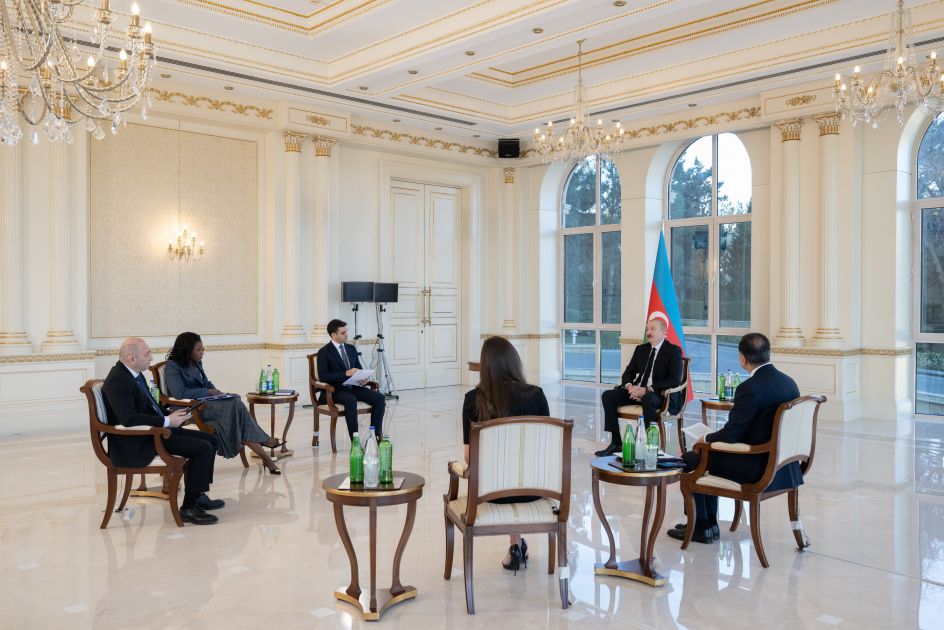
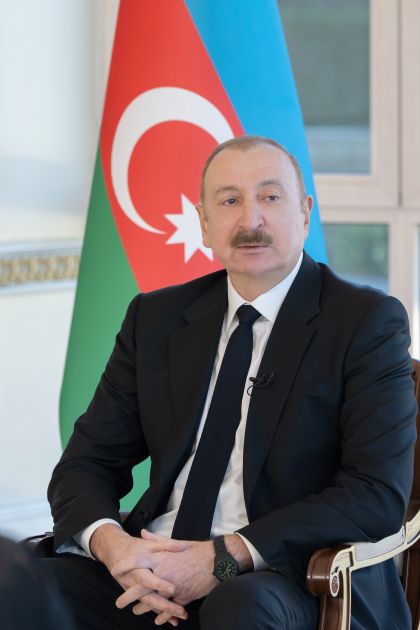
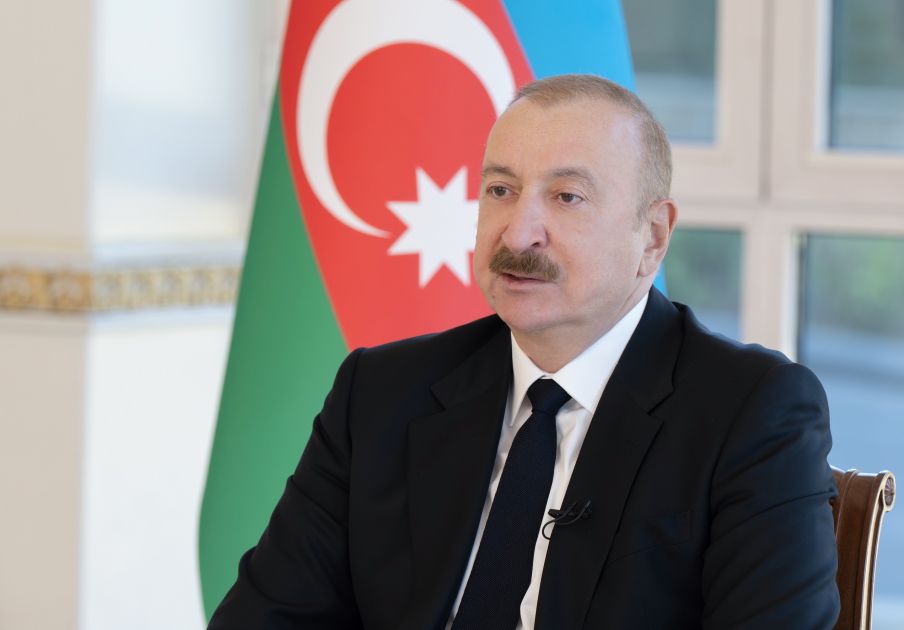
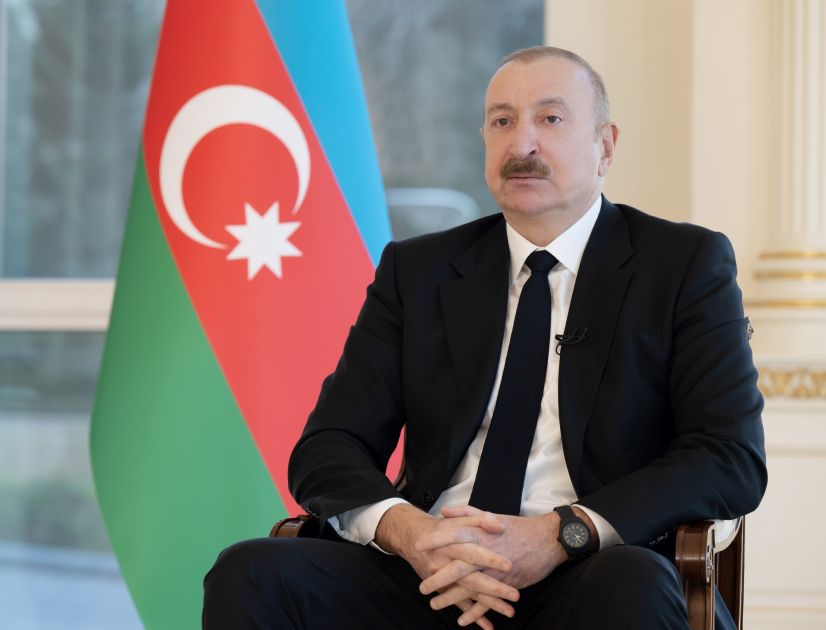
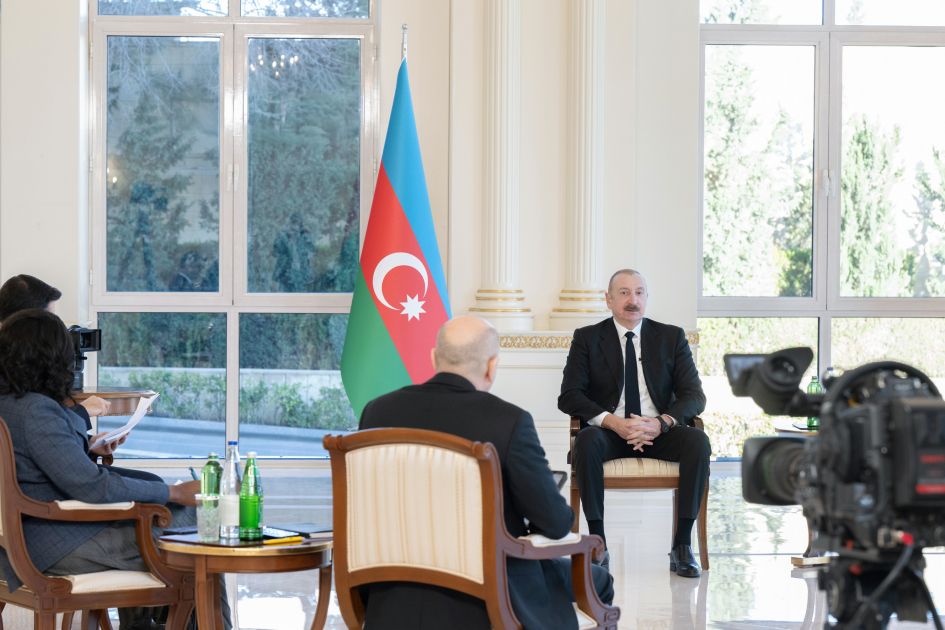
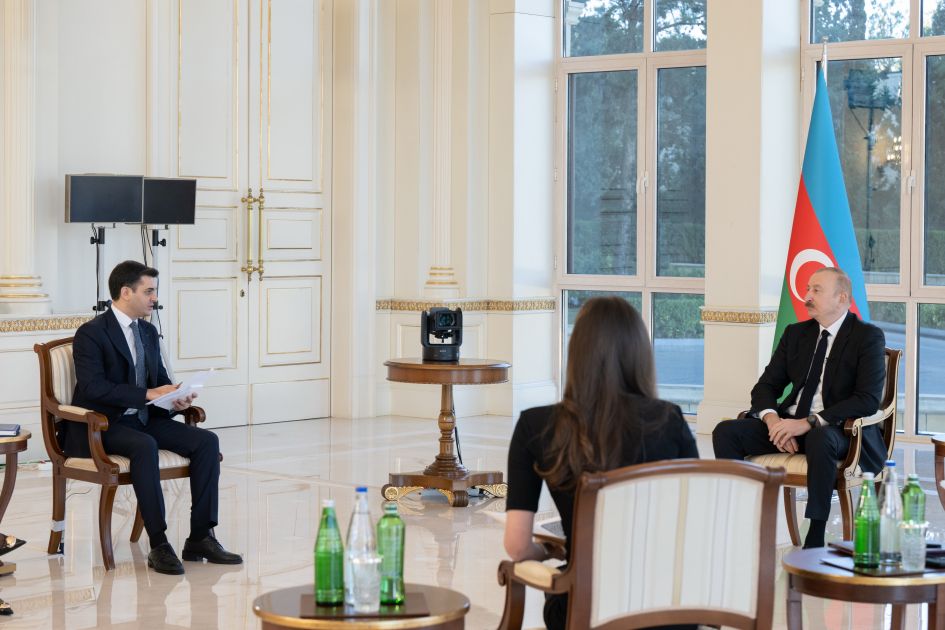
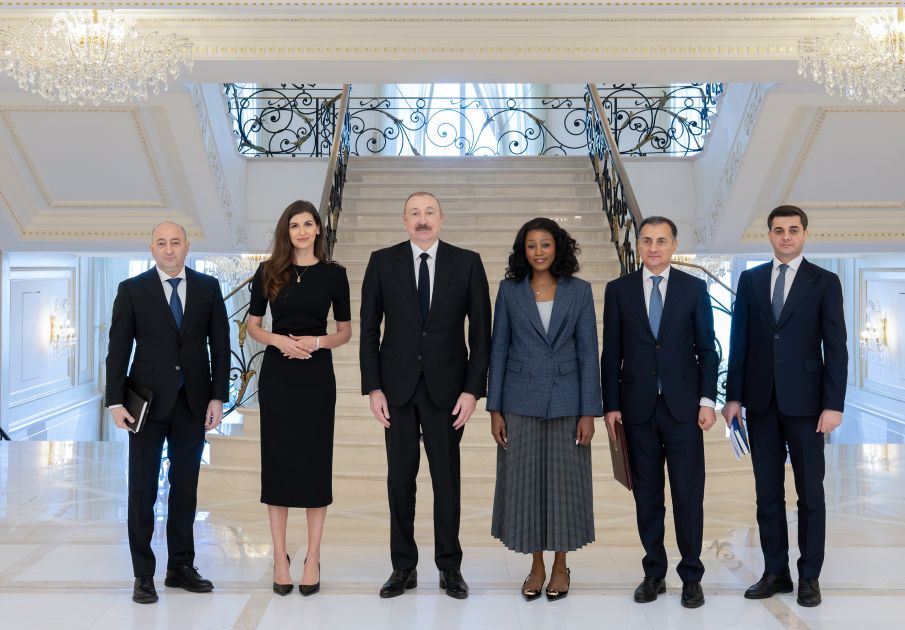
Here we are to serve you with news right now. It does not cost much, but worth your attention.
Choose to support open, independent, quality journalism and subscribe on a monthly basis.
By subscribing to our online newspaper, you can have full digital access to all news, analysis, and much more.
You can also follow AzerNEWS on Twitter @AzerNewsAz or Facebook @AzerNewsNewspaper
Thank you!