
Uzbekistan, Kazakhstan seek coop with NATO members
By Aynur Jafarova
The political situation is changing in Central Asia as the 2014 withdrawal of the NATO troops from Afghanistan is getting closer. While Uzbekistan and Kazakhstan are approaching NATO and the U.S., Kyrgyzstan and Tajikistan continue their traditional Russia-oriented policy, experts believe.
Recently the tendency of rapprochement with the U.S and NATO is obviously seen in Uzbekistan.
In 2012, NATO received a request from Uzbekistan for assistance in the field of defense education, according to NATO Secretary General Anders Fogh Rasmussen's latest annual report released in Brussels.
The Defense Education Enhancement Program (DEEP) initiative began in 2007 with a program in Kazakhstan that helps to sustain regional stability through multinational education and research.
Uzbekistan also wants to purchase U.S military equipment which will be brought from Afghanistan, an article published in The New York Times in early February said.
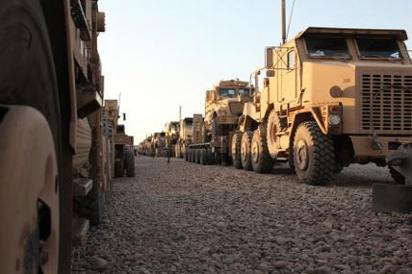
According to the article, Uzbekistan wants to gain common items like night-vision goggles as well as large and expensive American-made goods like MRAP vehicles, 14-ton armored utility trucks that help protect troops from roadside bombs, small arms, mine detectors, navigation equipment and possibly drones.
"Over the next two years, NATO forces are expected to remove about 70,000 vehicles and 120,000 shipping containers from Afghanistan," the article said.
Another NATO member, Britain, also plans to sell military hardware to Uzbekistan in exchange for safe passage for the thousands of vehicles and containers that are to be brought home from Afghanistan, the British daily newspaper Times reported with reference to British Defense Secretary Philip Hammond.
"We do not sell weapons that can be used for internal repression of any country," he said. "However, after 2014 Uzbekistan will face new risks. The matter rests not only in protection from the rebels or the Islamists, but fight against crime and drug trafficking."
Hammond said that the British military equipment that can be sold at a reduced price to Tashkent will help increase security at the Uzbek-Afghan border, which will be vulnerable after withdrawing the international coalition forces from Afghanistan.
In June, NATO reached agreements with Uzbekistan, Kyrgyzstan and Kazakhstan for taking equipment out of Afghanistan. Uzbekistan, which effectively controls rail shipments out of northern Afghanistan, has already announced that it will charge up to 150 percent of the distribution network's prevailing transit rates.
Not only Uzbekistan is interested in cooperation with NATO members; NATO states aim to cooperate with Uzbekistan as well. The goal of Uzbekistan in this cooperation is to maintain its security while NATO members' main aim in their cooperation with Uzbekistan is to maintain safe passage of military equipment through Uzbekistan and to provide the security of the region by selling part of the equipment to the Central Asian state.
In December 2012, Uzbekistan pulled out of Russia's regional security bloc, the Collective Security Treaty Organization (CSTO). Experts believe that the main reason of this step by Tashkent is that Uzbekistan takes advantage of its newly improved relations with the U.S. and NATO.
Moreover, NATO will soon design a special Central Asian strategy and Uzbekistan, as a partner in NATO's Partnership for Peace program, will logically be the alliance's key partner in the region. In this regard, Uzbekistan's CSTO membership would frustrate the Uzbekistan-NATO partnership.
However, it is noteworthy that the situation in the Central Asia region contributes to militarization and growth of military expenditure. According to several experts, the increasing threat of terrorism in the world as well as in Central Asia is indirectly contributing to militarization. Periodic discussions concerning transfer of military equipment and weaponry to Uzbekistan after the withdrawal of NATO troops from Afghanistan in 2014 is the logical end of the problem, experts say.
The same tendency of rapprochement with NATO and the U.S is observed in Kazakhstan.
In January 2013, Kazakh Foreign Minister Yerlan Idrissov held a meeting with NATO Secretary General Rasmussen in Brussels during which ways to maintain security in Afghanistan after 2014 were discussed.
"Our cooperation in maintaining security in Afghanistan, especially after 2014, when the majority of coalition forces are expected to leave [Afghanistan], certainly plays a special role for NATO," Idrissov told journalists. According to him, cooperation is important for both sides in order to ensure lasting security, stability and socioeconomic recovery in Afghanistan.
In general, Kazakhstan and NATO are cooperating in the fields of peacekeeping, preparation of specialists, technical assistance, development of military education system, etc.
However, in late January, Kazakhstan and Russia signed an
agreement on establishing a unified air defense system. Experts
believe that Russia is a military donor for Kazakhstan. Although
the establishment of the joint air defense system will maintain
military security of both Russia and Kazakhstan, this step is
realized by selling Russian arms to Kazakhstan for concessional
prices and aims to keep Kazakhstan at the level of a military ally
for Russia.
In general, the main issue for Central Asia is stability. If there
is stability in the region, investments will flow to the Central
Asian states and their economy will flourish, but if security is
not maintained, it will negatively affect economic development in
the whole region.
Here we are to serve you with news right now. It does not cost much, but worth your attention.
Choose to support open, independent, quality journalism and subscribe on a monthly basis.
By subscribing to our online newspaper, you can have full digital access to all news, analysis, and much more.
You can also follow AzerNEWS on Twitter @AzerNewsAz or Facebook @AzerNewsNewspaper
Thank you!