
Middle Corridor and New regional reality: messages from Munich

Qabil Ashirov
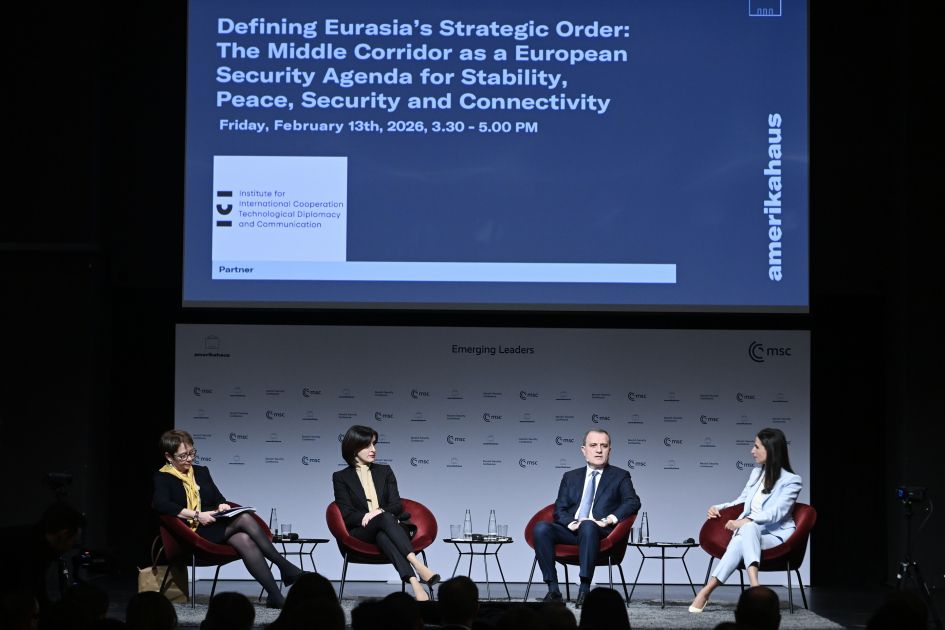
Read moreThe Munich Security Conference once again confirmed its role as one of the most influential platforms shaping the global security agenda. For the South Caucasus, however, one of the most significant discussions was “Defining Eurasia’s Strategic Order: The Middle Corridor” that carried special weight. In the platform, Azerbaijan’s Foreign Minister Jeyhun Bayramov’s remarks made clear that Baku is no longer simply a regional actor. It has become a strategic hub, systematically shaping Eurasian connectivity and positioning itself as a central player in the emerging order.
The transformation of the South Caucasus in recent years is not a coincidence. Since 2020, Azerbaijan has emerged as the decisive force reshaping the region’s security architecture. The message from Munich went beyond the post-conflict period and pointed to the contours of a new regional order—one that is pragmatic, interconnected, and increasingly defined by economic logic rather than geopolitical rivalry. This shift is not only about peace agreements or ceasefires; it is about building a sustainable framework where cooperation replaces confrontation.
One of the most striking developments involves Armenia. The removal of transit restrictions on cargo bound for Armenia and the start of oil product sales from Azerbaijan to Armenia are unprecedented steps in the history of the South Caucasus. These moves are about pragmatic politics. If stability is built on economic interdependence, Azerbaijan is demonstrating how this model can work in practice. By fostering trade and connectivity, Baku is signaling that the path to peace lies in shared interests rather than entrenched hostility.
At the same time, Azerbaijan’s position is unambiguous: sustainable peace requires the removal of legal obstacles. Armenia’s constitution still contains territorial claims against Azerbaijan, undermining normalization. For a peace treaty to be signed, these contradictions must be resolved. Without legal clarity, political agreements remain fragile, and the risk of renewed instability persists. The insistence on legal alignment is not a technicality; it is a recognition that durable peace must rest on solid foundations.
The Munich discussions also highlighted the TRIPP initiative—the “Trump Route for International Peace and Prosperity,” aligned with the Washington Declaration. This project is not merely about transport lines. Its ambition is to transform the South Caucasus from a zone of geopolitical competition into a space of economic integration. Such a vision resonates with Azerbaijan’s broader strategy: preventing the region from becoming a battleground for great powers and instead building a cooperation-based model. President Ilham Aliyev’s policy has consistently emphasized this approach, and Munich provided an international stage to articulate it clearly.
The Middle Corridor itself is no longer seen as an alternative route but as a geoeconomic necessity. Azerbaijan, Kazakhstan, Turkiye, and Georgia have already adopted a roadmap that simplifies transit procedures, reduces transport times, and increases cargo volumes. These practical steps demonstrate that the Middle Corridor rests on real economic foundations, not abstract geopolitical aspirations. The corridor is becoming a backbone of Eurasian trade, linking Europe and Asia through a reliable and efficient route.
The European Union’s growing involvement in the process adds further weight. At a time when energy security and supply chain diversification are top priorities for Europe, routes passing through Azerbaijan acquire strategic value. Turkiye and Georgia play complementary roles, reinforcing the corridor’s resilience and ensuring that it is not dependent on a single actor. This collective effort underscores the fact that the Middle Corridor is not just a regional project but a continental one, with implications for global trade and energy security.
The thesis voiced in Munich was profound: the South Caucasus will either remain a zone of competition or evolve into a space of connectivity. Azerbaijan is demonstrating that it has chosen the second path. This choice reflects political will, strategic vision, and a sense of regional responsibility. The message from Munich was clear: the Middle Corridor is the cornerstone of a new regional order, one that promises stability, prosperity, and integration in a region long defined by conflict.
Here we are to serve you with news right now. It does not cost much, but worth your attention.
Choose to support open, independent, quality journalism and subscribe on a monthly basis.
By subscribing to our online newspaper, you can have full digital access to all news, analysis, and much more.
You can also follow AzerNEWS on Twitter @AzerNewsAz or Facebook @AzerNewsNewspaper
Thank you!