
Europe’s energy dilemma: misinformation, radical activism and truth about Azerbaijani gas

Qabil Ashirov
Read moreThroughout human history, very few regions have shaped the world as profoundly as Europe. For this reason, humanity has often sought to look toward Europe, sometimes through conquest, as with the Achaemenids or the Huns, and sometimes through migration and cultural exchange. Yet over the past century or two, Europe has seen the rise of radical groups, including leftist movements, environmental activists, feminists, and others, that, intentionally or not, hinder the development of this historically powerful continent. By spreading fear, panic, and division, these movements have, in effect, tied the hands and feet of Europe’s historical engines of progress.
Recent events provide a clear example. Last week, media outlets in Azerbaijan and worldwide reported that Germany and Austria would purchase natural gas from Azerbaijan. Almost immediately, Lindsey Snell, a so-called journalist known for her support to radical and illegal groups in the Middle East and her hate towards Azerbaijan, Turkiye and Muslim community, suggested on social media that Azerbaijan was supposedly re-exporting Russian gas to Europe. Lindsey Snell's general aura, which is not at odds with either journalistic ethics or public culture in general, is well known to everyone. This culturally flowed journo with mixed intentions, who was deported from Turkiye, still doesn't quite understand what she wants.

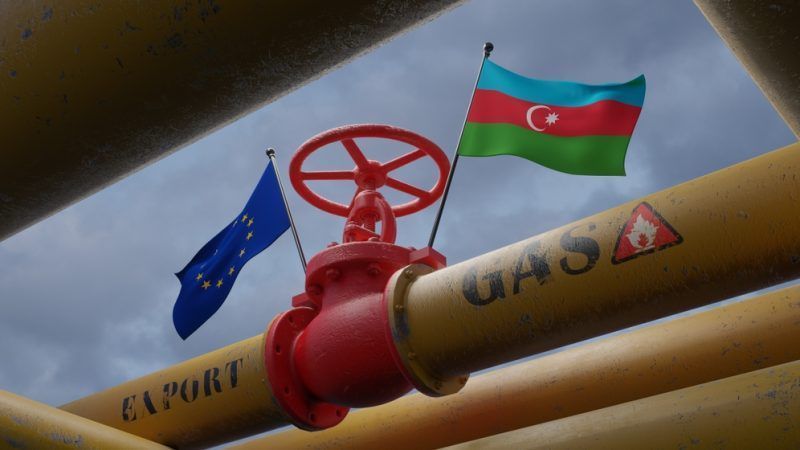
But what evidence supports this claim? None. This assertion has been previously circulated by pro-Armenian groups and media, yet the highest-ranking Azerbaijani officials have repeatedly clarified that Azerbaijan exports only its own natural gas, without any Russian involvement. In reality, Azerbaijan supplies natural gas to 14 countries, one of which is Ukraine.
Let us imagine, for a moment, that Azerbaijan were engaged in such a scheme. How could this go unnoticed by the West, which monitors global energy flows with satellites and other instruments? Even more, how could Ukraine—locked in a life-and-death struggle with Russia—ignore it? Ukraine actively targets Russian energy infrastructure not only on its territory but also in the Black Sea and the Indian Ocean, striking Russian shadow fleets to disrupt operations. Its president, Volodymyr Zelensky, shares crucial updates openly through the media and social media. Has he ever claimed that Azerbaijan is re-exporting Russian gas? Absolutely not. On the contrary, Azerbaijan is providing its own gas to Ukraine and other countries, strengthening regional energy security.
Claims like Snell’s are thus not only factually incorrect—they implicitly insult the Ukrainian people, who are fighting heroically on multiple fronts. Previously, such narratives relied on speculation: Azerbaijan’s gas reserves are smaller than Russia’s, so it supposedly cannot replace Russian gas in Europe. Yet these arguments ignore a crucial fact: even if Azerbaijan wanted to supply Europe entirely, it could not do so alone. Moreover, Europe does not seek a single substitute supplier. Instead, it aims to diversify its energy sources to prevent any future coercion, ensuring that no country can exert the leverage Russia once had.
This raises a larger question: how did Russia, a developing country, manage to gain influence over a continent historically at the forefront of global progress? Part of the answer lies in the radical movements mentioned earlier. Activists, pressure groups, and ideologues pushed European governments to close coal and nuclear facilities, arguing environmental harm. Consequently, Europe became dependent on Russian gas, creating strategic vulnerabilities and economic consequences, such as rising energy prices, while the human cost of war is borne in Ukraine.
Even as Europe attempts to correct these mistakes, misinformation persists. Figures like Lindsey Snell amplify radical narratives, attempting to obstruct the continent’s recovery. Yet history demonstrates that those who hinder progress without contributing are ultimately defeated. Meanwhile, Azerbaijan continues to act as a responsible energy provider, delivering natural gas to 14 countries, including Ukraine, and asserting its sovereignty and credibility in global energy markets.
Generally, the attempt to misrepresent Azerbaijan’s energy exports is not only inaccurate but strategically flawed. Those who spread false narratives ignore real facts, such as Azerbaijan’s diversified supply, Europe’s energy diversification strategy, and Ukraine’s active defense of its own energy interests. The lesson is clear: while radical movements may create noise and confusion, reality and responsibility ultimately prevail. Azerbaijan’s example shows that a country can assert itself on the global stage with transparency, efficiency, and integrity, even amid complex geopolitical pressures.
Here we are to serve you with news right now. It does not cost much, but worth your attention.
Choose to support open, independent, quality journalism and subscribe on a monthly basis.
By subscribing to our online newspaper, you can have full digital access to all news, analysis, and much more.
You can also follow AzerNEWS on Twitter @AzerNewsAz or Facebook @AzerNewsNewspaper
Thank you!