
Azerbaijan's President draws clear lines in Gaza and Mideast policy

Qabil Ashirov
Read morePresident Ilham Aliyev’s recent interview with local media went far beyond a discussion of Azerbaijan’s domestic politics and social issues. It also provided a comprehensive and clarifying overview of the country’s foreign policy, addressing sensitive international matters with notable precision and strategic clarity.
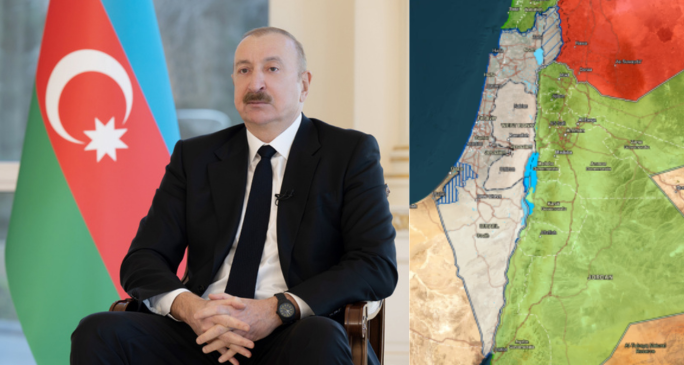
Among the foreign policy topics raised, the Palestinian issue stood out clearly. Over the past several days, the President’s remarks on Palestine have sparked intense debate across social media platforms as well as in both local and international media. This reaction, however, was largely predictable. In recent years, Azerbaijan has been targeted by certain forces in neighboring countries because of its relations with Israel. Protests were even organized in front of facilities belonging to SOCAR, Azerbaijan’s oil and gas giant, located in one of these countries. What is particularly striking is that rational and level-headed individuals have welcomed President Aliyev’s comments on Palestine within those very societies.
Overall, President Aliyev’s interview once again demonstrated his deep command of complex issues, his ability to address topics down to the finest details, and his clear strategic vision for Azerbaijan’s future. His remarks reflected a leader who not only understands global dynamics but also approaches them with foresight and consistency.
Moreover, President Aliyev’s statements on foreign policy—especially regarding Palestine—underscored that Azerbaijan’s diplomatic stance is precise, principled, and transparent. The rules of engagement are clearly defined in advance, and Azerbaijan has never deviated from them. The central priority of this policy is Azerbaijan itself and the national interests of the Azerbaijani people. These interests are never sacrificed for any country, regardless of ethnicity, religion, language, or political alignment, nor is Azerbaijan prepared to retreat from them for any country. President Aliyev made this unequivocally clear when he stated, “Every Azerbaijani citizen is precious to us. We have no intention of risking the lives and health of Azerbaijanis for the sake of others.”
No one, not even Azerbaijan’s adversaries, doubts that the country’s foreign policy functions with clockwork precision. President Aliyev’s words were, in fact, a clear articulation of the policy Azerbaijan has pursued consistently over the past three decades. It is precisely this approach, openly stating one’s position in advance and remaining steadfast, that has enabled Azerbaijan to achieve its political successes. Today, Azerbaijan is one of the rare countries that maintains relations based on mutual respect with both Israel and Palestine. Due to this transparency, Israel does not criticize Azerbaijan for its ties with Palestine, nor does the Palestinian side reproach Azerbaijan for its relations with Israel.
It is worth noting that following the restoration of its independence, Azerbaijan was among the first former Soviet republics to recognize Palestine. It has also consistently and openly supported the establishment of a Palestinian state across all international platforms to which it belongs. As President Aliyev noted, “….Azerbaijan has always supported Palestine and the creation of a Palestinian state in the UN, the Non-Aligned Movement, and the OIC. The Palestinian Embassy operates in Azerbaijan, supported in part by Azerbaijani financial assistance.”
Azerbaijan is ready to contribute to lasting peace between Israel and Palestine, but it has never sought to enforce peace upon any party. This has never been Azerbaijan’s approach. It is well-known that Azerbaijan has participated in peacekeeping missions in various conflict zones and possesses substantial experience in this field. As President Aliyev explained, “…before making a decision, we must clearly understand what the mandate of the operation would be and what kind of operations are planned. We have experience participating in peacekeeping operations in Iraq, previously in Kosovo, and certainly in Afghanistan; therefore, we are well-acquainted with the operational structure.
Regarding the situation in the Gaza Strip, in our view, it remains unclear who will issue the mandate and what its nature will be. Will these be "peacekeeping" operations or "peace enforcement" operations? These are two different things. We are naturally not ready for the latter, nor have we ever considered participating in it.”
Thanks to this clear and predictable policy, Azerbaijan’s position is accepted by both Arabs and Jews alike. Has there ever been a case where a Palestinian politician, activist, or public figure has accused Azerbaijan of wrongdoing? The same question applies to other Arab countries and Israel as well. Yet, for some reason, certain actors attempt to be “more Catholic than the Pope.” Azerbaijan does not engage in such behavior. Being more Catholic than the Pope is not our way.
Azerbaijan cannot contribute more to the Gaza issue than the Arabs of the region themselves, including the Palestinians. This is neither realistic nor technically possible. Arab states, by virtue of geography and influence, are better positioned to play a decisive role. Moreover, history shows that the more external actors interfere in the Palestinian issue, the greater the harm inflicted on Palestine and its people. Several wars have taken place between Arab states and Israel, primarily over the Palestinian question. A closer examination of these conflicts reveals an interesting fact: in most wars, Arab states possessed far greater resources than Israel. Ordinarily, wars are won by the side with superior resources, which would suggest Israel’s defeat was inevitable. Yet internal rivalries among Arab states and Israel’s skillful exploitation of these divisions led to Israel’s victories. Ultimately, the party that suffered most was Palestine.
Taking all this into account, it becomes clear that determination among Arab states is crucial to resolving the Palestinian issue. As President Aliyev rightly stated, “…I have always maintained that the affairs of Arab countries should be resolved by the Arab countries themselves. I remain deeply convinced that non-Arab Muslim countries should not get ahead of themselves. This will lead to no good. There is the Arab League; the Arab League has a position that is quite clear, and we follow it.”
This sober, realistic, and principled approach is precisely what defines Azerbaijan’s foreign policy today, and why it continues to command respect across diverse and often divided regions of the world.
Here we are to serve you with news right now. It does not cost much, but worth your attention.
Choose to support open, independent, quality journalism and subscribe on a monthly basis.
By subscribing to our online newspaper, you can have full digital access to all news, analysis, and much more.
You can also follow AzerNEWS on Twitter @AzerNewsAz or Facebook @AzerNewsNewspaper
Thank you!