
Iran-Pakistan gas pipeline project on final phase, US voices concerns
By Sara Rajabova
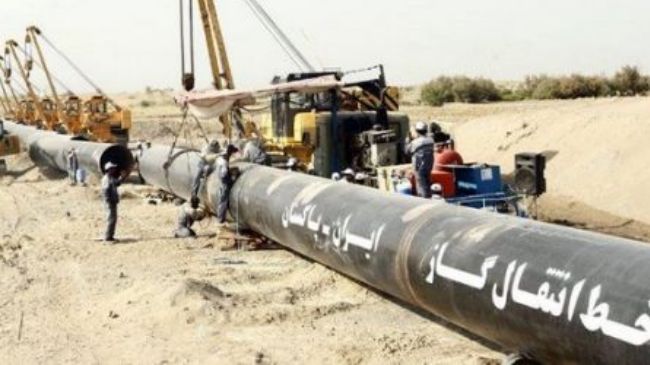
The Iran-Pakistan (IP) gas pipeline project is a great development to meet Pakistan's energy demand, Pakistan's Minister for Information and Broadcasting Qamar Zaman Kaira said on Monday.
In his televised interview Kaira said this project has great importance in view of energy demand that is why the government has started the mega project, Business Recorder daily reported.
He said that IP gas pipeline project is not against or in favour of any country except Pakistan.
He said the heads of state of both countries are showing great interest to inaugurate the mega project because it has great importance for regional cooperation.
Speaking about Turkmenistan-Afghanistan-Pakistan-India (TAPI) project, he said this project is too difficult to start because it has link with peace in Afghanistan.
He said that the regional stability could not be possible without maintaining peace in Afghanistan.
Iranian Oil Minister Rostam Qasemi said that the IP gas pipeline project serves the interests of the Iranian and Pakistani nations, Press TV reported.
Iranian oil minister made the remarks during the inauguration ceremony of the final construction phase of the project, which was held on the Iran-Pakistan border on Monday.
Qasemi said "despite the efforts made by the enemies of the two countries, the project is moving into its final stages."
He expressed hope that other regional countries would also be able to use Iran's gas after the project is completed.
On the other hand, Iranian deputy oil minister Javad Owji said that Pakistan has raised its demand for natural gas imports from Iran to 30 million cubic meters (mcm) per day from a previous 21.5 mcm.
The remarks by Owji, who is also managing director of National Iranian Gas Company (NIGC), coincided with the inauguration on Monday of the IP gas pipeline project to carry natural gas from Iran to its eastern neighbour.
"Negotiations have started with the Pakistani side to that effect and in case of an agreement, an appendix will be attached to the current contract," Owji said.
He added that the pipeline would totally cost $5 billion.
Owji also said that Iran has hitherto spent $2 billion to build its own section and that the Pakistani section would need $3 billion.
The official stated that the 2,000-kilometer pipeline, 780 km of which is on the Pakistani side, would start pumping 1.5 mcm per day of natural gas to Pakistan as of December 2014.
"Iran can serve as a secure source for the transfer of energy to the neighbouring states and distant markets," he said.
The pipeline is designed to help Pakistan overcome its growing energy needs at a time when the country of 180 million is grappling with serious energy shortages.
Iranian President Mahmoud Ahmadinejad and his Pakistani President Asif Ali Zardari officially inaugurated the final construction phase of the multi-billion-dollar project on Monday.
It is also reported that Pakistan will pay fine equal to one million dollars per day if it fails to complete the Iran-Pakistan pipeline in time.
The 2,000-kilometer pipeline, which is projected to cost 1.2 to 1.5 billion, dollars, would enable the export of 21.5 million cubic meters of Iranian natural gas per day to Pakistan.
Iran has constructed more than 900 kilometres of the pipeline on its territory.
The Tehran-based Tadbir Energy Development Group will reportedly undertake all engineering procurement and construction work for the first segment of the pipeline which starts from the Iran-Pakistan border, and will cost around 250 million.
The Iranian firm will also build the second segment of the pipeline and extend the financing to $500 million in the future.
Additional funding is expected to be generated through Pakistan's Gas Infrastructure Development Cess (GIDC).
Concerns over IP pipeline
Despite Iran and Pakistan hailed the IP gas pipeline, there are some countries that decisively opposed this project.
The U.S. State Department has threatened Islamabad with sanctions if the country goes through with a joint multi-billion-dollar gas pipeline project with Iran.
"We have serious concerns, if this project actually goes forward, that the Iran Sanctions Act would be triggered," State Department spokeswoman Victoria Nuland said on Monday.
"We've been straight up with the Pakistanis about these concerns," Nuland added.
Earlier she said if this deal is finalized for a proposed Iran-Pakistan pipeline, it would raise serious concerns under U.S's Iran Sanctions Act.
"We've made that absolutely clear to our Pakistani counterparts," Nuland said last week.
The 1996 Iran Sanctions Act allows the U.S. government to ban imports from any non-American company that invests more than $ 20 million a year in the Iranian oil and natural gas sector.
Nuland said the U.S. was "supporting large-scale energy projects in Pakistan that will add some 900 megawatts to the power grid by the end of 2013."
The threats came on the same day as the inauguration of the final construction phase of the IP gas pipeline, intended to carry natural gas from Iran to its eastern neighbor.
Besides, earlier in March, Canada's Foreign Minister John Baird has issued a statement about the disappointment of the country's federal government over the IP gas project, which was slammed by Iran.
Baird said the Canadian federal government got deeply disappointed by Pakistan's decision to build a new natural gas pipeline with Iran and to purchase Iranian gas through it.
Iran's Foreign Ministry Spokesman Ramin Mehmanparast has censured Canada's stance on the IP gas pipeline project, warning Ottawa against turning into the source of threat to global peace.
Pakistan President Zardari earlier reiterated that Islamabad would not stop the pipeline project at any cost.
The Pakistani president stressed that his government would continue to pursue the construction of the gas pipeline despite US threats and pressure.
Here we are to serve you with news right now. It does not cost much, but worth your attention.
Choose to support open, independent, quality journalism and subscribe on a monthly basis.
By subscribing to our online newspaper, you can have full digital access to all news, analysis, and much more.
You can also follow AzerNEWS on Twitter @AzerNewsAz or Facebook @AzerNewsNewspaper
Thank you!