
Across Caspian, Azerbaijan and Turkmenistan are building Eurasia’s future

Qabil Ashirov
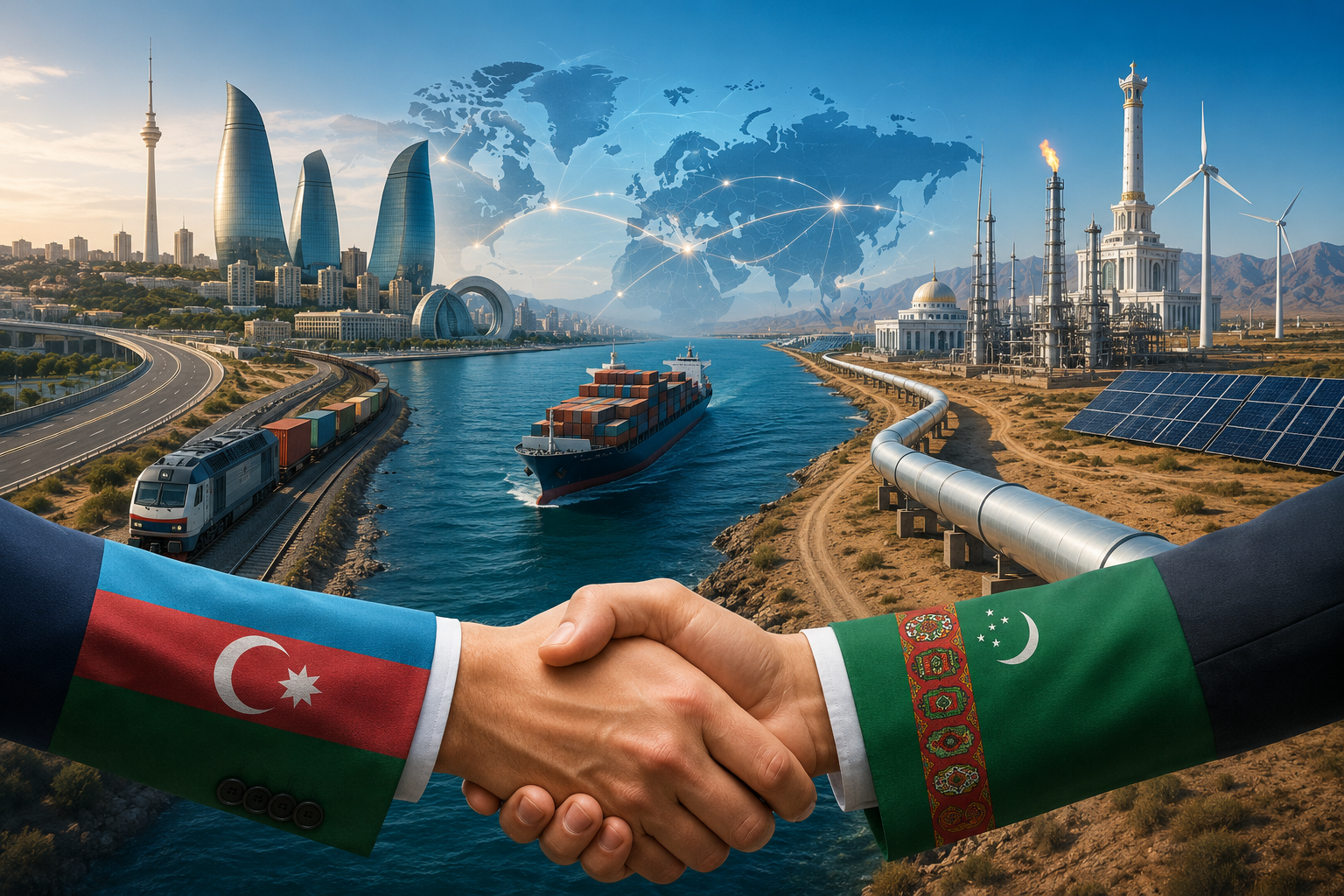
Read moreAs Turkmen President Serdar Berdimuhamedov touches down in Baku today, the optics of the welcome ceremony at Heydar Aliyev International Airport carry a significance that extends far beyond standard diplomatic protocol. In an era defined by fractured global supply chains and a relentless scramble for energy diversification, the meeting between the leaders of Azerbaijan and Turkmenistan represents a critical recalibration of the Eurasian economic map. For decades, the Caspian Sea was viewed by external observers as a geographic barrier or a zone of unresolved legal disputes. Today, it has indisputably evolved into a vital economic bridge, with Baku and Ashgabat serving as its two main pillars.
The current economic relationship between Azerbaijan and Turkmenistan is built on a foundation of calculated pragmatism and shared opportunity. At the core of this partnership sits the historic 2021 memorandum on the joint exploration of the "Dostluq" hydrocarbon field. By transforming a long-standing maritime boundary dispute into a collaborative commercial venture, both nations provided a masterclass in regional diplomacy. Yet, the true value of the current Baku-Ashgabat axis lies in its role as the dual-engine of the Trans-Caspian International Transport Route, widely known as the Middle Corridor.
As cargo volume between the Baku International Sea Trade Port in Alat and the Turkmenbashi International Seaport continues to scale up annually, the two nations are no longer just oil and gas exporters; they are the indispensable transit facilitators linking East Asian manufacturing centers with European consumer markets.
However, treating this state visit as a mere celebration of existing transit stats would be a misreading of the deeper strategic current. The real narrative unfolding today is about what the future promises. We are witnessing the transition of bilateral ties from a transactional transport relationship into a deeply integrated economic ecosystem.
The first major frontier of this future promise is the inevitable realization of the Trans-Caspian Gas Pipeline. With the expansion of the Southern Gas Pipeline infrastructure on the European side, the integration of Turkmenistan’s mammoth onshore reserves—such as the Galkynysh field—into Azerbaijan’s transit network is shifting from a theoretical ambition to an economic imperative. For Baku, this solidifies its status as Europe’s premier energy hub. For Ashgabat, it provides the long-sought diversification of its export routes away from total reliance on monolithic regional buyers.
Beyond the traditional roar of heavy industry and fossil fuels, the future of the Azerbaijan-Turkmenistan relationship is quietly going digital and green. The "Digital Silk Way" project, featuring a fiber-optic communication cable currently being laid along the Caspian seabed between the two nations, will soon establish a high-capacity digital data corridor between Europe and South Asia. By lowering data latency and building robust digital infrastructure, Baku and Ashgabat are positioning the Caspian littoral zone to host the data centers and cloud architecture of tomorrow.
Furthermore, as global markets demand lower carbon footprints, early-stage discussions regarding the transit of Central Asian renewable energy westward across the Caspian indicate that the bilateral corridor is actively future-proofing itself against the global energy transition.
Domestically, this integration is set to trigger a powerful wave of industrial synergy. Azerbaijan's Alat Free Economic Zone offers the ideal legal and logistical framework for Turkmen enterprises to establish joint manufacturing ventures, effectively transforming raw materials like Turkmen cotton, fertilizers, and sulfur into high-value secondary goods destined for Western markets. This opens up wide avenues for cross-border investments and public-private partnerships in the construction, engineering, and tech sectors.
When the history of 21st-century Eurasian integration is written, the turning point will not be found in declarations signed in distant capitals, but in the practical, infrastructure-driven alignment taking place right now across the Caspian Sea. The state visit in Baku today is a clear signal that both leaderships recognize the historical weight of the moment. By anchoring their energy grids, digital infrastructure, and logistics hubs into a unified framework, Azerbaijan and Turkmenistan are not just securing their own economic futures—they are collectively reshaping the geopolitical economy of the entire continent.
Here we are to serve you with news right now. It does not cost much, but worth your attention.
Choose to support open, independent, quality journalism and subscribe on a monthly basis.
By subscribing to our online newspaper, you can have full digital access to all news, analysis, and much more.
You can also follow AzerNEWS on Twitter @AzerNewsAz or Facebook @AzerNewsNewspaper
Thank you!