
Moldova’s challenge reveals Eastern Europe in transition

Qabil Ashirov
Read moreFor much of the past decade, Russia projected an image of durable influence across its near abroad and beyond. From Eastern Europe to the Middle East, Moscow cultivated the perception that it could sustain allies, freeze conflicts, and deter challenges to its authority. That perception is now beginning to erode. The war in Ukraine, far from delivering decisive strategic gains, has instead exposed the limits of Russian power—and, perhaps more importantly, encouraged others to test those limits.
The consequences are not unfolding in dramatic, headline-grabbing moments, but in smaller, calculated moves across different regions. The first clear signal emerged in Syria. There, opposition forces began to intensify pressure on the government of Bashar al-Assad, long sustained by Russian military backing. What made this moment significant was not merely the renewed activity of the opposition, but Moscow’s increasingly limited capacity to respond. With substantial military resources tied down in Ukraine, Russia appeared less able to project the level of force that had once sustained Assad’s position. The message was subtle but unmistakable: Russia could no longer guarantee outcomes as it once did.
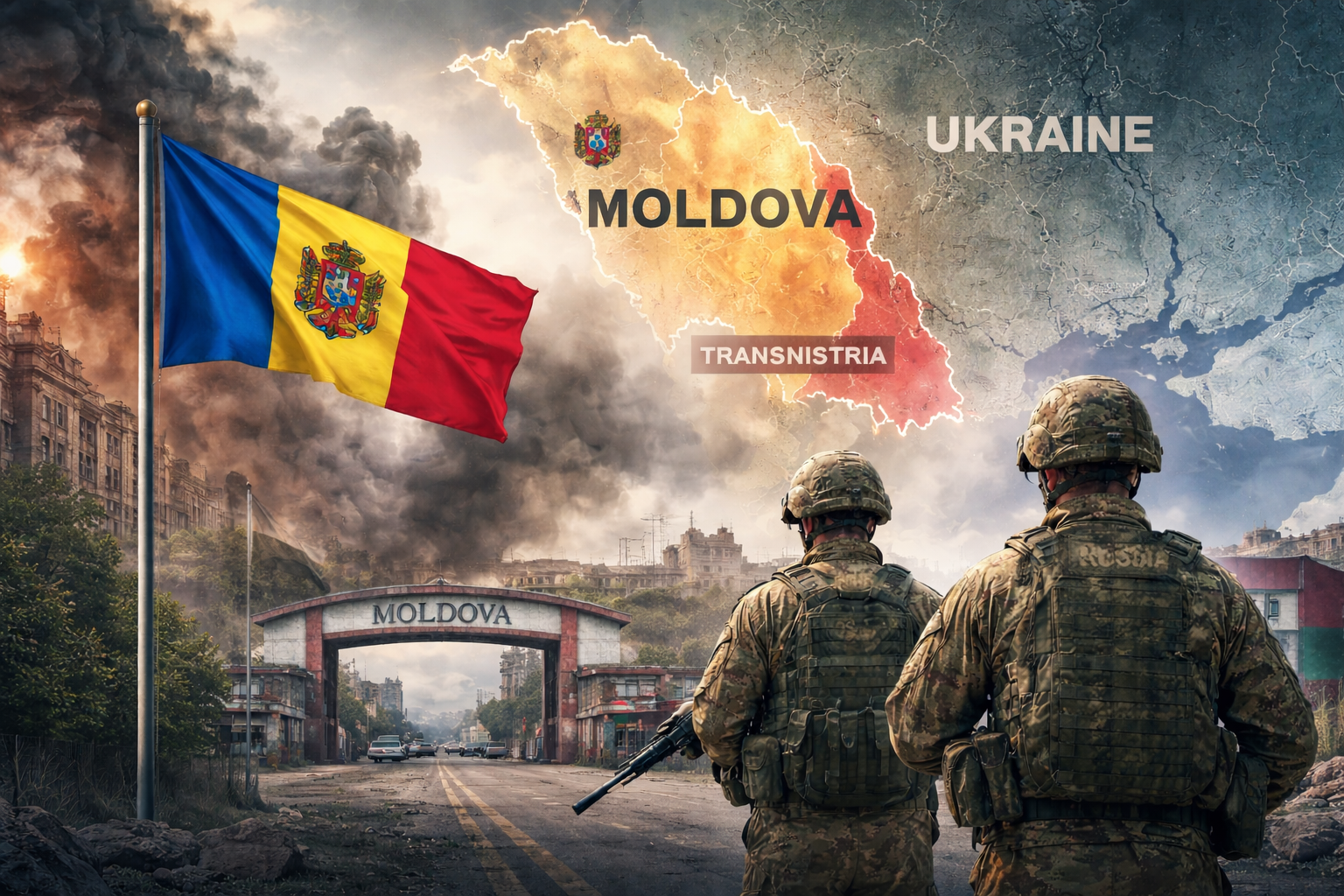
A similar dynamic is now taking shape closer to Russia’s own borders, in Moldova. For years, Chișinău has sought to reintegrate the breakaway region of Transnistria, a narrow strip of land that has remained outside central government control since the collapse of the Soviet Union. Despite its legal claims, Moldova has lacked both the military capacity and the economic leverage to alter the situation. The presence of Russian troops in the region has served as a constant reminder of those limitations.
That reality is beginning to shift—not because Moldova has suddenly grown stronger, but because Russia has become more constrained. As the war in Ukraine drags on, absorbing resources and attention, Moscow’s ability to manage peripheral theaters has weakened. It is in this context that Moldova’s recent decision to declare several Russian officers persona non grata should be understood.
On the surface, the move may appear routine, even symbolic. Diplomatic expulsions are a common feature of international relations. But the geographic and political context transforms its meaning. These officers are not stationed in Moscow or operating through a typical embassy structure. They are linked to the Russian military presence in Transnistria—a presence that is increasingly isolated.
Geography now works against Russia in ways that were less pronounced before the war. Transnistria is effectively cut off. Moldova does not recognize the legitimacy of the Russian military contingent on its territory, and Ukraine—once a more permissive neighbor in this equation—has become an active adversary of Moscow. This leaves Russian forces in the region in a peculiar position: physically present, but strategically constrained, with limited avenues for reinforcement or rotation.
In this light, Moldova’s decision is not merely a bureaucratic act. It is a probe—a test of how far it can push without triggering a disproportionate response. It reflects a growing confidence in Chișinău that the risks of action may now be lower than the risks of continued passivity. The expulsion of the officers sends a signal not only to Moscow, but also to domestic and international audiences: Moldova is willing to assert its sovereignty more actively.
This does not mean that Moldova is preparing for a military confrontation. On the contrary, its structural weaknesses remain unchanged. But power in international politics is not only measured in tanks and budgets. It is also shaped by timing, perception, and the shifting calculations of risk. Russia’s deepening entanglement in Ukraine has altered those calculations across the region.
What we are witnessing is not a sudden collapse of Russian influence, but a gradual fraying at the edges. Countries that once operated with caution are beginning to explore new margins of maneuver. They are not breaking away in dramatic fashion; rather, they are testing boundaries, step by step, to see how far the center will hold.
Moldova’s move fits squarely within this pattern. It is cautious, limited, and reversible. Yet it is also indicative of a broader shift. The post-Soviet space, long defined by frozen conflicts and entrenched spheres of influence, is becoming more fluid. The assumptions that underpinned regional stability—however fragile—are being quietly reassessed.
If Russia’s strategic objective in Ukraine was to reinforce its position as a decisive regional power, the unintended consequence may be the opposite. By committing itself to a prolonged and costly conflict, Moscow has created openings elsewhere. In Syria, in Moldova, and potentially in other contested spaces, actors are beginning to respond to this new reality.
These shifts may not produce immediate breakthroughs. Transnistria will not be resolved overnight, just as Syria’s conflict remains far from settled. But the direction of change is becoming clearer. Influence that once seemed fixed is now being questioned. And in international politics, perception often precedes reality.
Moldova’s quiet defiance is one such moment of perception. It suggests that the balance of power, while still heavily tilted, is no longer as immovable as it once appeared.
Here we are to serve you with news right now. It does not cost much, but worth your attention.
Choose to support open, independent, quality journalism and subscribe on a monthly basis.
By subscribing to our online newspaper, you can have full digital access to all news, analysis, and much more.
You can also follow AzerNEWS on Twitter @AzerNewsAz or Facebook @AzerNewsNewspaper
Thank you!