
Armenia's war on historical reality finds new battleground in Blue Mosque

Qabil Ashirov
Read moreIt is difficult to watch the historical decline of a nation that has given so much to human civilisation. Our neighbours in Armenia have every reason to expect the gratitude of the world. After all, this is the nation that invented the apricot, made fashion when the rest of humanity was still struggling to find something to wear in its caves, and embraced Christianity centuries before Jesus Christ was born. Such extraordinary foresight deserves recognition. The fact that Christianity is generally associated with Jesus is perhaps another example of Armenian modesty.
The list of achievements is practically endless. Television? Armenian invention. The automobile? Armenian ingenuity. Radio? Armenian genius. Computers? Naturally, Armenian. Even the Roman Empire reportedly owes much of its greatness to Armenian contributions. Had it been left to the Romans themselves, they might have spent their time building roads without understanding where civilisation was supposed to go.
Napoleon, meanwhile, would probably have remained an obscure Corsican artillery officer without Armenian assistance. It was apparently "Armenian strategic wisdom" that enabled him to defeat the Russians, march triumphantly towards Moscow and reach the very heart of the Russian Empire. When the campaign subsequently turned into a disaster, and Alexander Suvorov faced the challenge of reversing Napoleon’s advance, the same historically generous nation reportedly came to the rescue. Napoleon had Armenian assistance on the way in, and Suvorov had Armenian assistance on the way out. European military history, it seems, was essentially an Armenian family business.
The Second World War provides an equally impressive illustration. The Soviet Union, with its enormous population, industrial base, military establishment and millions of soldiers, apparently owed its victory over Nazi Germany to five Armenian marshals. Stalin, Georgy Zhukov and the remaining Soviet leadership could presumably have spent the war making tea and watching events unfold. Five marshals from one nation were enough to defeat Hitler and save a country of approximately 200 million people. Britain and the United States, too, reportedly benefited from Armenian contributions. One wonders how the Allies managed to write their military histories without giving this extraordinary assistance the attention it deserves.
And yet, despite having apparently invented half of modern civilisation, helped Napoleon conquer Russia, rescued Russia from Napoleon, defeated Hitler and made Rome great, Armenia has somehow arrived at a rather curious moment in its cultural development.
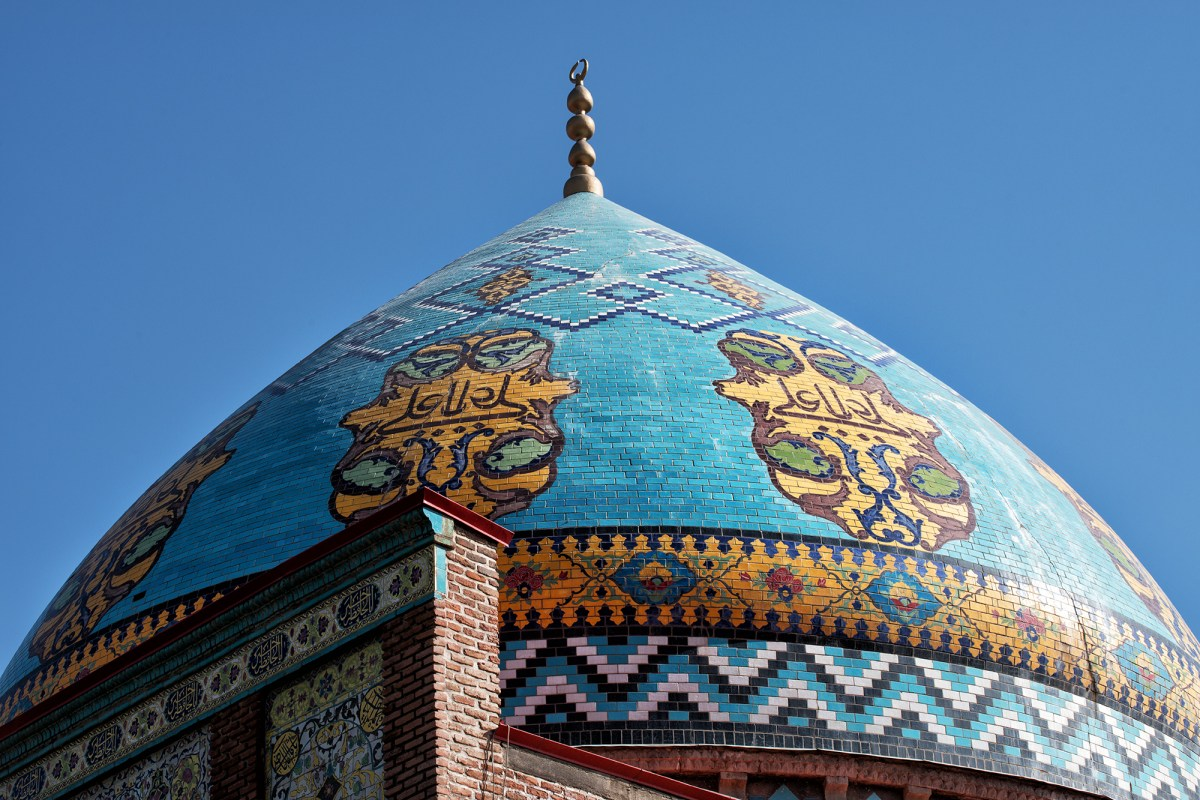
The latest illustration comes from Yerevan, where the ceremonial hall of the Blue Mosque has been named after Armenian poet Yeghishe Charents, with plans reportedly announced to install his bust inside the complex.
The choice is particularly interesting given the history of the building. The Blue Mosque was constructed in 1765–1766 under Huseyn Ali Khan, ruler of the Iravan Khanate. It is an important surviving monument of the Azerbaijani Muslim architectural and cultural heritage of the region. Its historical origins are documented, including in Armenian official tourism materials.
Modern Armenian society, meanwhile, appears to have reached a rather extraordinary stage of historical and cultural disorientation. Surrounded by Muslim neighbours on practically every side, it seems to have developed remarkably little understanding of the religious and cultural traditions that have shaped the region for centuries. For a nation that once reportedly helped make the Roman Empire great, this is quite an unexpected development.
Consider the basic differences between Christianity and Islam. Christian denominations and religious institutions frequently carry national or ethnic designations: the Russian Orthodox Church, the Armenian Catholic Church, the German Lutheran Church and others. Religious buildings also commonly feature paintings, icons, statues and busts. Islam follows a considerably more universal religious tradition. A mosque is a place of worship for Muslims regardless of nationality. There is no established Islamic equivalent of an Azerbaijani Shiite mosque or a Turkish Sunni mosque as an ethnic designation. The religious identity comes first; nationality is secondary.
Yet Armenia appears to have difficulty understanding even these elementary distinctions. The Blue Mosque, commissioned by Huseyn Ali Khan, ruler of the Iravan Khanate, in the eighteenth century, is repeatedly presented through an Iranian mosque. Similar attempts have surrounded the Yukhari Govhar Agha Mosque in Shusha. Its historical identity is equally clear: Govhar Agha, daughter of Karabakh Khan Ibrahim Khalil Khan, financed its construction, and the mosque bears her name.
Apparently, the historical identity of a monument becomes a rather flexible concept when viewed through Armenia's increasingly distorted cultural lens. The distinction between an Azerbaijani Muslim monument and an Iranian cultural connection seems to have become too complicated to appreciate.
The latest episode makes matters even more peculiar. The ceremonial hall of the Blue Mosque has been named after Yeghishe Charents, a twentieth-century communist poet, while plans have been announced to install his bust inside the complex.
In Islamic tradition, mosques are frequently named after their founders, benefactors, locations or historical patrons. The Govhar Agha Mosque illustrates this principle particularly well. Naming a mosque after someone who financed its construction has a clear historical explanation. Applying a similar logic to a communist poet who lived more than a century after the Blue Mosque was built is an entirely different matter.
The proposed bust makes the situation even more striking. Islamic jurisprudence contains different interpretations concerning figurative representation, but statues and human images have traditionally faced substantial restrictions in Islamic religious spaces. The installation of a political-literary bust inside a mosque therefore raises serious questions about religious sensitivity and respect for Islamic traditions.
The deeper irony is that Armenia appears to be applying Christian institutional traditions to Islam, as though the two religions operated according to identical rules. Apparently, after centuries of inventing television, discovering the apricot and helping Napoleon reach Moscow before assisting Suvorov in sending him back, our neighbours have yet to discover that mosques and churches have different religious traditions. Perhaps the next Armenian invention will be an Azerbaijani Shiite cathedral or a Turkish Sunni church. For a nation that supposedly made Rome great and defeated Nazi Germany through five marshals, understanding the religious heritage of its Muslim neighbours should hardly require another historical revolution. Yet here we are, witnessing another remarkable discovery.
Here we are to serve you with news right now. It does not cost much, but worth your attention.
Choose to support open, independent, quality journalism and subscribe on a monthly basis.
By subscribing to our online newspaper, you can have full digital access to all news, analysis, and much more.
You can also follow AzerNEWS on Twitter @AzerNewsAz or Facebook @AzerNewsNewspaper
Thank you!