
The stolen heritage of ancestors
By Seymur Aliyev, AzerNews Staff Writer
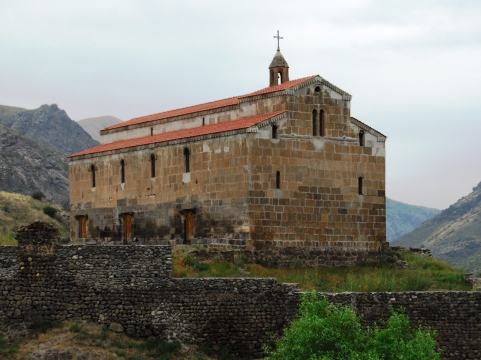
In order to create historical grounds for their arguments Armenian pseudo-historians try to steal the history of Caucasian Albania -- an ancient Azerbaijani state where Turkic speaking tribes had lived since ancient times. The main historical appropriation of the Armenians is tangible and intangible heritage of Caucasian Albania.
Falsification of data about the ancient Albanian kingdom in Azerbaijani territory and presenting it as an Armenian state helps to convince the public that they dwelled there for ages. For many centuries, Armenians have had claims to the territory of Azerbaijan's Karabakh. They appropriated Albanian Christian churches, monasteries, sanctuaries, cross-shaped tombstones, and claim Albanian alphabet, which was more ancient than the Armenian one, and armenianized ancient Azerbaijani poets, translating their creations into Armenian.
According to Prof. Kamran Imanov, the head of the Copyright Agency of Azerbaijan, the Armenians committed appropriation of Albanian tangible heritage even during the times of the Russian Empire. There were two main churches in the region. One of them was Armenian Gregorian church, and another, more ancient one was Albanian Apostolic Church. In 1836, the cherished dream of the Armenians came true: a special decree of the Tsarist government of Russia and Holy Synod adopted the Statute on the Armenian Gregorian Church and abolished the Albanian Apostolic Church. Thus, the Albanian church lost its independence, the title of Albanian Catholicos and the church archives were liquidated and further granted to the disposal of the Armenian Church. Cultural tangible heritage of the church and ancient Albanian valuables were subjected to Armenian occupation. Soon after the statute was issued the Armenians began to destroy or remake in their own way the Albanian manuscripts, inscriptions, holy sites, epigraphs in the churches. Some of the Albanian churches were simply renamed into Armenian ones, and no Albanian monasteries were built thence.
The well-known Albanian Gandsazar monastery was also added to the list of the "Armenian" monuments in Karabakh. The fact is that the monastery complex, according to the accounts of Albanian historian Kirakos Ganjinski, was built in 1204 by Hasan Jalal, the ruler of Khachen and Artsakh, who was a descendant of Mehranids -- an ancient Albanian kingdom. The monastery was a dynastic burial of the Jalalids, the rulers of Khachen. Hasan Jalal was also buried there.
Another example of Armenian appropriation described in Prof. Imanov's book "Tall Armenian tales: a guide to the 'art' of heritage thievery", is popular Azerbaijani sanctuary Aghoglan (White Fellow). This facility is situated 8 km away from the Armenian village Banazur, and at 2-3 km distance from Azerbaijani villages Aghoglan, Shahveledi and Efendiler. Now the question is why the Armenians built "their" monastery so far from their villages in the circle of Azerbaijani villages. Perhaps there was not an Armenian church at all. The Armenians call this sanctuary "Spitak dga", which is also translated into its original name, White Fellow.
The Armenians are telling the international community that their alphabet dating back to the 5th century is very antique and the most ancient among the neighbor nations. They also asserted that Albanian and Georgian alphabets were created by Armenian Mesrop Mashtots. Indeed, that is not true. Prof. Imanov stressed in his book that Mashtots did not know Albanian and communicated with the help of an interpreter. According to Armenian historian Koryun, Mashtots was deported to Albania by Albanian priest Beniamin. Koryun quotes: "By chance some priest from Albania by the name of Beniamin came. He (Mashtots) studied foreign speech."
Albanian historian Moses of Kalankatuyk writes that Mashtots created an alphabet together with the Albanians on the basis of the Georgian language. In other words, creation of the Albanian alphabet was at least a result of collaboration. They merely improved the existing Albanian alphabet. And this is not all. Moses of Kalankatuyk, based on accounts from Roman author Ippolit, who lived in 170-235, informs that the Albanians are mentioned in the list of the nations who have their own language and alphabets. It becomes clear that the Roman author wrote about the Albanian alphabet in the 2nd and 3rd centuries. Despite the Armenian allegations about their "ancient alphabet" created in the 5th century. The fact that the Albanians had their own alphabet is also confirmed by Kamilla Trever, a prominent Russian historian and Albanian studies scholar. She cites two examples from the authors about the letters of the Albanian rulers to the Romans in the 1st century A.D. and the 3rd century A.D. Also, the discovery of Georgian scholar Zaza Aleksidze in Sinai in the St. Catherine monastery allowed him to conclude that even in the 4th century the Albanians had a rich and developed literature, written in the Albanian language in the Albanian alphabet that existed long before Mashtots.
The Armenian alphabet is very similar to the Ethiopian one and this fact raises doubts over its authenticity.
The Armenians also appropriated ancient Albanian poets, translating and renaming their works, Prof. Imanov says. For instance, one of them is Davtag Kertog, who wrote an elegy to the death of great Albanian ruler Javanshir. Logically, only an Albanian poet would mourn an Albanian ruler, not an Armenian one. Another example from the long list of Armenian theft is poet Mukhtar Gosh, who was Albanian by descent. The Armenians stole his works "Code of Laws" and "The Collection of Parables". The appropriated version of "Code of Laws" itself is called "the Armenian code of laws". As to the well-known book "The Collection of Parables", which is based on folklore samples, it had the same fate: that is, examples of folklore authored by Gosh were rewritten as Armenian ones, though they were unrelated to the Armenians.
Prof. Imanov told AzerNews that Kirakos Ganjinski's "History" work was also "corrected" and renamed into "The History of Armenia". Numerous adjustments, alterations and distortions were made in his other work titled "Life-martyrdom of Khosrov Ganjinski". It is worthy of note that Ganja is an Azerbaijani city located in the territory of present-day Azerbaijan.
This is just a little part of the great Azerbaijani heritage, which was appropriated by the Armenians.
Now they try to change the history, but they cannot change the truth; they try to steal stanzas of poems but they cannot steal the talent of the Azerbaijani nation; they try to steal the past, but they cannot make a decent future for themselves with theft.
Here we are to serve you with news right now. It does not cost much, but worth your attention.
Choose to support open, independent, quality journalism and subscribe on a monthly basis.
By subscribing to our online newspaper, you can have full digital access to all news, analysis, and much more.
You can also follow AzerNEWS on Twitter @AzerNewsAz or Facebook @AzerNewsNewspaper
Thank you!