
Remains prove mass killings by Armenians
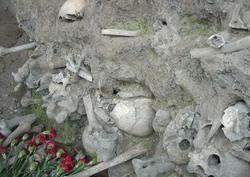
Human remains in northern Azerbaijan have been proven to be those
of Azerbaijanis killed by Armenian death squads on May 1-10, 1918,
a scholar involved in fact-finding research has said.
Gahraman Aghayev, a senior scholar at the National Academy of Sciences Institute of Archaeology and Ethnography who heads a scientific expedition conducting archaeological excavations in the Guba district, told an AzerNEWS correspondent on-site that several facts prove these findings.
"First of all, it was established that the bones are not older than 90 years. Ancient bones would have solidified, while the bones found in Guba are still moist. Secondly, eyewitnesses of the developments recall that Azerbaijanis massacred in the early 20th century had been buried in those areas. Thirdly, the location used to be a garden called Sad Pristavov that belonged to the Russians, and local residents were unable to even come close to it."
Aghayev went on to say that entry to the garden was banned during the Soviet times as well. Access by the local population was granted only in the 1960s.
"This fact, by itself, shows that the Russians, who acted as Armenians` benefactors, were aware that mass burials of Azerbaijanis had been carried out in Guba. It is for this reason that no one was let in there for so long," the expert concluded.
Aghayev emphasized that all of the buried persons were civilians, which is proven by substantial facts. For instance, most of the buried corpses are the bodies of children, the elderly and women.
The total area of the burial is 500 square meters. 196 skulls have been found there to date.
The mass burial was discovered during the operations on building a stadium in Guba in April 2007. In July that year, an expedition of the Institute of Archaeology and Ethnography embarked on archaeological research in the area.
During the tragic developments in 1918, Armenians killed over 50,000 Azerbaijanis throughout the republic and 10,000 people were ousted from their homes. 16,000 people were slain in the Guba district alone.
Azerbaijan and Armenia have been locked in conflict over Upper (Nagorno) Garabagh for over a decade. The region, which is internationally recognized as part of Azerbaijan, was occupied by Armenia in early 1990s, along with seven other Azerbaijani districts, after large-scale hostilities that killed up to 30,000 people and forced a million Azeris out of their homes. The ceasefire accord between the two South Caucasus republics was signed in 1994, but peace talks have been fruitless so far and refugees remain stranded.
Gahraman Aghayev, a senior scholar at the National Academy of Sciences Institute of Archaeology and Ethnography who heads a scientific expedition conducting archaeological excavations in the Guba district, told an AzerNEWS correspondent on-site that several facts prove these findings.
"First of all, it was established that the bones are not older than 90 years. Ancient bones would have solidified, while the bones found in Guba are still moist. Secondly, eyewitnesses of the developments recall that Azerbaijanis massacred in the early 20th century had been buried in those areas. Thirdly, the location used to be a garden called Sad Pristavov that belonged to the Russians, and local residents were unable to even come close to it."
Aghayev went on to say that entry to the garden was banned during the Soviet times as well. Access by the local population was granted only in the 1960s.
"This fact, by itself, shows that the Russians, who acted as Armenians` benefactors, were aware that mass burials of Azerbaijanis had been carried out in Guba. It is for this reason that no one was let in there for so long," the expert concluded.
Aghayev emphasized that all of the buried persons were civilians, which is proven by substantial facts. For instance, most of the buried corpses are the bodies of children, the elderly and women.
The total area of the burial is 500 square meters. 196 skulls have been found there to date.
The mass burial was discovered during the operations on building a stadium in Guba in April 2007. In July that year, an expedition of the Institute of Archaeology and Ethnography embarked on archaeological research in the area.
During the tragic developments in 1918, Armenians killed over 50,000 Azerbaijanis throughout the republic and 10,000 people were ousted from their homes. 16,000 people were slain in the Guba district alone.
Azerbaijan and Armenia have been locked in conflict over Upper (Nagorno) Garabagh for over a decade. The region, which is internationally recognized as part of Azerbaijan, was occupied by Armenia in early 1990s, along with seven other Azerbaijani districts, after large-scale hostilities that killed up to 30,000 people and forced a million Azeris out of their homes. The ceasefire accord between the two South Caucasus republics was signed in 1994, but peace talks have been fruitless so far and refugees remain stranded.
Here we are to serve you with news right now. It does not cost much, but worth your attention.
Choose to support open, independent, quality journalism and subscribe on a monthly basis.
By subscribing to our online newspaper, you can have full digital access to all news, analysis, and much more.
Subscribe
You can also follow AzerNEWS on Twitter @AzerNewsAz or Facebook @AzerNewsNewspaper
Thank you!