
From war to trade: How Washington declaration changing South Caucasus
By Mazahir Afandiyev | AzerNEWS
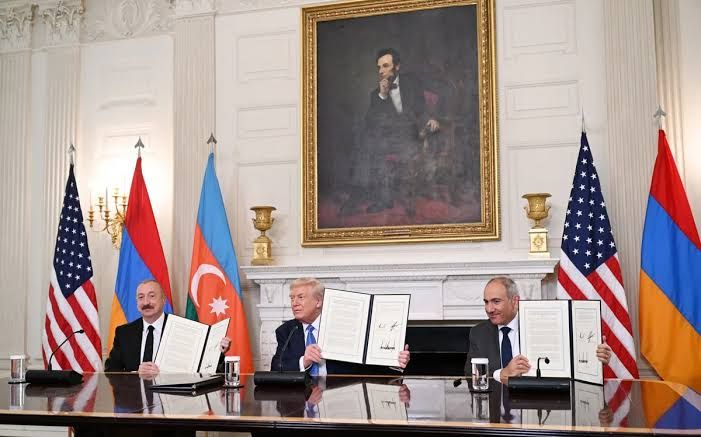
8 August 2025 was widely seen as a turning point in the political history of the South Caucasus. Its significance, however, reaches beyond the region. The meeting in Washington between Azerbaijan’s President Ilham Aliyev, US President Donald Trump and Armenia’s Prime Minister Nikol Pashinyan, and the Joint Declaration that followed, formally marked a new stage in relations between Baku and Yerevan.
The initialling of the peace agreement and the understandings reached on opening regional communication routes were more than diplomatic gestures. They laid the foundations for a different political and economic future for the South Caucasus.
For Azerbaijan, the pursuit of that future has long been presented as part of a wider commitment to international security. After nearly three decades of negotiations failed to resolve the conflict, Azerbaijan argued that the relevant UN Security Council resolutions adopted in 2020 had to be implemented. The Second Karabakh War, followed by the restoration of Azerbaijan’s sovereignty in 2023, fundamentally altered the political landscape of the South Caucasus and the calculations of outside powers.
The military phase of the conflict had already been brought to an end on 10 November 2020, following Armenia’s appeal to Russia and an agreement between the leaders of Azerbaijan, Armenia and Russia. The resulting declaration established a new framework for relations and ended the immediate phase of hostilities.
But ending a war and building a peace are not the same thing.
In the years that followed, Azerbaijan repeatedly argued at bilateral and multilateral meetings that the region had reached a point where the politics of conflict should give way to reconstruction, development and cooperation. The United States, the European Union and Russia all assumed mediating roles at different stages of the process, while Azerbaijan sought to position itself not simply as a party to the conflict but as a country with a broader interest in regional stability.
That process eventually produced the seven-point Joint Declaration signed in Washington on 8 August 2025.
A year later, the significance of that moment can be judged less by the symbolism of the summit than by what has happened since.
The tangible effects are increasingly visible. Economic and trade relations have developed, transit opportunities have expanded, and the restoration of transport and communication links has moved closer to becoming a practical reality. These developments matter because sustainable peace is ultimately tested not only in presidential meetings or diplomatic documents, but in whether it changes the economic incentives facing the countries of the region.
The first anniversary itself offered a revealing sign of how far the relationship has moved. Pashinyan called Aliyev on 8 August, a gesture that would have been difficult to imagine during the years when the conflict dominated relations between the two countries.
The conversation also highlighted the continuing role of the United States and the Trump administration in advancing the peace process. But its significance went beyond diplomacy. The leaders discussed practical questions of economic cooperation, including the export of Azerbaijani petroleum products to Armenia, transit freight and the implementation of the TRIPP route.
That is perhaps where the real significance of the Washington process lies.
A peace agreement matters, but connectivity can make peace durable. Roads, railways, energy links, freight routes and trade create interests that are harder to reverse than political declarations. If the region can turn the commitments made in Washington into functioning economic links, the benefits could extend well beyond Azerbaijan and Armenia.
The South Caucasus has spent decades being defined by closed borders, competing geopolitical interests and unresolved conflict. Its future could instead be shaped by connectivity.
Azerbaijan has consistently argued for a regional order based on peace, security and stability. Its efforts now extend into transport, energy, trade and investment – areas that could help create a more interconnected regional economy.
The challenge is that none of this is automatic. Political agreements can falter, infrastructure projects can be delayed and old mistrust can return. The task after Washington is therefore harder than signing a declaration: it is to turn political commitments into institutions, infrastructure and economic realities.
One year on, however, there are signs that this process has begun.
The Washington Declaration did not erase the South Caucasus’s difficult history. Nor can one summit guarantee a lasting peace. But it helped create the political space for a different future – one in which the region’s countries can increasingly measure their interests not through the logic of conflict, but through the opportunities created by cooperation.
For Azerbaijan, that means continuing to push for lasting peace while expanding the region’s potential as a hub for transport, energy and trade.
For Armenia, it means the possibility of deeper economic integration with its neighbours.
And for the wider South Caucasus, it offers something that has been missing for far too long: the prospect that peace might become not merely an agreement between governments, but the foundation for shared economic opportunity.
The real test of Washington, then, is not what was signed on 8 August 2025. It is whether, years from now, the roads, railways, energy networks and trading relationships that followed can make a return to conflict increasingly unthinkable.
- Mazahir Afandiyev is a member of the Azerbaijan Parliament
Here we are to serve you with news right now. It does not cost much, but worth your attention.
Choose to support open, independent, quality journalism and subscribe on a monthly basis.
By subscribing to our online newspaper, you can have full digital access to all news, analysis, and much more.
You can also follow AzerNEWS on Twitter @AzerNewsAz or Facebook @AzerNewsNewspaper
Thank you!