
World powers, Iran content with nuclear talks, reveal dates of next meetings
By Sara Rajabova
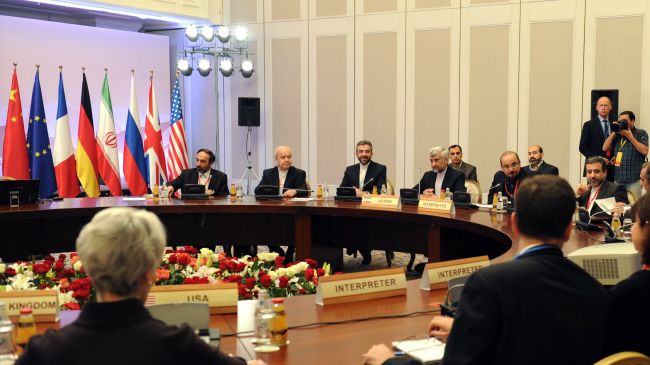
After the two days of talks between the world powers and Iran in Almaty, the sides have agreed to meet at expert level in Istanbul next month and to hold further high-level negotiations in Kazakhstan in April.
Iran said the expert-level talks would be held in Istanbul on March 18 and another round of political negotiations in Almaty on April 5-6.
Russia's negotiator, Deputy Foreign Minister Sergei Ryabkov, also said the Istanbul meeting would take place on March 17-18 and gave the same dates as Iran for the Almaty talks.
The meeting in Almaty that ended on Wednesday was the first between the world powers and Iran in eight months.
Iran and the P5+1 group -- Britain, China, France, Russia, the United States, and Germany -- have wrapped up their first round of talks in Kazakhstan's biggest city, Almaty, with each side offering its own package of proposals.
Throughout the first day of talks on Tuesday, the P5+1 reportedly demanded that Iran stop enriching uranium up to 20 percent, ship out its stockpile of enriched uranium and shut down the Fordow nuclear facility near the central city of Qom. In return, the Western governments offered to lift some sanctions.
The six world powers offered that they would ease gold, petrochemical and banking sanctions against Iran, if it scaled back nuclear activity the West fears could be used to build bombs.
The Group of six has put forward proposals to resolve Tehran's nuclear problem taking into consideration propositions from the Iranian side, the head of EU diplomacy Catherine Ashton said on Wednesday, RIA Novosti reported.
"The Group of six has put forward revised proposals to the Iranian side. It considers various issues and takes into account the propositions of the Iranians," Ashton said after talks in Kazakhstan.
She did not specify the nature of new proposals. "Let's give the Iranians time to study our proposals," the head of EU diplomacy said.
"We have worked very hard and collectively on it (proposals) to get tangible results from this process," Ashton said. However, she said speaking of the positive results would only be possible after the next meeting of the Group of six and Iran.
"What remains to be seen is how the experts will be able to work together. When we return here in few weeks, we will be able see how we can continue to move forward. And that's what I call a positive result," she said.
On the other hand, an Iranian source said the P5+1 group has not presented Iran with a new proposal and only replied to Iran's proposals presented during Moscow talks eight months agoas they concluded meetings in Kazakhstan.
"P5+1 has revived its Baghdad offer to reply to Iran's Moscow proposals," the source said.
Meanwhile, Iran's head nuclear negotiator, Secretary of the Iran's Supreme National Security Council (SNSC) Saeed Jalili said that overall the talks with the P5+1 group were positive, Press TV reported.
"We have yet to reach a desired point, but so far it is good," Jalili said.
Speaking at the press conference following the second day of the nuclear talks, Jalili said that these talks are regarded as positive, and they can lead to further steps.
Jalili added that there is a need to establish a new mechanism that would make the made proposals be put to into force.
Speaking about the prepositions that Iran put forward at the talks, Jalili said his country cited five key points, some of which he highlighted.
"The key point is that Iran's nuclear rights should be acknowledged as a legal right," he said. "We also expressed our opposition towards weapons of mass destruction, and we also spoke on transparency agreements and regional cooperation."
Jalili added that Iran's right to enrichment is the right acceptable to all NPT members, thus Iran reserves this right.
"We need it to meet our needs, to achieve our goals, be it 5 percent enrichment or 20 percent," Jalili said. "At the time when we were not able to enrich uranium ourselves, we announced to the P5+1 group that we need it for our medical needs. They did not provide us with it, so we did it ourselves."
Jalili said Iran is refining uranium by 20 percent to produce nuclear fuel for Tehran nuclear research center, but if the West countries commit to supply Iran with fuel, Iran would recognize their proposal.
The last round of negotiations was held in Moscow in June 2012. The Baghdad talks were held on May 23-24, 2012.
The U.S. and its Western allies suspect Iran of developing a nuclear weapon, a claim Iran has consistently denied. The Islamic Republic has on numerous occasions stated that it does not seek to develop nuclear weapons, using nuclear energy for medical researches instead.
Despite the rules enshrined in the Non-Proliferation Treaty (NPT) entitling every member state, including Iran, to the right of uranium enrichment, Tehran is now under four rounds of UN Security Council sanctions for turning down West's calls to give up its right of uranium enrichment.
Here we are to serve you with news right now. It does not cost much, but worth your attention.
Choose to support open, independent, quality journalism and subscribe on a monthly basis.
By subscribing to our online newspaper, you can have full digital access to all news, analysis, and much more.
You can also follow AzerNEWS on Twitter @AzerNewsAz or Facebook @AzerNewsNewspaper
Thank you!