
OIC summit recognizes Khojaly tragedy as genocide
By Sara Rajabova
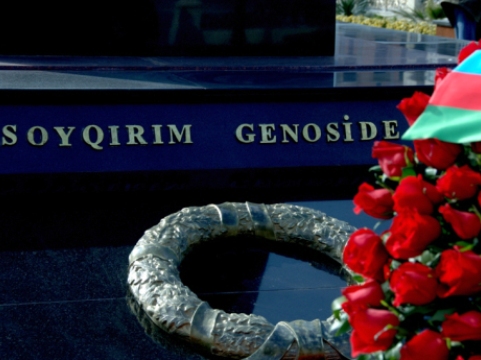
The Khojaly massacre committed by Armenian armed forces against Azerbaijani civilians during the 1990s war was recognized as an act of genocide and crime against humanity at the 12th session of the Islamic Summit Conference, the highest body of the Organization of Islamic Cooperation, held with the participation of OIC leaders in Cairo on February 2-7.
The OIC summit called on the international community to make every effort to resolve the Armenia-Azerbaijan Nagorno-Karabakh conflict, spokesman for the Azerbaijani Foreign Ministry Elman Abdullayev said on Friday.
"The Organization of Islamic Cooperation has again supported Azerbaijan's just position on the Nagorno-Karabakh conflict," he said.
Abdullayev said that due assessment of the Khojaly genocide in terms of law and policy is gaining increased scope each year within the framework of international organizations, as well as at the level of individual countries, and stressed the importance of this tendency.
"The position of an authoritative international organization is important for Azerbaijan and Baku appreciates the OIC members' support," Abdullayev said.
He added that the resolution adopted by the OIC summit urges member countries to recognize the Khojaly genocide.
Azerbaijan participated at the 12th OIC summit with a delegation led by Foreign Minister Elmar Mammadyarov.
OIC Secretary General Ekmeleddin Ihsanoglu, addressing the summit, expressed support for the position of Azerbaijan on the Nagorno-Karabakh conflict.
"We have always supported and will support the just position of Azerbaijan on the Armenian-Azerbaijani conflict over Nagorno-Karabakh, and we are concerned about the presence of this conflict," he said.
Ihsanoglu stated that Azerbaijan faced large-scale aggression and suffered tremendous injustice -- aggression and occupation of its ancestral territories. "And we are trying to fight this injustice and occupation," he said.
Ihsanoglu noted that Azerbaijan is very important and close country for the OIC and during his work in the organization as chairman, OIC jointly with Azerbaijan took strides and achieved progress in this area.
"I want to note that with the personal support of President Ilham Aliyev, we with the government of your country have done a lot, and I assure you that we will continue to actively work in this direction," the OIC secretary general said.
The OIC leaders' condemnation of the Khojaly massacre was expressed in the clause on humanitarian issues of their final communique adopted at the OIC summit. In the document, the leaders of 57 OIC countries welcomed the "Justice for Khojaly" international campaign, initiated by Leyla Aliyeva, General Coordinator for Intercultural Dialogue of the Islamic Conference Youth Forum for Dialogue and Cooperation.
The mentioned clause calls on the member states to be closely involved in the campaign's activities and make an effort to achieve recognition of this genocide on worldwide scale.
The Nagorno-Karabakh conflict emerged in 1988 when Armenia made territorial claims against Azerbaijan. Since the lengthy war that displaced over one million Azerbaijanis, Armenian armed forces have occupied over 20 percent of Azerbaijan's internationally recognized territory, including Nagorno-Karabakh and seven adjacent regions. The UN Security Council has adopted four resolutions on Armenia's withdrawal from the Azerbaijani territory, but Armenia has not followed them to this day.
The town of Khojaly was situated within the administrative borders of the Nagorno Karabakh region of Azerbaijan. Its population constituted over 7,000 people. Because of its communication advantage of having a civilian airport, just before the start of Nagorno-Karabakh conflict it had become a shelter for refugee Meskhet Turks who fled the bloody inter-ethnic clashes in Central Asia as well as Azerbaijani refugees deported from Armenia.
Late into the night of February 25, 1992, the town came under intensive fire from the town of Khankendi and Askeran already occupied by Armenian forces. At night the Armenian armed forces supported by the ex-Soviet 366th regiment completed the surrounding of the town already isolated due to ethnic cleansing of the Azerbaijani population of its neighboring regions. The joint forces occupied the town, which was ruined by heavy artillery shelling.
Under these conditions the towns' residents stepped into the darkness of the night to be met along the away by an ambush of Armenian forces. Several thousand fleeing civilians were ambushed in several locations and, faced with heaving shooting, they tried to find refuge in the nearby forests and mountainous areas. However, punitive teams of the so-called NK defense army reached the unprotected civilians to slaughter them, mutilating and scalping some bodies.
In just a few hours, 613 civilians were killed, including 106 women, 70 elderly and 83 children. A total of 1,000 civilians were disabled. 56 people were killed with outrageous brutality, eight families were totally exterminated, and 25 children lost both parents, while 130 children lost at least one parent, in what became the most brutal punishment of civilians during the three years of the conflict's military phase. Moreover, 1,275 innocent people were taken hostage, while the fate of 150 remains unknown.
Here we are to serve you with news right now. It does not cost much, but worth your attention.
Choose to support open, independent, quality journalism and subscribe on a monthly basis.
By subscribing to our online newspaper, you can have full digital access to all news, analysis, and much more.
You can also follow AzerNEWS on Twitter @AzerNewsAz or Facebook @AzerNewsNewspaper
Thank you!