
Pashinyan’s battle with Armenia’s church becomes test of state power and Russian influence
Akbar Novruz
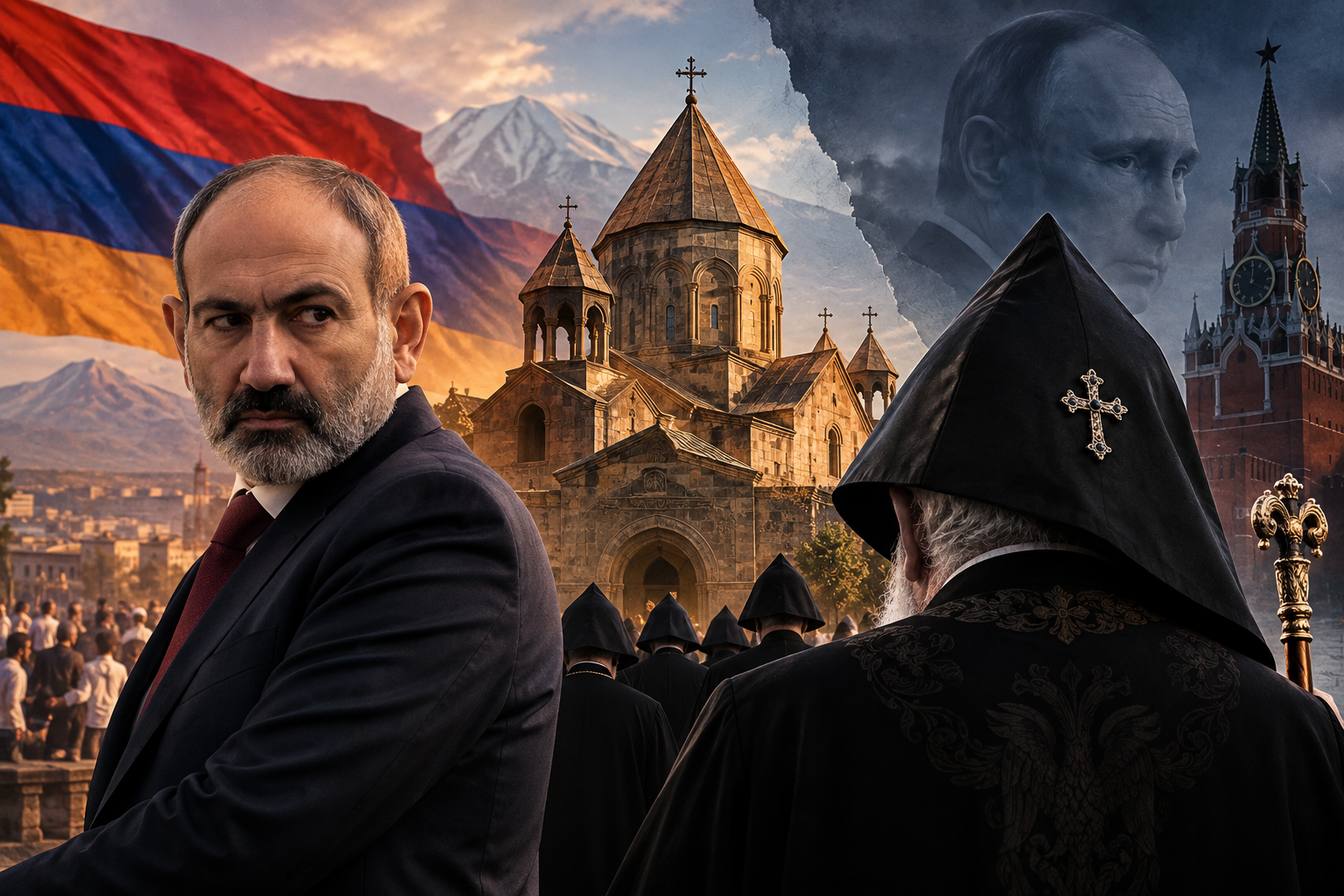
Read moreThe confrontation between Armenian Prime Minister Nikol Pashinyan and the Armenian Apostolic Church is entering a phase in which rhetoric is increasingly being translated into questions of law, institutional authority, and the future governance of one of Armenia's most influential institutions.
On September 24, a state-run center under the Prime Minister's Office published a report, commissioned by Pashinyan, alleging a crisis in the Church and proposing ways to address it. Pashinyan subsequently described the Church as having been effectively "seized" by Catholicos Garegin II and his supporters and argued that legislation should be used to broaden the participation of believers in Church governance. The Mother See rejected the report as unconstitutional and an unlawful intrusion into ecclesiastical affairs.
The dispute is particularly sensitive because the boundary between Church and state is already defined, though not without complexity, in Armenian law. The Constitution separates religious organisations from the state while simultaneously recognising the Armenian Apostolic Church's "exclusive mission" in Armenia's spiritual life, national culture and preservation of national identity. It also provides that relations between the state and the Church may be regulated by law. Armenia's law on religious organisations, meanwhile, says the state should not interfere in the internal affairs of religious organisations operating within the law.
Church leaders have increasingly clashed with Pashinyan's government, while the dispute has become entangled with Armenia's deteriorating relationship with Moscow. In August, Reuters reported that Garegin II and six senior clerics had gone on trial amid the widening Church-government confrontation, while noting accusations from Pashinyan's side that the Church functions as a Russian proxy, an allegation the Church rejects.
The report, prepared at the Prime Minister's instruction, was published on September 24.
"Consequently, laws must be adopted to resolve the situation regarding the seizure of the church," said Nikol Pashinyan.
The Prime Minister added that legislative changes are necessary to end the occupation of the church and ensure the church community's full participation in its administration.
"The decision should be made by the church community, not by Ktrich Nersisyan (the secular name of Karekin II, Catholicos of All Armenians – Ed.). Who becomes a priest should not be determined by KGB agents. We will make these decisions based on the Constitution. Relations are regulated by law," he stated.
The Prime Minister also said that there should be no priests without salaries and that every penny entering the church must be accounted for—specifically, how much money was received and how it was spent. According to him, members of the clergy should also benefit from social security and guarantees. “Catholicos Nersisyan must go, and the state will use every means to achieve this. Who is he to sit in the holiest of places? He is nobody,” Pashinyan stated.
Unusually visible inter-church solidarity has reinforced the Russian dimension. In September, a senior Moscow Patriarchate delegation met Garegin II in Etchmiadzin, conveyed Patriarch Kirill's support and publicly argued that secular interference in the Church's internal affairs was unacceptable. The Armenian and Russian churches have also continued to emphasize their close institutional relationship.
Is Pashinyan primarily seeking to reform the governance of the Armenian Apostolic Church, or does the struggle also form part of Armenia's wider attempt to loosen institutions and networks historically associated with Russian influence? How do the legislative changes proposed by Pashinyan comply with the principle of separation of church and state enshrined in the Constitution of Armenia?
Armenian analyst Levon Ghazaryan, in remarks exclusively to AzerNEWS, argues that the latter dimension should not be underestimated. In his view, the Armenian Church controversy cannot be separated from the wider post-Soviet legacy of Moscow's political and religious influence.
"The Armenian Apostolic Church is no exception. The principal guiding center for churches across much of the post-Soviet space, and even in some Eastern European countries, remains Moscow. The Russian Empire itself, being closely intertwined with the Church, attached great importance to keeping religious institutions under Moscow's influence."
Ghazaryan argues that Moscow's continuing efforts to preserve the international standing and institutional influence of the Russian Orthodox Church demonstrate the importance the Kremlin attaches to religious structures as an element of its broader influence.
According to Ghazaryan, this helps explain why developments surrounding the Armenian Apostolic Church have acquired significance beyond purely ecclesiastical affairs. He noted that Moscow has continued to attach considerable importance to the Russian Orthodox Church even as its relations with Western governments have deteriorated sharply.
“We can see how much importance Moscow attaches to preserving the position of the Russian Orthodox Church internationally. Even while senior Russian political, military and business figures have faced extensive sanctions, Russia has sought to protect the Church and Patriarch Kirill from measures that could restrict their international activities. This demonstrates that religious institutions are regarded as having importance beyond religion alone.”
Ghazaryan therefore sees one possible consequence of Pashinyan's proposed reforms as a weakening of informal channels through which Russia has historically been able to retain influence within Armenian society.
At the same time, he cautioned against reducing the entire Armenian Apostolic Church to an instrument of Russian policy. The Church is considerably older than Armenia's relationship with either the Russian Empire or the Soviet Union and occupies a distinctive position in Armenian national identity. From Ghazaryan's perspective, the more relevant question is whether particular structures and relationships within the institution have allowed outside political interests to acquire disproportionate influence.
“This does not mean that the Armenian Apostolic Church itself should simply be described as a Russian institution. It is an Armenian national institution with its own history and an enormous role in the preservation of Armenian identity. The question is different: whether certain relationships and mechanisms that developed over many years have made it possible for external actors, including Moscow, to exercise influence through institutions inside Armenia.”
For the expert, the outcome will consequently depend not merely on whether Garegin II remains Catholicos, but on whether any reform changes the institutional relationship between clergy, ordinary believers and the state.
“If Nikol Pashinyan succeeds in implementing the reforms he has announced, one possible result would be a reduction in Moscow's ability to influence Armenia's domestic political processes through established institutional relationships. But I think there is another aspect that is equally important. If reforms create greater accountability and give the church community a more meaningful role in governance, they could also contribute to healthier relations within Armenian society itself.”
The Armenian Apostolic Church retains symbolic importance well beyond regular churchgoers, meaning that an attempt to reform its governance can easily be interpreted by opponents as an attack on the institution itself. Conversely, the government argues that challenging the existing hierarchy is not equivalent to challenging the Church, precisely because it defines the Church as the wider community of believers rather than its senior clergy.
Ghazaryan believes this distinction will ultimately determine how consequential the confrontation becomes.
“The decisive question is whether society sees this process as state interference in the Church or as an attempt to return greater influence to the believers themselves. Those are two very different interpretations. If the second approach takes root, the consequences could extend beyond the Church and contribute to a broader transformation of Armenia's political and institutional culture.”
Here we are to serve you with news right now. It does not cost much, but worth your attention.
Choose to support open, independent, quality journalism and subscribe on a monthly basis.
By subscribing to our online newspaper, you can have full digital access to all news, analysis, and much more.
You can also follow AzerNEWS on Twitter @AzerNewsAz or Facebook @AzerNewsNewspaper
Thank you!