
Brussels puts €12bn behind a route it once viewed with suspicion

Akbar Novruz
Read moreUrsula von der Leyen does not usually use the annual State of the European Union speech to make such announcements about funding freight corridors. However, the fact that she chose to do it this year and pledged to mobilize up to €12 billion in funding [the biggest yet] for what the EU is now calling the Middle Corridor from the South Caucasus and Central Asia all the way to European markets is a testament more to how the strategic thinking regarding the route has changed since the invasion of Ukraine by Russia than to the EU's newfound interest in logistics.
"Our goal is to diversify routes, triple trade flows and significantly reduce cargo transit times by 2030," von der Leyen told the European Parliament, framing the money as part of the EU's broader Global Gateway strategy, the infrastructure-investment vehicle that has already mobilised more than €306bn worldwide since 2021, hitting its original €300bn target two years ahead of schedule. A regional connectivity summit, co-hosted with Bulgaria, is meant to convert the pledge into concrete projects.
It should not be forgotten how recently the Middle Corridor did not matter at all. Volumes of cargo transported on the Trans-Caspian International Transport Route, which is officially called the Middle Corridor nowadays, were only 0.6- 0.8 million tonnes annually during 2019-2021, a rounding figure in global transportation terms. By 2024, the figure grew up to 4.5 million tonnes already, almost a sixfold growth within three years, and cargo volumes of transit via Azerbaijan alone, by road, rail, air, and sea transport, amounted to 9.1m tonnes in the first seven months of 2026, marking a 11.6% growth year on year, the highest since 2021. At the same time, the World Bank and the Asian Development Bank have started to forecast another threefold growth of 2024 volumes till 2030, which coincidentally happens to be the same target set in Brussels.
Even the stance taken by the EU itself has shifted similarly.
It was only last year that European officials in Brussels were reportedly conflicted about taking an option that is heavily linked to the interests of Chinese BRI (Belt and Road Initiative) projects. Evidently, that conflict has been resolved. The rating agency Moody's recently cited the increase in shipping risks in the Strait of Hormuz as an additional indicator of the strategic importance of Caspian and South Caucasus options, thus reaffirming what the Europeans themselves had learned from Red Sea disturbances and the loss of the Russian land link. Perhaps resilience is now a rival to cost as an option criteria, and land links that circumvent Moscow and Gulf bottlenecks are insurance routes.
The concrete expression of that change in direction can be seen through the operation of Baku’s Alat terminal, located about 70km away from the capital, where in the previous year 8.2m tonnes of cargo and 107,000 TEU of containers were transported, comfortably exceeding its previous 15m tonnes capacity limit and resulting in an expansion project to a capacity of 25m tonnes and 500,000 TEU of containers that was approved by Aliyev in December 2024. The volume of container handling increased by another 20% year-to-date in the first seven months of 2026 to 72,370 TEU, and dry cargo handling increased by 82% to 1.4m tonnes. The Baku-Tbilisi-Kars railway, in turn, has been expanding its yearly capacity from 1m to 5m tonnes as a result of the reconstruction of its Georgian section and experienced a 35% surge in its traffic per week in March due to unusual demand levels. In 11 months of 2025, Azerbaijan Railways operated 350 block trains from China, increasing the level of 2024 by 34%.
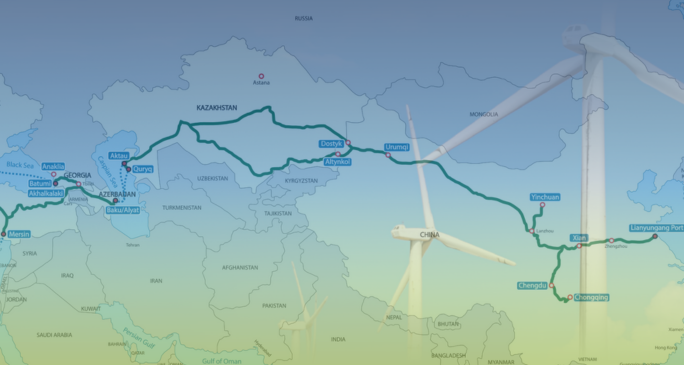
The EBRD separately estimates that roughly €18.5bn is needed just for Central Asia's share of transport infrastructure linked to the corridor, which puts the EU's €12bn in useful perspective: substantial, genuinely additive, but still a partial answer to a considerably larger bill. And yet the declared objective of the EU, namely trebling the traffic volume while reducing transit times, is not something that can be achieved through railroad development alone. This is precisely what the EU understands very well. Indeed, transit times between China and Europe via this route have decreased from 45-50 days in 2018 to 15-19 days now, due at least in part to the digitalization of customs and border processes rather than faster trains. In order to achieve a trebling of cargo volume by 2030, it is necessary to tackle more difficult issues, such as harmonizing tariffs and data exchange through a route crossing no fewer than six sovereign customs territories: Georgia, Azerbaijan, Kazakhstan and others. Bottlenecks of physical nature are thus an easy issue compared to the challenge of persuading six governments to recognize one electronic transit document.
Azerbaijan's stake in the outcome
International cargo transportation is already one of Azerbaijan's principal sources of non-oil revenue, and the country captures roughly 63% of current TITR traffic passing through its territory. Every additional euro Brussels commits to route diversification, tariff harmonisation or port capacity translates fairly directly into higher transit receipts, one more reason regional peace, which directly affects cargo volumes and investor confidence alike, sits so close to the top of Baku's own strategic priorities. The EU's €12bn is, in that light, not simply a gift to Central Asian connectivity. It is a down payment on a South Caucasus that Brussels increasingly needs to function as smoothly as any highway on its own continent.
*the image on the cover was created by artificial intelligence.
Here we are to serve you with news right now. It does not cost much, but worth your attention.
Choose to support open, independent, quality journalism and subscribe on a monthly basis.
By subscribing to our online newspaper, you can have full digital access to all news, analysis, and much more.
You can also follow AzerNEWS on Twitter @AzerNewsAz or Facebook @AzerNewsNewspaper
Thank you!