
Azerbaijan launches multi-billion-dollar push to transform agriculture [OPINION]
![Azerbaijan launches multi-billion-dollar push to transform agriculture [OPINION]](https://www.azernews.az/media/2026/05/26/8587d0a8434570b0812c9e0bc3bc1867_1_upscaled.png)
Akbar Novruz
Read moreThe World Urban Forum ended in Baku three days ago with a Call for Action on housing and sustainable urbanism. The agricultural development conference held right after that, on Monday, was in many ways a domestic version of it, a discussion by officials of the other half of the urbanization process highlighted in WUF13 for five days in an international forum. In his address to open the agricultural conference, President Ilham Aliyev made a direct connection between the two: migration from villages to cities, he said, is "a negative trend inherent not only in our country but in all nations," and reversing it requires making rural economic life genuinely competitive. Perhaps a big issue, and with the addition of wars, disrupted supply chains, and the closure of the Strait of Hormuz, has concentrated minds on food security in a way that years of policy papers could not.
Before enumerating, sector by sector, ton by ton, where we are independent and where we are not and how much we lose due to this dependency, the President added, explaining the background to his announcement of the most comprehensive analysis of food security in Azerbaijan that anyone has seen in years, and which forms the basis of a national programme for agricultural development to be adopted and funded within the present calendar year. The timing is not incidental. Azerbaijan's WUF13 discussions on urbanisation just concluded in Baku, and one of the forum's recurring themes was rural-urban migration as a structural drag on food production globally. Aliyev cited it directly: "The second important factor, which was also reflected in the discussions of the World Urban Forum recently held in Baku, is large-scale urbanisation, namely, migration from villages to cities. This is a negative trend inherent not only in our country but in all nations."
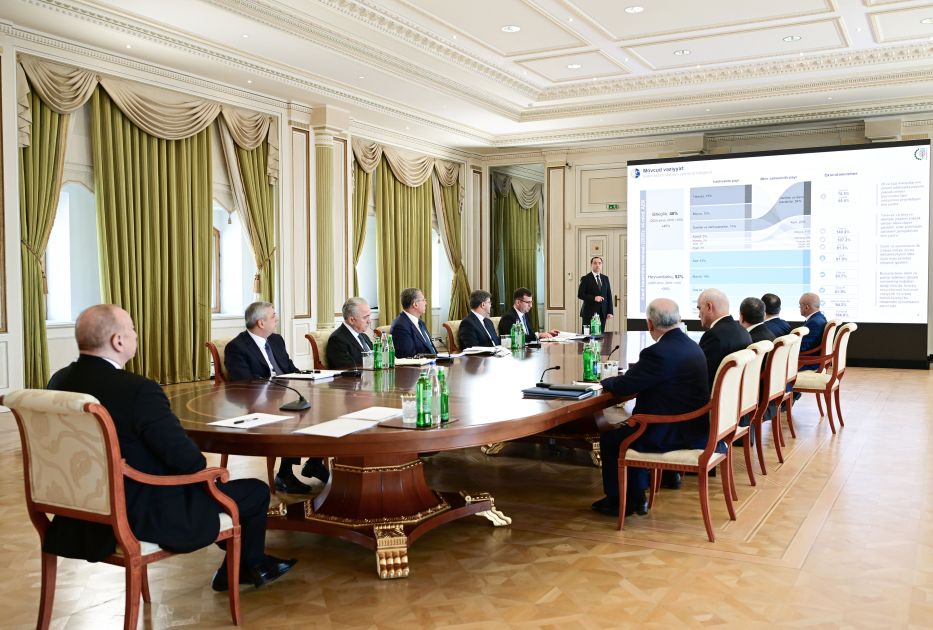
This initiative has been partly created to address that challenge, with the aim of making village life economically viable enough to prevent the continued drain that occurs when workers leave their communities and reduce the potential for farming productivity.
Let us look at the 'scorecard' to identify the gaps and what is satisfactory:
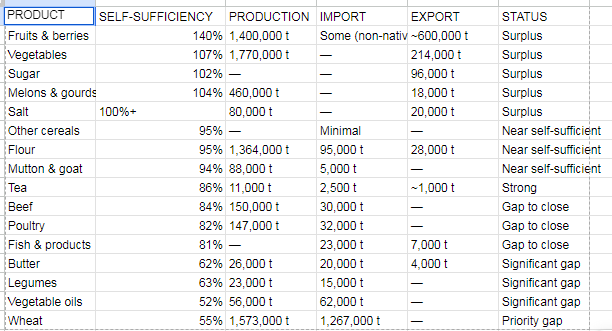
*source: State Statistics, and State Customs Committees
The wheat number is by far the most significant in terms of strategy, and cannot meet the supply demand of the country. Local production levels at 1,573,000 tons while imports are 1,267,000 tons. Ilham Aliyev expressed that "We must reduce these imports. In any case, 55 percent is an unacceptable figure, and it must be increased."
With $85 billion in sovereign reserves and a plan to be an energy and food-secure middle power, Azerbaijan is wasting a considerable amount of resources on purchasing 1.2 million tons of wheat annually from its neighboring states, such as Russia and Kazakhstan. The Iran War had already showed the dangers of having to import food from another region when a crisis occurs unexpectedly.
However, there is no blanket criticism of the scorecard, either. There are a number of industries in Azerbaijan that are real development successes, dating even before this week's conference took place. Perhaps the most obvious one is cotton production. The productivity has gone up to about 3.6 tonnes per hectare, the record output for any period since the Soviet days, with an overall production of 360,000 tonnes compared to the starting base of 20,000 tonnes at the beginning of the programme. Hazelnuts' output stands at 84,000 tonnes, with 30,000 tonnes having already been exported; Azerbaijan ranks third or fourth worldwide in hazelnut production, by sheer volume. "Practically extinct" sericulture has been successfully revived, as well. Fruit and berry production, with a self-sufficiency level of 140% and an export volume of 600,000 tonnes, is another example of what can be done through targeted intensive investment in agriculture.
The infrastructure foundations supporting these accomplishments are also very real. Storage facilities with the ability to store 400,000 tons of produce have been developed, and as Azerbaijan President Aliyev noted, "without them it is impossible to preserve produce." Modern systems of irrigation are now available in 130,000 hectares of land. The Carbamide Plant has made it possible to have nitrogen-based fertilizers available to both domestic consumers and exports. An entirely new base for agricultural equipment has been established over two decades through purchases, and now the government has begun to manufacture such equipment itself. This is the base on which productivity improvements can occur, but without which productivity improvements could not happen.
How does the five-year programme look if implemented to its full potential?
The State Programme on Agricultural Development for the years 2026 to 2030 outlines a financial framework that necessitates state financing of over 2 billion AZN [1,17 bln. USD], which is to be allocated within this calendar year as per presidential instruction. Additionally, the programme calls for private sector investment exceeding 3 billion AZN, aiming to engage both Azerbaijani entrepreneurs and foreign investors. With nearly half of 2026 already elapsed, the effective implementation window for this initiative is 4.5 years.
Productivity – Grains
3.2 → 5 tons per hectare
Current yield stands at 3.2 t/ha; previously, it was around 2 t/ha. 5 tons target can be met only by implementing precise agriculture, AI and satellite-assisted digital land mapping, and better variety. “Every piece of land should have its passport.” – Aliyev
Productivity – Cotton
3.6 → 5 tons per hectare
If it could be done on 100,000 ha of area used for growing cotton, then production would amount to 500,000 tons. Plans are to develop it in Kazakhstan and produce yarn, etc., instead of exporting raw material. Factories needed.
Irrigation
130,000 → 300,000 hectares
Doubling the modern irrigation coverage. Restoration of the Shirvan Canal (lining with concrete and completion by 2027) and construction of the Karabakh Canal to irrigate 200,000-300,000 hectares. Completion of construction of Sarsang and Sugovushan dams, and construction is ongoing of Bargushad and Hakari dams.
Cold Storage
400,000 → 500,000 tonnes
Requirement of another 100,000-tonne capacity cold storage facilities. Currently, 400,000 tonnes storage capacity were built using concess
Horticulture
+20,000 hectares of new orchards
Aliyev cited Zangilan as proof of concept: "exports are already being carried out from the fruit orchard established near the village of Aghali." The liberated territories are positioned as a new intensive horticulture frontier. Target is 20,000 additional hectares across the country.
Greenhouses
1,500 → 2,000 hectares
Additional 500 hectares of greenhouse space are required, primarily through private sector efforts. This expansion enables year-round vegetable production and reduces seasonal import dependency. It is particularly relevant for managing food inflation that affects low-income households most acutely.
********
Now, regarding the urbanisation problem, which indeed received the most reflective attention. "We must ensure that a reverse migration process, from cities back to villages, begins," Aliyev said. "To achieve this, disparities between rural and urban areas across all sectors must be reduced." This idea of reverse migration has been put down as a goal to be reached in many agricultural policies of various nations, but has rarely been realised. The instrument that Azerbaijan is planning to use in pursuit of that goal is quite traditional in terms of improving the rural areas' infrastructure and increasing their income by way of raising agricultural production, etc. But what differs somewhat is the approach, which combines this usual strategy with new freed territories, 11,600 square kilometres of fertile lands ready to be colonised with the help of the Great Return programme and built anew without the burden of the Soviet legacy.
The private sector message embedded in the data presentation deserves explicit acknowledgment. "The figures I will present here are a message to both local and foreign investors," Aliyev said at the outset, and the scorecard he then presented is precisely that: a gap analysis that doubles as an investment prospectus. This, whether foreign investors take it as such or not, is a function of the rule-of-law situation within the country, which the IMF Article IV mission has always stressed as the bottleneck for the sector.
Here we are to serve you with news right now. It does not cost much, but worth your attention.
Choose to support open, independent, quality journalism and subscribe on a monthly basis.
By subscribing to our online newspaper, you can have full digital access to all news, analysis, and much more.
You can also follow AzerNEWS on Twitter @AzerNewsAz or Facebook @AzerNewsNewspaper
Thank you!