
Brotherhood meets business as OTS sets its sights on global influence
Akbar Novruz
Read moreThere’s a phrase that keeps turning up in the official verbiage of the Organization of Turkic States - "fraternal peoples," "brotherly nations," "our common roots" - and until recently, the content of the rhetoric was just that. Culture, heritage, a shared linguistic family from the Bosphorus to the steppes of Central Asia. What was assembled in Baku on Thursday was somewhat more down-to-earth.
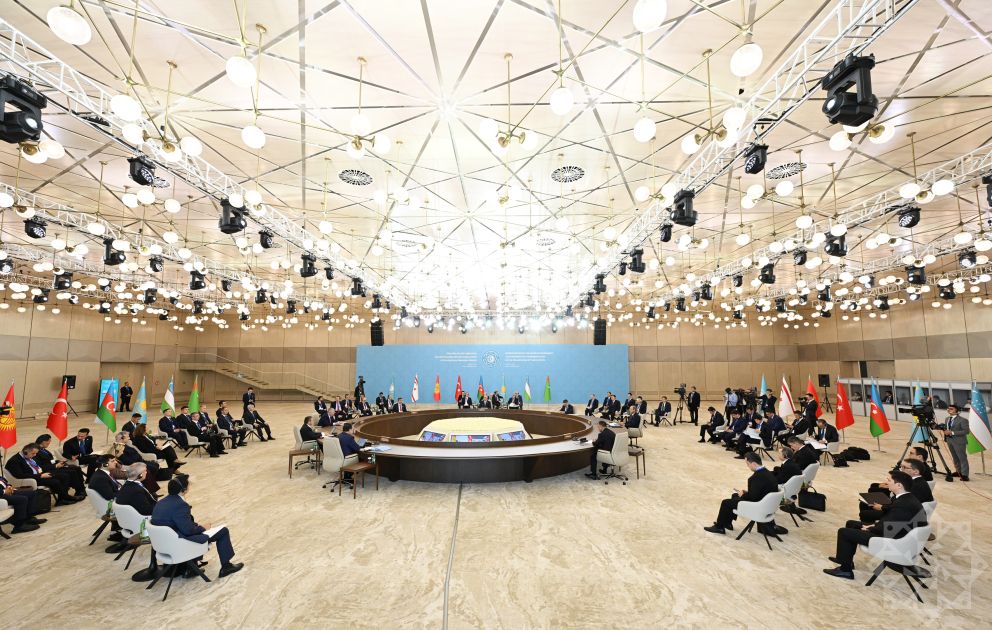
The second meeting of OTS heads of government and vice presidents took place at the historic Gulustan Palace and included the prime ministers of Azerbaijan, Kazakhstan, Kyrgyzstan, and Uzbekistan, as well as Türkiye's vice president, the prime minister of Northern Cyprus, Turkmenistan's deputy cabinet chairman, and OTS Secretary General Kubanychbek Omuraliev. The agenda included investment, transport corridors, digital infrastructure, energy, and artificial intelligence. The joint statement was adopted. And the host country specified the value of its role in these countries in numbers.
Azerbaijan's Prime Minister Ali Asadov addressed the meeting, saying, "Our total investments in OTS member states now exceed 21 billion U.S. dollars. Joint investment funds were created with Uzbekistan, Kazakhstan, and Kyrgyzstan. Several projects are currently underway, and more are in preparation. The expansion of trade and investment relations between our countries is of particular importance. The trade turnover between Azerbaijan and OTS member states increased by more than 5% last year. Although this is an impressive result, it is still below what we consider to be considerable untapped potential."
President Ilham Aliyev, who received the participants separately, was more expansive. "We have invested more than $20 billion in the economies of the member states," he said, framing the figure not merely as a commercial statistic but as evidence of Azerbaijan's commitment to the organisation's depth and durability.
If there was one theme which brought the day's discussions together, it was the Middle Corridorthe Trans-Caspian International Transport Route which stretches from China via the Central Asian republics across the Caspian Sea to Azerbaijan and Georgia, and then on to Turkey and European markets. OTS Secretary General Omuraliev specifically urged the need to urgently develop the Middle Corridor infrastructure, logistics centers, and new vessels on the Caspian Sea, calling for the bloc's Turkic Investment Fund to be used to finance the region's priority projects.
Turkish Vice President Cevdet Yilmaz described the corridor as "a strategic route that strengthens supply chains, diversifies trade, and reinforces connections between Turkic states," and highlighted the Baku-Tbilisi-Kars railway as a key pillar of its significance. Aliyev framed Azerbaijan's contribution in concrete terms: "Our railways, the Baku Trade Port, highways, and airports — all transport infrastructure has been brought to full readiness." Cargo traffic through the Middle Corridor has grown by approximately 90% since 2022, a figure that reflects both the route's rising strategic importance and the disruption to competing routes through Russia following the Ukraine war.
"The Middle Corridor passing through our countries serves the interests of all of us. Especially in the current geopolitical environment, projects such as the Middle Corridor, the Trans-Caspian Corridor, and the Zangezur Corridor are becoming increasingly important,"- Ilham Aliyev
The OTS was created, in its original form as the Turkic Council, as a vehicle for linguistic and cultural solidarity among the Turkic-speaking states. What has developed, however, especially since Azerbaijan took its turn as chair at the Gabala Summit in October 2025, is an organisation with considerably more ambition. It has proposed an "OTS+" format in its Gabala Declaration to formalise relations with non-member partner states. It has agreed in principle to hold its first-ever joint military exercises, in Azerbaijan, this year. In its joint statement issued in Baku on Thursday, it added artificial intelligence, space technologies, green energy, critical minerals, and nuclear energy to an agenda that was, not so long ago, largely restricted to heritage and culture.
The assembled representatives account for a population of around 170 million, vast hydrocarbon and mineral resources, and a vast geographic area stretching from the Eastern Mediterranean to China's western frontier. No closer to being answered is the question that analysts have long posed about the OTS: whether cultural affinity translates into political and economic coordination. But Thursday's meeting, and the numbers it cited suggests that the organisation is at least posing the question with greater seriousness than before. In an environment characterized by growing uncertainty, from shifting alliances to tensions in the Gulf, the Organization of Turkic States must stand as a counterweight to growing instability and a means through which to exert pressure. Through its growing economic links, transport routes, and political ideology, the OTS is hopefully seeking to function as a tool through which to respond to growing instability and assert pressure beyond borders.
Here we are to serve you with news right now. It does not cost much, but worth your attention.
Choose to support open, independent, quality journalism and subscribe on a monthly basis.
By subscribing to our online newspaper, you can have full digital access to all news, analysis, and much more.
You can also follow AzerNEWS on Twitter @AzerNewsAz or Facebook @AzerNewsNewspaper
Thank you!