
Azerbaijani ashigs assemble on epic night
By Sabina Idayatova
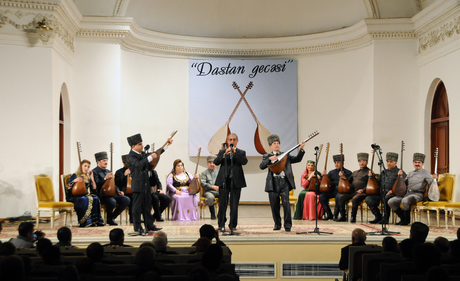
An epic night organized by the Azerbaijan Ashigs Union (AAU) was held at the Azerbaijan State Philharmonic Hall named after Muslim Magomayev in Baku on Wednesday, Azertag state news agency reported.
The chairman of the Union, national poet Zalimkhan Yagub spoke about the development path of ashig art at the event.
Yagub stressed that not accidentally, the event was named an epic night, since one of the greatest abilities of the ashigs is to skilfully convey Azerbaijani epics to the listeners. He said that by organizing this event it was intended "to carry the lovers of ashig music back to the past, to the mysterious world of our epics".
Yagub also noted that AAU will broaden further activities in this area to hold special nights for each of the Azerbaijani epics.
The performances of famous Azerbaijani ashigs Gulara Azafli, Sardar Mammadov, Jahangir Guliyev and others were of great interest for the audience. Fragments from the great epics like "Shah Ismail and Arabzangi", "Ashig Ali and Basti khanum", "Valeh and Zarnigar", "Salim Shah" and other legends were sounded.
The art of Azerbaijani ashigs dates back many centuries, being a symbol of cultural heritage and an emblem of national identity and the guardian of Azerbaijani language, literature and music.
Combining poetry, storytelling, dance and vocal and instrumental
music into a traditional art of performances, the ashigs touch the
subtle emotions of every person.
Characterized by the accompaniment of saz, originally named
"kopuz", a stringed musical instrument, the classical repertoire
includes 200 songs, 150 literary-musical compositions known as
dastans, nearly 2,000 poems in different traditional
poetic forms and numerous stories. The regional variations may
include other musical instruments, but all are united by a common
national language and history of art.
The earliest traces of Azerbaijani ashig art can be found in the 7th century Book of Dede Korkut, which contains the most popular epic stories of the Oghuz Turks. The main genres of Azerbaijani Ashig poetry include goshma, dastan, ustadnameh, as well as their poetic forms - gerayli, divani, tajnis.
Contemporary professional Azerbaijani ashigs were divided into two categories: Ashig poets and Ashig performers. Ashig poets, along with storytelling activities, engaged in poetry which is called Ustad, translated from Persian as "master". Famous Ashig poets include such gifted poets as Gurbani, ashig Abbas from Tufargan, Hasta Gasym, ashig Valeh, Ashig, Ashig Alasgar, and many others. They had a tremendous impact not only on ashig poetry, but also greatly influenced the written literature of Azerbaijan.
Ashig performers, on the contrary, despite being professional storytellers, are not engaged in poetry. Due to their individual abilities and a keen understanding of the specifics of the folklore, they make different kinds of variations and changes in their epics and legends, especially in their prose.
The popular ashigs of present-day Azerbaijan include Zalimkhan Yagub, ashig Zulfiyya, ashig Ahliman, ashig Adalat, ashig Kamandar, Ali Tovuzly and ashig Khanlar.
Ashigs take part in weddings, parties and festive events
throughout the Caucasus and appear on concert stages, radio and
television, sometimes synthesizing classical tunes with
contemporary ones as they continue to recreate their repertoire.
Ashigs represent the consciousness of the people, and also help to
promote cultural exchange and dialogue: Kurds, Lezhins, Talishes,
Tats and other ethnic groups living in the country often perform
Ashig art, and their poems and songs have spread across the
region.
As of 2009, the total number of Azerbaijani ashigs in the world is
3,000 and ashig art is included in UNESCO's Representative List of
the Intangible Cultural Heritage of Humanity.
Here we are to serve you with news right now. It does not cost much, but worth your attention.
Choose to support open, independent, quality journalism and subscribe on a monthly basis.
By subscribing to our online newspaper, you can have full digital access to all news, analysis, and much more.
You can also follow AzerNEWS on Twitter @AzerNewsAz or Facebook @AzerNewsNewspaper
Thank you!