
Azerbaijan’s $4 bln Georgia footprint expands its regional economic reach

Qabil Ashirov
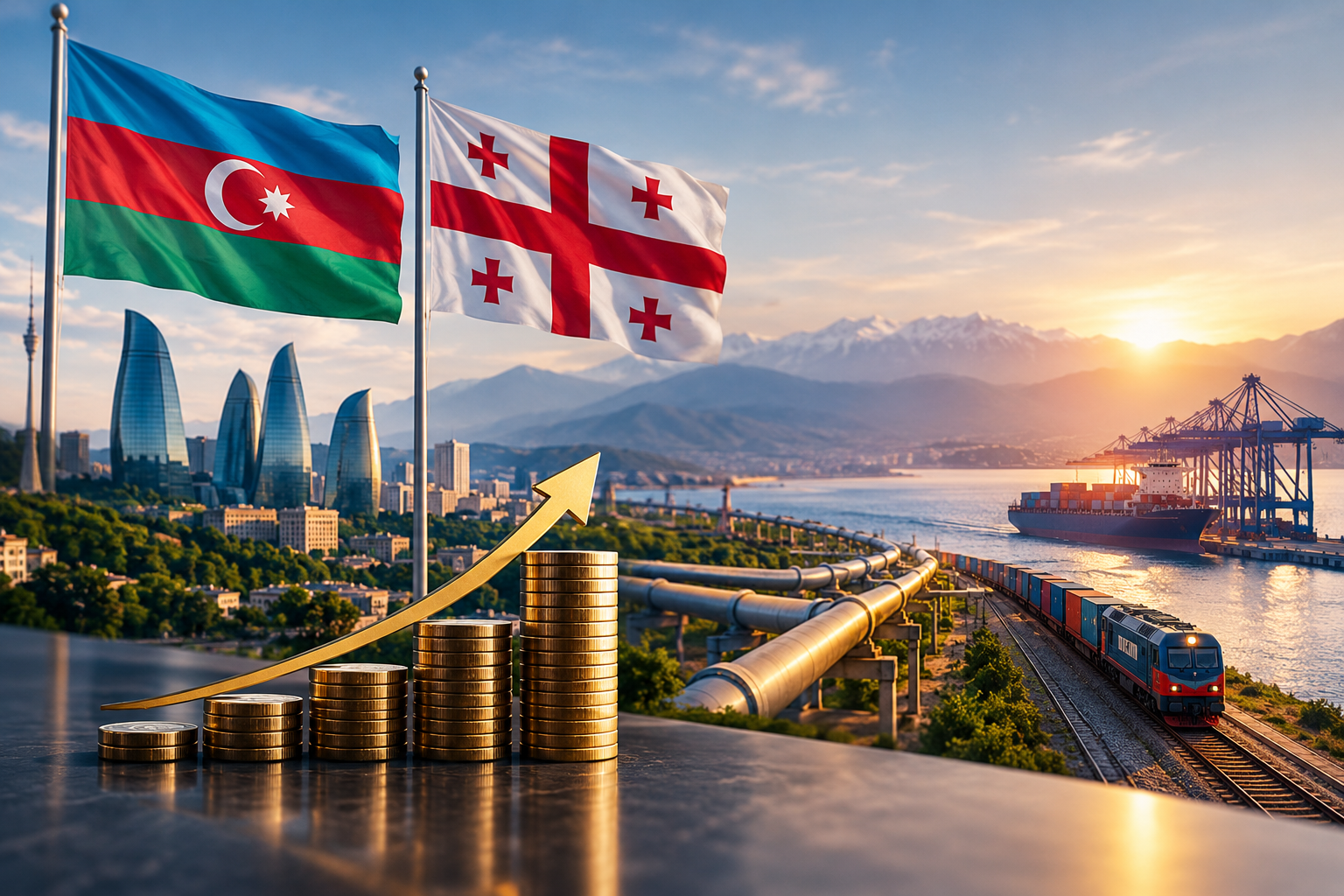
Read moreAzerbaijan’s investment footprint in Georgia has become a clear expression of Baku’s regional economic strategy. The nearly $4 billion figure cited by Prime Minister Ali Asadov captures a relationship extending beyond individual company balance sheets. It reflects the conversion of geographical proximity into commercial access, infrastructure influence and strategic leverage.
More than 5,500 companies operating in Georgia have Azerbaijani investment, according to Ambassador Faig Guliyev. This network connects investors with consumers, suppliers, property markets, financial services and transport businesses. Its value lies in the reach of these relationships as much as in the headline investment total.
Annual data confirm Azerbaijan’s position among Georgia’s leading partners. Revised figures from Georgia’s National Statistics Office put total foreign direct investment at $1.90 billion in 2025. The United Kingdom ranked first with $426.6 million, or 22.4 percent; Azerbaijan placed second with $214.4 million, or 11.3 percent. Türkiye followed with $202.4 million, or 10.6 percent. Azerbaijan’s investment was roughly half the British figure and slightly higher than Türkiye’s, placing it among Georgia’s three principal sources of foreign capital.
The comparison reveals a competitive investment market. Malta contributed $148.3 million, Israel $145.1 million, the Netherlands $136.8 million, the United States $131.3 million and Russia $109.5 million. Azerbaijan’s second-place ranking gives its presence particular regional significance.
The distinction between annual flows and accumulated investment is essential. The $214.4 million recorded in 2025 measures investment during one year; the $3.6 billion figure represents the broader volume cited by the ambassador. Geostat’s preliminary data recorded $45.3 million in Azerbaijani direct investment during the first half of 2026. These indicators cover different timeframes and statistical concepts, yet together demonstrate the depth and continuation of Azerbaijani business engagement.
Trade adds another layer. Ambassador Guliyev put annual bilateral turnover at approximately $1.4 billion and identified $2 billion as the next target. Separately, Azerbaijan’s State Customs Committee recorded $887.9 million in trade with Georgia during January–September 2026, up 42.3 percent year on year. The customs figure covers nine months and reflects Azerbaijan’s reporting methodology, while the $1.4 billion statement refers to annual turnover. They are complementary indicators.
The strategic logic becomes clearer when investment is viewed alongside infrastructure. The Baku–Tbilisi–Ceyhan pipeline and South Caucasus gas pipeline place Georgia at the centre of Azerbaijan’s westbound energy architecture. The Baku–Tbilisi–Kars railway and Middle Corridor extend connectivity to freight transport, linking the Caspian and Central Asia to Türkiye, the Black Sea, and European markets. Georgia is therefore both an investment destination and an essential economic corridor for Azerbaijan.
This geography creates mutual leverage. Azerbaijan supplies energy, capital and access to Caspian trade routes; Georgia provides transit infrastructure and connections towards Black Sea ports and Türkiye. The value of each side’s assets rises with the reliability and capacity of the wider network. Pipelines, railways and logistics terminals generate greater returns when customs systems, port operations and investment rules work in coordination.
Changing investor rankings reinforce the need for a long-term approach. China led Georgia’s second-quarter 2026 FDI with $219.5 million, accounting for 46.8 percent of the quarter’s $468.8 million total. The United Kingdom followed with $123.5 million, while the United Arab Emirates invested $47.7 million. Quarterly shifts show how large transactions can reshape rankings quickly. Azerbaijan’s advantages are its established business network, geographical proximity and decades of energy and transport cooperation.
The next phase should focus on capital productivity. Renewable electricity, transmission links, logistics, warehousing, tourism, agriculture, manufacturing and digital services offer opportunities to diversify the relationship. The $2 billion trade target provides a measurable ambition, while the 5,500-company network offers a platform for supplier partnerships and cross-border production.
That makes investment quality, sectoral diversification and measurable economic returns central tests of the partnership's next stage.
Ultimately, the strategic measure of Azerbaijan’s investment in Georgia will be the value generated by its assets, returns earned by its companies and the resilience of corridors connecting the Caspian to global markets. Nearly $4 billion in reported investment, a second-place FDI ranking in 2025, and more than 5,500 Azerbaijani-invested companies give Baku a substantial foundation. Turning it into higher productivity and deeper regional integration is the real test of economic influence.
Here we are to serve you with news right now. It does not cost much, but worth your attention.
Choose to support open, independent, quality journalism and subscribe on a monthly basis.
By subscribing to our online newspaper, you can have full digital access to all news, analysis, and much more.
You can also follow AzerNEWS on Twitter @AzerNewsAz or Facebook @AzerNewsNewspaper
Thank you!