
Baku wants to turn its agricultural abundance into industrial value

Akbar Novruz
Read moreEvery summer, refrigerated trucks and rail containers leave Azerbaijan's orchards and greenhouses for the north. Between January and September this year, they carried 563,300 tonnes of fresh fruit and vegetables worth $671.4m, 11.4% more than in the same period of 2025, according to the State Customs Committee. Last year, total exports were 846,000 tons valued at $901.5 million. Given the efforts of Baku for decades in developing an oil-free sector, it is considered to be a success story. But its geography needs closer inspection.
Russia took 83.1% of the value of Azerbaijani fruit and vegetable exports in the first eight months of 2026, some $529.5m of the $637.1m shipped, according to the agriculture ministry. The rest of the top five is quite tiny by comparison: Italy (4.3%, largely hazelnuts), Germany (2.7%), Belarus (2.2%) and Georgia (1.6%). For tomatoes, the concentration is starker still. In some recent years, nearly all of Azerbaijan's tomato exports have gone to Russia, and shipments there this year reached 134,500 tonnes worth $160.8m.
All of this is not irrational at all, and in fact, there is no issue with exporting goods to Russia, since the Russians have been dealing with Azerbaijani produce for years and the logistics are well-known, not to mention that the harvest schedule coincides with the needs of Russia. Fruits and vegetables constituted a fourth of Azerbaijan's key exports outside of oil in 2025, which earned Russia about $696m worth, up 30 percent from last year.
However, dependence comes with a price tag. In the past summer season, an organization representing Azerbaijan’s exporters claimed that Rosselkhoznadzor, Russia’s plant safety authority, was placing “artificial barriers” for tomato pest inspections. While the exports were not banned and proceeded despite additional costs and delays, there are some lessons to be learned from the case. Armenian producers may recall how fast agriculture legislation turned into political instruments in May-June 2019 due to temporary import bans on their products. Azerbaijani-Russian bilateral trade has decreased by about 25% over the year, despite good results in farm exports. 83% of export volumes should not depend on the discretion of a single buyer. One of the few things that Azerbaijan needs is diversification, recognizing that Russia is always present on our border. However, establishing and adding contacts with different countries will benefit Azerbaijan not only in the agricultural sector but also in many other aspects.
Raw-material trap
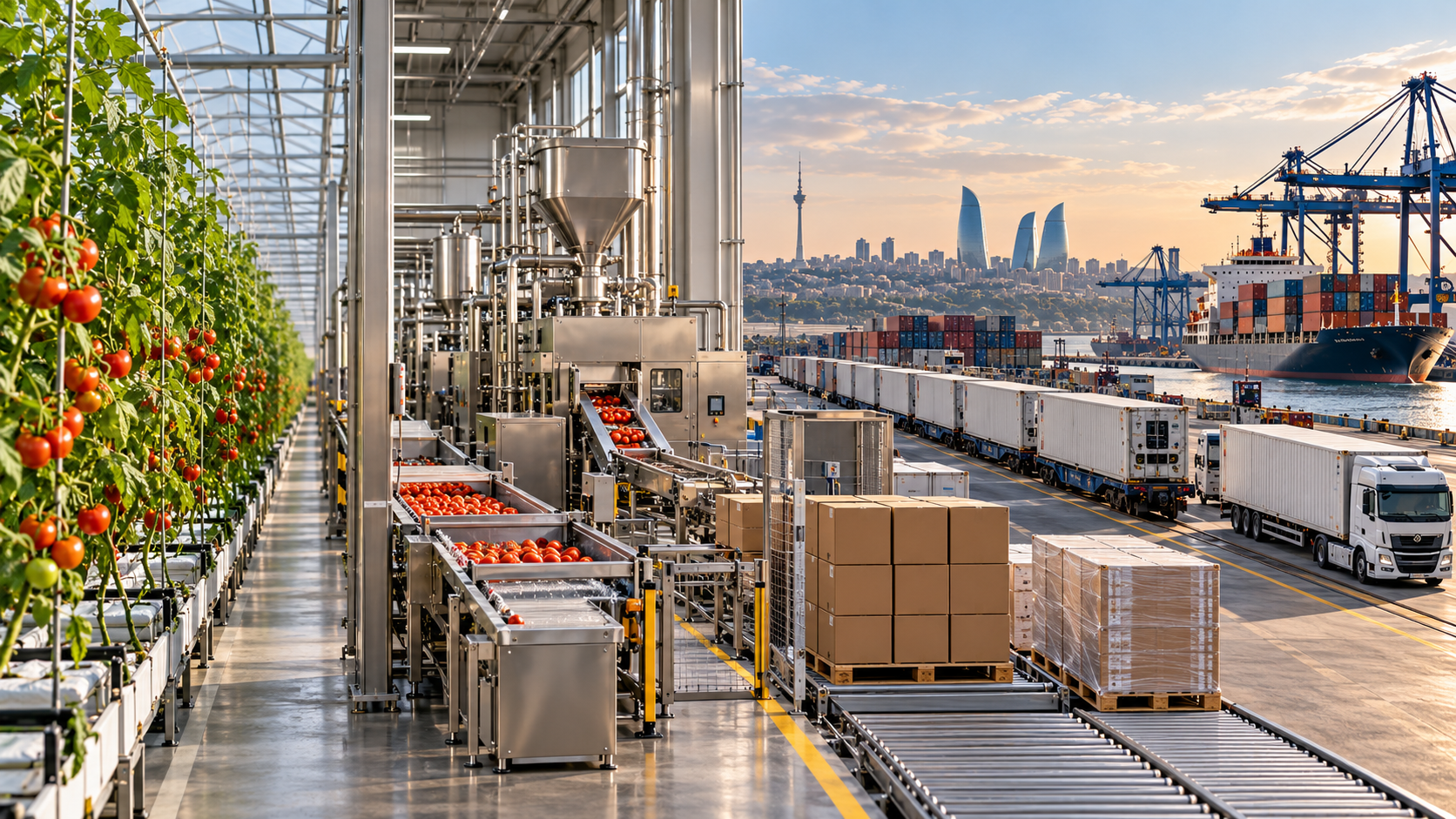
The solution, according to the government, set out in a state programme enacted in May, is an investment of some 6 billion manat ($3.5 billion) in the sectors of agriculture, fishery and processing from 2026 to 2030. This state programme follows the adoption of reforms initiated in mid-2019 and will seek to increase output, improve quality standards and encourage exports. Around three-quarters of Azerbaijani agricultural exports consist of fresh products and unprocessed materials, while the other quarter is made up of processed and packed products. It makes a difference. Selling a ton of tomatoes in July will be done at the price determined by an abundance of supply and freshness limits, while selling a ton of tomato paste or fruit juice could be made at any time in the year.
The exporters believe that is the direction the industry should be moving towards. Fresh fruit that has been shipped long distances to go up against growers from the south that have a massive volume of the same produce on offer is not a profitable business model. Produce that has a long lifespan, such as dried fruits, preserves, juice and jams, has access to markets where fresh fruit does not, assuming that they pass all sanitary and sensory tests at customs. The agriculture union in the Turkic world has estimated current Azerbaijani agricultural exports at about $1.2bn and believes that they could easily exceed $10bn.
The geography is beginning to change. The produce from Azerbaijan is getting to the Middle East, North Africa and China due to the efforts of AZPROMO, the agency for exports promotion that provides exhibition, business missions, market research and certification through the “Made in Azerbaijan” label. In addition, a decree issued recently allows a portion of the expenses incurred in transporting non-petroleum exports such as agricultural products to be subsidized by the government.
Diversification, on the other hand, is not just about getting another buyer. Diversification entails having products capable of making the trip, labeling according to the standards set by the importers, and having brands that buyers know. There are also shortcomings in this particular chain: Azerbaijan needs more domestic manufacturers of glass jars, plastic and metal lids, and the chemical elements needed for food, which it currently imports.
The example shows that there exists an equal mix of possibility and failure in the matter. For instance, the worldwide halal food market is valued at over $2tn annually and has been developing rapidly. Azerbaijan is a predominantly Muslim country with Gulf and Turkish business partners and a pending chairmanship in the Organisation of Islamic Cooperation; thus, it should have been the natural supplier of halal products. According to a local observer, the country’s exports of halal products are barely noticeable; certification, quality, and packaging are the issues here.
What to watch
"Success" should be more about getting the export basket right than about the next tomato tonnage increase. If the share of processing exceeds a quarter; if the share of the largest market falls to under 80%; if new markets receive anything other than small consignments, then the reforms will have achieved some structural change. If not, then Azerbaijan will continue to be a seasonal exporter to a large neighbour with strong growth rates and risky market concentration. The 2019 reforms have delivered the farms. The 2026-30 programme must deliver the processing, the brands and the buyers.
Here we are to serve you with news right now. It does not cost much, but worth your attention.
Choose to support open, independent, quality journalism and subscribe on a monthly basis.
By subscribing to our online newspaper, you can have full digital access to all news, analysis, and much more.
You can also follow AzerNEWS on Twitter @AzerNewsAz or Facebook @AzerNewsNewspaper
Thank you!