
Azerbaijan ranks among world’s lowest-debt economies with $89 bln in reserves

Qabil Ashirov
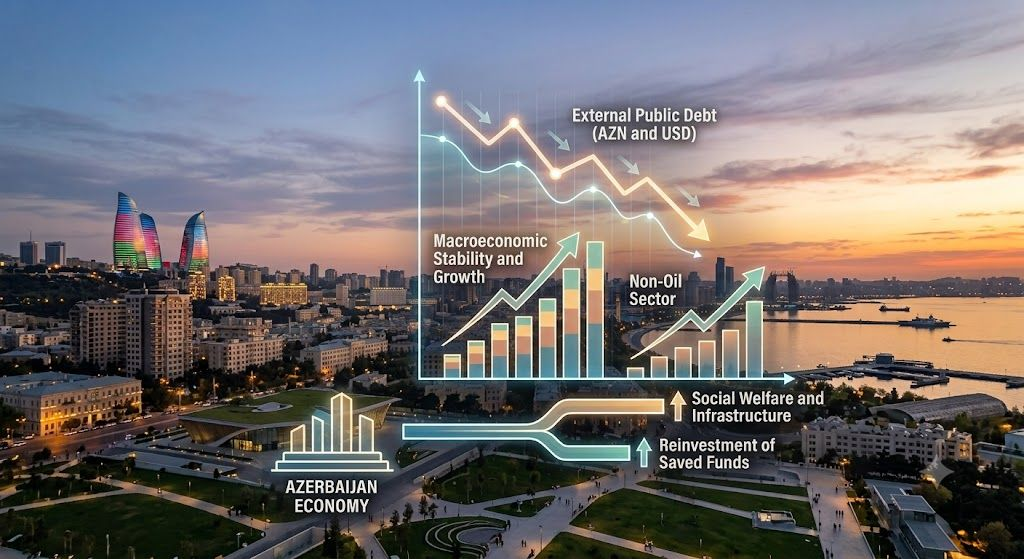
Read moreAzerbaijan’s external debt position offers a compelling example of how fiscal discipline and accumulated financial reserves can strengthen a country’s economic independence. Thus, currently, Azerbaijan ranks among the world’s top three countries with the lowest external debt relative to gross domestic product (GDP), while holding the leading position in Europe. With the ratio slightly above 5%, Azerbaijan occupies a distinctive position in the international financial landscape. This achievement deserves recognition as a strategic economic advantage, particularly at a time when governments worldwide face rising financing costs and mounting fiscal pressures.
The country’s financial indicators reinforce this position. As of September 30, 2026, Azerbaijan’s external public debt stood at $4.509 billion, while strategic foreign exchange reserves reached $89.381 billion. Reserves were therefore approximately 19.8 times the size of external public debt. The debt figure had declined by 7.8% year-on-year, while strategic reserves had increased by 9.7%. These figures demonstrate the scale of Azerbaijan’s financial buffer and the importance of preserving it through prudent economic management.
The significance of this position extends beyond international rankings. Countries with substantial external obligations must allocate resources to interest payments and debt servicing, leaving less room for infrastructure development, social programmes and economic transformation. Azerbaijan’s relatively low external public debt provides greater flexibility in managing international shocks, responding to changing energy prices and financing strategic priorities. Financial independence creates policy choices, and those choices become especially valuable when global markets experience volatility.
Azerbaijan’s strategic reserves provide an additional layer of protection. The $89.381 billion reserve position offers substantial capacity to support external stability and meet international financial commitments. Combined with comparatively low external public debt, these resources strengthen the country’s ability to withstand periods of weaker export earnings or tighter global credit conditions. The challenge is to maintain this advantage while ensuring that public spending generates measurable economic value.
The next priority should be converting financial strength into broader productive capacity. Azerbaijan’s economy continues to benefit from oil and gas revenues, but long-term prosperity increasingly depends on expanding non-energy industries, developing competitive services and increasing private-sector productivity. In January–September 2026, GDP reached 102.05 billion manats, increasing by 1.5% year-on-year. The non-oil and gas economy grew by 2.6%, while non-oil and gas industry expanded by 5.4%. Transport and storage services increased by 10%, and information and communication services advanced by 11.1%.
These figures point towards sectors capable of supporting a more diversified growth model. Investment in logistics, digital infrastructure, manufacturing, agricultural processing and workforce development could help Azerbaijan generate additional export earnings and create higher-value employment. Low debt provides financial flexibility, while successful diversification can make the economy more resilient over time.
The country’s debt advantage also creates an opportunity to pursue carefully selected development financing. Borrowing can remain useful when it supports projects with credible economic returns, strengthens productive infrastructure or expands export capacity. The objective should be to preserve fiscal space while directing available resources towards investments that increase national income and competitiveness. Every major project should be assessed according to its long-term contribution to productivity, employment and economic diversification.
International comparisons, however, require consistent definitions. External public debt differs from total external debt, which can include obligations owed by banks and private companies. Rankings also depend on the countries included and the methodology applied. Azerbaijan’s reported position among the world’s top three and first in Europe should therefore be attributed to the World Economics data cited by Bayramov, rather than treated as a universal ranking covering every possible debt measure.
Ultimately, Azerbaijan’s low external debt ratio is more than a favourable statistic. It represents financial room for manoeuvre, stronger protection against external shocks and an opportunity to pursue long-term economic priorities from a position of relative strength. The combination of a debt ratio slightly above 5%, $89.381 billion in strategic reserves and $4.509 billion in external public debt provides a substantial foundation for economic security. The defining task ahead is to translate this advantage into diversified production, stronger productivity and rising prosperity for future generations. Azerbaijan has built a considerable financial cushion; the lasting measure of success will be the economic value created from it.
Here we are to serve you with news right now. It does not cost much, but worth your attention.
Choose to support open, independent, quality journalism and subscribe on a monthly basis.
By subscribing to our online newspaper, you can have full digital access to all news, analysis, and much more.
You can also follow AzerNEWS on Twitter @AzerNewsAz or Facebook @AzerNewsNewspaper
Thank you!