
Azerbaijani gas offers Albania a way out of its hydropower trap

Akbar Novruz
Read moreFor a country that is, by most measures, the most hydropower-dependent in Europe, Albania has had remarkably little say over the enormous pipeline running beneath its own soil. The Trans-Adriatic Pipeline, the final 878 km segment of the Southern Gas Corridor through which Azerbaijan’s gas travels from the Caspian to southern Italy, has flowed through Albanian soil since 2020 virtually untouched, merely acting as a pipe in which gas flows from Greece to underneath the Adriatic Sea without much of it stopping at any point along the way. This, however, is slowly beginning to change.
As was confirmed by TAP AG this month, by the fourth quarter of 2027 there will be a new facility built, known as “Fier South,” near the already present ACS03 compressor station, serving as a brand new exit point of the pipeline onto Albanian soil, with ownership transferring to the Albanian government upon completion.
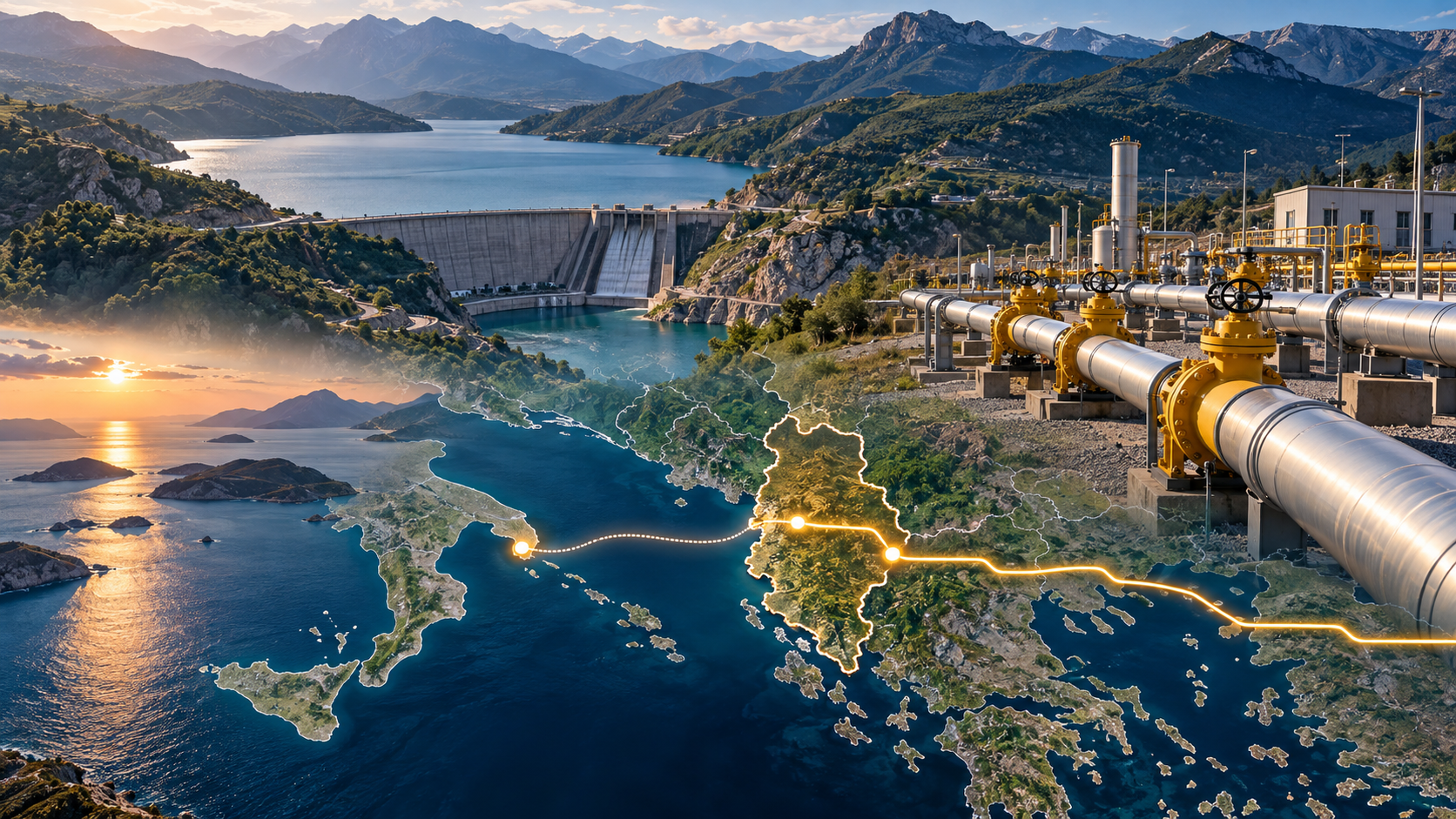
Indeed, this is a relatively mundane project: a metering station, not an energy station or grid. However, the project is of great importance in no way related to its technical complexity, but to what it enables. Almost 100 percent of Albania's electricity is produced using hydropower, as is indicated by Albania's national energy regulatory agency. Such dependence on hydropower is so severe that both officials and NGO's consider the energy system "extremely vulnerable." Every dry year leads to both a financial and energy crisis in Albania; below-average rainfall has made Albania import expensive electricity. Access to gas has not been available to Albania, unlike every other European country. However, it is not because Albania was far from the gas source, but because there were no facilities to turn transit gas into usable gas.
TAP AG, Albania's Ministry of Infrastructure and Energy, and state transmission operator Albgaz signed a cooperation agreement as far back as July 2021 establishing the principle that infrastructure built around an entry-exit point near Fier would eventually transfer to Albanian state ownership, exactly the mechanism now being executed. The pace has been deliberately incremental rather than dramatic, consistent with TAP's broader approach to Albanian integration: build capacity in discrete, bankable stages, hand off completed assets, repeat.
This trend also exists in other parts of the TAP system. Starting from January 1, 2026, 1.04bn cubic meters per year of extra long-term capacity would become available in the Kipoi-Italy segment of the pipeline, which lies on the Greek-Turkish border – Phase I of an extension that followed TAP's market test in 2021. Furthermore, starting October 1, 0.16bn cubic meters per year of capacity would become available solely for the transport of gas entering the pipeline through the DESFA network in Greece and exiting the pipeline through a new exit point in Roskovec, in Albania – a point, incidentally, also picked as the location of the first-ever Albanian gas-fired power plant of 170 megawatts of generating capacity built by the Greek developers GEK Terna and DEPA Commercial, as decided by Albania's Council of Ministers in December 2024.
Among the few things that need to be taken into consideration is the fact that this is not a one-way export route, but a two-way pipe. The more substantial structural change happened on the same October 1st date when TAP made the connection point in Greece known as Nea Mesimvria bidirectional – only the second physical connection point of the pipeline, which was able to transport gas bi-directionally between TAP and the Greek national grid. "This will allow for gas flows in both directions between TAP and the Greek natural gas transmission system and will also contribute towards market integration as well as increased flexibility in case of changing market conditions," the company says. In other words, this makes TAP a two-way corridor that is flexible and allows for transporting natural gas in two directions at once – either in case of European demand going to Italy or in case of local shortage or price difference going back to Greece and the Balkans. Considering that TAP has already provided 61.4 billion cubic meters of natural gas to European consumers, this is an essential development.
Behind this, there is also a maintenance mechanism which subtly demonstrates the extent to which TAP has been incorporated within the national institutions of Albania. Maintenance work on the pipeline in Albania has been awarded to AGS CO, which is a joint venture between 75% Albgaz, the Albanian state gas company, and 25% Snam, Italy’s main gas infrastructure company – a deal that was signed for the first time in December 2018. It is a system that ensures that the actual physical network remains in Albanian and Italian ownership despite the gas being sourced from Azerbaijan’s Shah Deniz field miles away.
Now, of course, none of this transforms Albania into a major gas consumer overnight. A metering station and 0.16bn cubic metres of Roskovec capacity allocated to TAP are relatively insignificant numbers compared to the overall capacity of the pipeline, as well as Albania's plans to gasify the whole country, which include an old plan to introduce gas in the city of Korça and then expand this system to Pogradec, Elbasan and other places. However, for a nation that still entirely relies on a single energy source susceptible to weather conditions, such an opportunity is extremely important.
*the cover image has been generated by artificial intelligence
Here we are to serve you with news right now. It does not cost much, but worth your attention.
Choose to support open, independent, quality journalism and subscribe on a monthly basis.
By subscribing to our online newspaper, you can have full digital access to all news, analysis, and much more.
You can also follow AzerNEWS on Twitter @AzerNewsAz or Facebook @AzerNewsNewspaper
Thank you!