
Azerbaijan is becoming Europe’s gateway to Asia beyond energy

Akbar Novruz
Read moreIn Baku this week, a European Union diplomat offered an unusually revealing glimpse of Brussels’ next ambition in the South Caucasus. Speaking at a conference on cyber diplomacy, Gediminas Varanavičius, the EU delegation’s chargé d’affaires, said negotiations on the bloc’s partnership priorities with Azerbaijan for 2026–30 were in their final stage. Energy security and transport remained prominent, but so did artificial intelligence, cybersecurity, and sustainable infrastructure.
As much as the language seems bureaucratic, the economic consequences are far from it. Europe, which has relied on Caspian natural gas as it cut down on its reliance on Russia, is now considering whether the very same arrangement can guarantee the safety of the connections between Europe and Central Asia in terms of transport, energy and information infrastructure. Azerbaijan, for its part, is hoping to become more than just a resource provider and a switching station.
Well, the talks are not yet a concluded agreement. In fact, the Commission’s proposal in September was to change the name to “Strategic Priorities for the EU-Azerbaijan Partnership”. No matter how impressive the new title may sound, it will not pay for the railroads or reconcile the two governments. What it can do, however, is demonstrate the efforts to make their economic interdependence sustainable.
Where it all started and where it should be [or is] heading...
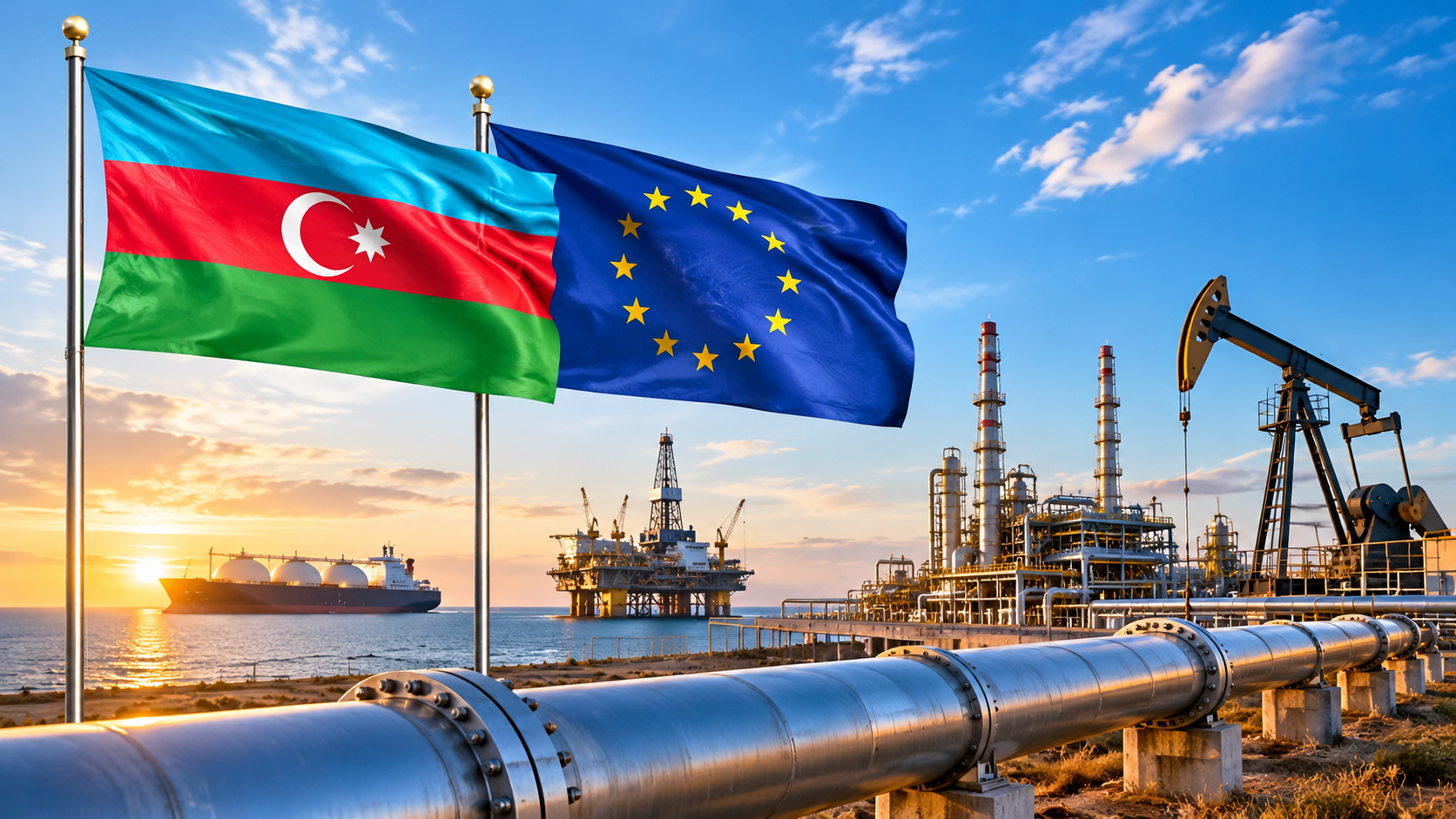
The presence of hydrocarbons explains the reason why Brussels continued to maintain a strong relationship with Baku despite an eventful ten years. Azerbaijan and its state oil company delivered 12.5 billion cubic metres of natural gas to members of the EU in 2025, which is 53.8 per cent higher than what they did in 2021.4 However, this gas contributes only about 4 per cent of EU needs, although other pipelines are now considered strategically significant after Russia invaded Ukraine.
EU accounts for 38.7 per cent of the total trade of Azerbaijan while taking 70.2 per cent of its exports, according to the Commission. Europe’s imports from Azerbaijan is confined to fuels, whereas exports to it are made up of machinery and transport equipment. This is clearly a strong relationship, but not a diversified one. The question is whether a trade pattern built on extracting hydrocarbons can evolve into one built on processing goods, moving data and providing higher-value services. For Azerbaijan, that would support its long-running effort to build a non-oil economy. For the EU, it would create another commercial anchor in a region where logistics increasingly carry a security premium. Because, at the end of the day, there are limits on how much Baku can provide gas to Europe.
With that said, money is beginning to follow the map, although not all the figures mean what headlines suggest. During European Commission president Ursula von der Leyen’s July visit to Baku, the EU announced up to €200mn in connectivity grant funding designed to mobilise as much as €2bn in public and private investment across the South Caucasus. The larger sum is a potential investment outcome, not an already financed construction programme. Another €20mn was earmarked for community-level peace initiatives in Armenia and Azerbaijan.
One proposed beneficiary is railway connectivity towards Nakhchivan, Azerbaijan’s exclave. The EU and the European Bank for Reconstruction and Development have launched a feasibility study, but no construction contract has been awarded. Brussels also wants to strengthen the Middle Corridor, the network of ports, ferries, railways and roads connecting China and Central Asia to Europe via the Caspian, Azerbaijan and Georgia.
A September study from the World Bank predicted that improved infrastructure and operational capacity could more than triple trade volumes through the corridor and cut travel time in half by 2040. Additionally, it highlighted that $25bn was required to build infrastructure, and another $30bn for connections, machinery and IT support throughout the entire route, not just Azerbaijan. Having a railway is good; having a functioning railway system is even better.
There is also a peace dividend here. As Azerbaijan and Armenia make progress towards normalisation, their rail linkages become more plausible. The draft priorities also include collaboration on water management, a necessity for agriculture and climate adaptation. Still, investments follow standard customs procedures and stable income sources, not only statements.
That is why the draft list of priorities puts digital connectivity in parallel with conventional transportation. In October, Azerbaijan and Kazakhstan opened a 380km fibre-optic cable in the Caspian Sea, which will allow the transmission of no less than 400 terabits per second. The significance of such a breakthrough does not lie in merely increased Internet speeds but in data-carrying capacities that make part of the infrastructure needed for cloud computing, logistics, and AI.
However, digital corridors imply their own threats to security. Information from customs authorities, train schedules, electricity dispatching, and data centers cannot afford fragmented standards and ineffective cybersecurity measures. Cooperation in these spheres that Varanavičius pointed out may have both diplomatic and commercial value. The World Bank recommended countries that use corridor to move from isolated paperwork to common digital platform.
Electricity could be another possible layer. The countries of Azerbaijan, Georgia, Romania, and Hungary have already conducted a feasibility study to create an energy corridor between the Caspian Sea and the Black Sea, which will generate 4 gigawatts of electricity. The project is supposed to operate on a phased basis starting in 2032, with a final investment decision expected in 2029. Funding from Europe and power-purchase agreements are still required.
Political limits and the delivery
Commercial logic has not erased political mistrust. There has always been an atmosphere of friction between the EU and Azerbaijan, certainly in recent times. The European Parliament continues to navigate a landscape of political mistrust despite the influence of commercial interests. In October, the Parliament passed a resolution with a significant majority of 492 votes to 23, expressing concerns regarding various domestic issues in Azerbaijan. In response, Azerbaijan’s parliament dismissed the resolution, deeming it biased. Moreover, negotiations on a broader EU–Azerbaijan agreement began in 2017, while its trade chapter has been stalled since 2022. A new priorities document cannot be mistaken for a comprehensive free-trade accord. Both sides appear to be testing a practical proposition: cooperate on infrastructure where interests overlap, without pretending that every institutional disagreement has been resolved. Such compartmentalisation is plausible. It is not guaranteed, however.
The truly telling barometer for the year 2030 will be whether investors fund their projects, producers use the lines, electricity flows through the new interconnectors, and data gets transferred safely across markets.
For Brussels, Azerbaijan represents an ever more important point where European consumers are connected to Asian producers. For Baku, European investments represent the opportunity to convert geography and hydrocarbons into business strengths that will endure. Neither is assured. The next phase of the relationship will be measured less in terms of its name and more in terms of the corridors' functionality.
Here we are to serve you with news right now. It does not cost much, but worth your attention.
Choose to support open, independent, quality journalism and subscribe on a monthly basis.
By subscribing to our online newspaper, you can have full digital access to all news, analysis, and much more.
You can also follow AzerNEWS on Twitter @AzerNewsAz or Facebook @AzerNewsNewspaper
Thank you!