
Azerbaijan, Vietnam build economic bridge linking Asian factories to European markets

Qabil Ashirov
Read moreAzerbaijan is seeking to transform its economic relationship with Vietnam into a broader strategic partnership built around energy, investment, industrial cooperation and international transport corridors. With bilateral trade reaching $153.41 million in 2025, transit shipments increasing almost sixfold during the first nine months of 2026, and Vietnamese companies exploring investment opportunities in Azerbaijan, the two countries are gradually establishing a more substantial economic relationship.
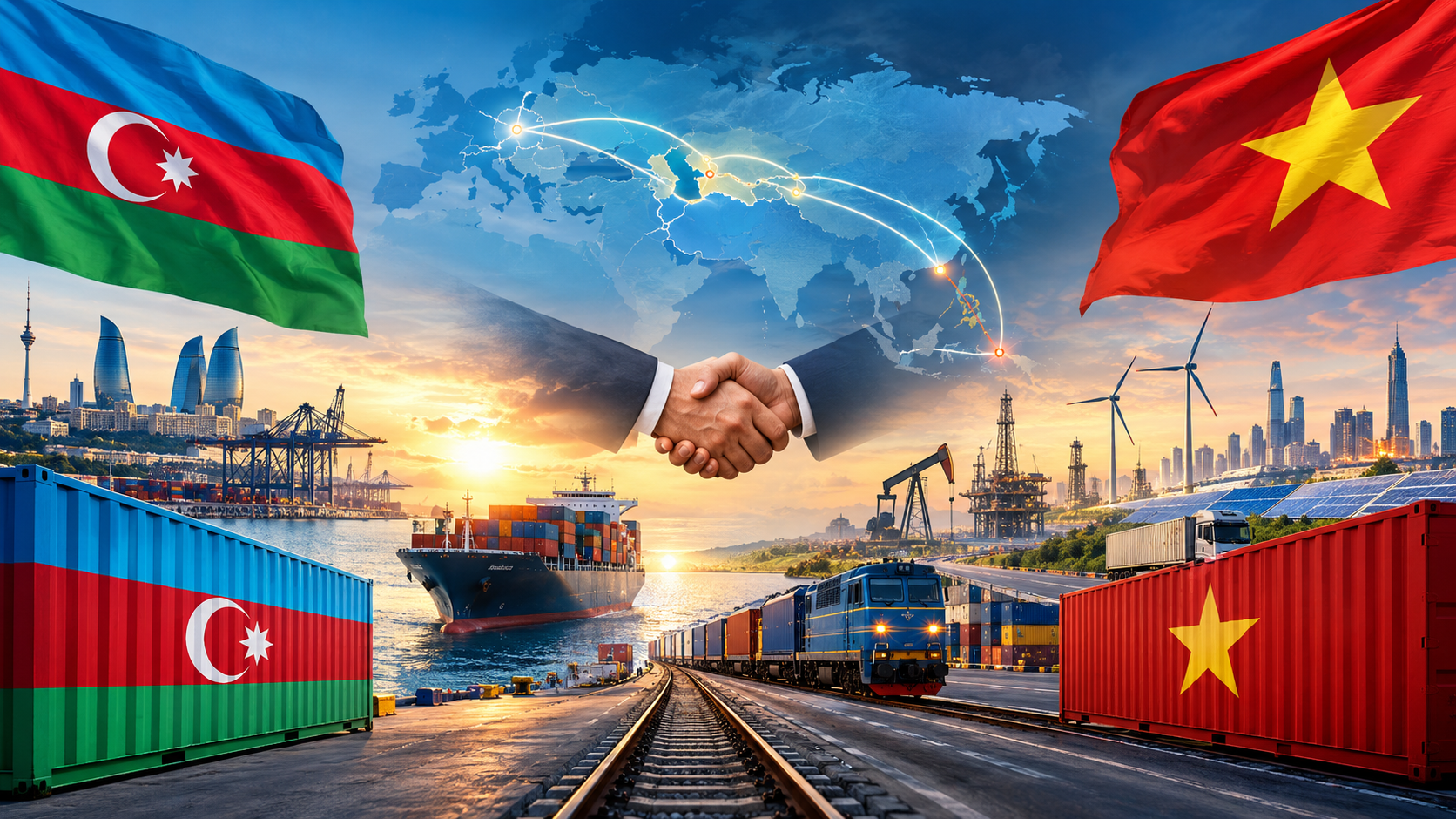
The emerging partnership reflects a wider shift in global trade geography, in which connectivity between Asian manufacturing centres and European consumer markets has become increasingly important. For Azerbaijan, Vietnam represents an opportunity to strengthen its economic presence in Southeast Asia, attract new investment and increase the commercial value of its transport infrastructure.
As Azerbaijani President Ilham Aliyev said: "Trade and economic relations between Azerbaijan and Vietnam are developing steadily. In 2025, bilateral trade exceeded US$150 million. However, this figure does not yet reflect the full potential of our economic ties, and both countries have considerable opportunities to expand bilateral trade."
The figures support the argument that considerable room for expansion exists. Vietnam's economy reached approximately $514 billion in 2025, while its merchandise exports amounted to $475.04 billion, representing annual growth of 17%. Total merchandise trade reached $930.05 billion, an increase of 18.2%, while the country recorded a trade surplus of $20.03 billion. Its exports of manufactured products alone reached $421.47 billion, accounting for 88.7% of total merchandise exports. These figures demonstrate the scale of the industrial and commercial ecosystem with which Azerbaijan is seeking closer engagement.
The trade relationship offers an opportunity to connect Vietnam's industrial capabilities with Azerbaijan's geographic position and access to regional markets. Vietnam's principal exports include electronics, electrical equipment, machinery, footwear, textiles and agricultural products. Azerbaijan, meanwhile, can offer energy resources, petrochemical products, agricultural goods and access to markets across the Caucasus, Central Asia, Türkiye and Europe. Expanding commercial contacts between companies, establishing distribution networks and facilitating business-to-business partnerships could help turn the existing trade relationship into a more diversified economic partnership.
Energy remains the historical foundation of bilateral cooperation. The relationship between Azerbaijan's State Oil Company (SOCAR) and Vietnam's national oil and gas group, PetroVietnam, offers opportunities across crude oil supplies, exploration, production, technical services and professional training. The cooperation framework signed in 2025 provides an institutional basis for developing these activities, while agreements involving Vietnam's Binh Son Refining and Petrochemical company envisage long-term Azerbaijani crude oil supplies to the Dung Quat refinery.
The commercial relationship already has a substantial energy component. More than 1.1 million tonnes of Azerbaijani crude oil have been supplied to Vietnam since 2023, according to Azerbaijan's Ministry of Energy. Discussions have also covered refining, petrochemicals, oilfield services and potential liquefied natural gas supplies. These areas offer opportunities for cooperation throughout the energy value chain, connecting Azerbaijan's production and export capabilities with Vietnam's refining and industrial requirements.
As Azerbaijani President Ilham Aliyev said: "The oil sector, which has been a cornerstone of our partnership since the Soviet era, remains a key area of cooperation."
The next stage of this relationship could involve deeper industrial collaboration, technical exchanges and joint participation in upstream and downstream projects. For SOCAR, cooperation with PetroVietnam offers another channel for international commercial engagement, while Vietnam gains access to a partner with decades of experience in offshore production, oilfield development and energy infrastructure.
Renewable energy represents another promising dimension. Vietnam's ROX Group has emerged as a potential investor in Azerbaijan's construction, infrastructure and green energy sectors. During the Second Azerbaijan International Investment Forum in Baku on September 25, 2026, the company and Azerbaijani government institutions signed cooperation documents covering construction and development as well as renewable energy.
The energy memorandum envisages examining a 600-megawatt onshore wind project in Azerbaijan and a 200-megawatt solar project in the Nakhchivan Autonomous Republic. Together, these projects represent a potential generation capacity of 800 MW, with electricity exports forming part of the proposed development framework. Feasibility studies, grid capacity assessments and technical integration arrangements constitute the next important stages.
For Azerbaijan, this cooperation fits into a broader strategy of attracting international capital into renewable electricity generation and developing export-oriented energy infrastructure. For Vietnamese investors, it offers an opportunity to participate in a market with considerable wind and solar resources and growing electricity connectivity ambitions.
Transport and logistics, however, could become the most strategically transformative element of the partnership. During January-September 2026, Vietnam-related transit shipments through Azerbaijan reached 8,300 tonnes, almost six times the volume recorded during the corresponding period of 2025. This expansion highlights growing commercial interest in connecting Southeast Asian cargo flows with European destinations through the Caspian region.
Azerbaijan's wider transport performance reinforces this opportunity. Total transit freight through the country exceeded 12 million tonnes during the first nine months of 2026, representing annual growth of 14.5%. Container throughput at Azerbaijani ports increased by 29% to 100,000 TEU, while dry cargo handling rose by 71% to 1.73 million tonnes. The country's 2026 transit freight target exceeds 16 million tonnes, with approximately 5.5 million tonnes expected along the Middle Corridor.
The Middle Corridor, connecting Asian markets with Europe through Central Asia, the Caspian Sea, Azerbaijan, Georgia and Türkiye, offers Vietnam an additional multimodal logistics option. The North-South Transport Corridor provides another potential route for connections with markets in Russia, Iran and South Asia. Azerbaijan's investments in railway infrastructure, port facilities and customs digitalisation strengthen the commercial foundations of these connections.
As Azerbaijani President Ilham Aliyev said: "Azerbaijan's transport and logistics infrastructure can be effectively utilized to facilitate the transportation of goods from Vietnam to Europe and vice versa via the Middle Corridor and the North-South Transport Corridor."
For Vietnamese exporters, these routes could support the movement of electronics, machinery, consumer goods and manufactured products towards European markets. Azerbaijani logistics operators, meanwhile, could benefit from additional freight volumes, warehousing demand, port services and railway transportation revenues.
The economic rationale extends beyond transportation. Vietnam's manufacturing sector, which generated 88.7% of the country's merchandise exports in 2025, could create opportunities for Azerbaijani logistics companies, industrial distributors and businesses seeking stronger connections with Asian suppliers. At the same time, Azerbaijan could use its transport infrastructure to encourage Vietnamese manufacturers to consider the country as a regional distribution and investment location.
Agriculture, food processing, industrial production and professional education also deserve greater attention. The presence of seven Vietnamese-invested companies in Azerbaijan provides an existing business foundation for further expansion. The proposed development of an Azerbaijan-Vietnam Business Council and progress towards an investment protection agreement could strengthen the institutional environment for private-sector cooperation.
Azerbaijani President Ilham Aliyev touched on the issue and said: "Our countries possess the necessary resources and potential to substantially increase bilateral trade and successfully implement major joint projects in energy, industry, agriculture, transport, and logistics – in short, across virtually all key sectors."
Ultimately, the Azerbaijan-Vietnam partnership brings together two complementary economic profiles: Vietnam's manufacturing strength and export-oriented economy with Azerbaijan's energy resources, geographic position and international transport infrastructure. The $153.41 million trade turnover recorded in 2025, the 1.1 million tonnes of Azerbaijani crude supplied since 2023, the potential 800 MW renewable energy portfolio and the 8,300 tonnes of Vietnam-related transit shipments recorded during the first nine months of 2026 provide measurable foundations for further cooperation.
The next phase will depend on converting memorandums into operational projects, attracting private capital and establishing reliable commercial connections. If these priorities advance together, Azerbaijan and Vietnam could develop a partnership that extends well beyond conventional bilateral trade, creating a practical economic bridge between Southeast Asia, the Caspian region and European markets.
Here we are to serve you with news right now. It does not cost much, but worth your attention.
Choose to support open, independent, quality journalism and subscribe on a monthly basis.
By subscribing to our online newspaper, you can have full digital access to all news, analysis, and much more.
You can also follow AzerNEWS on Twitter @AzerNewsAz or Facebook @AzerNewsNewspaper
Thank you!