
Shenzhen Declaration echoes Azerbaijan's longstanding calls for UN reform

Ulviyya Poladova
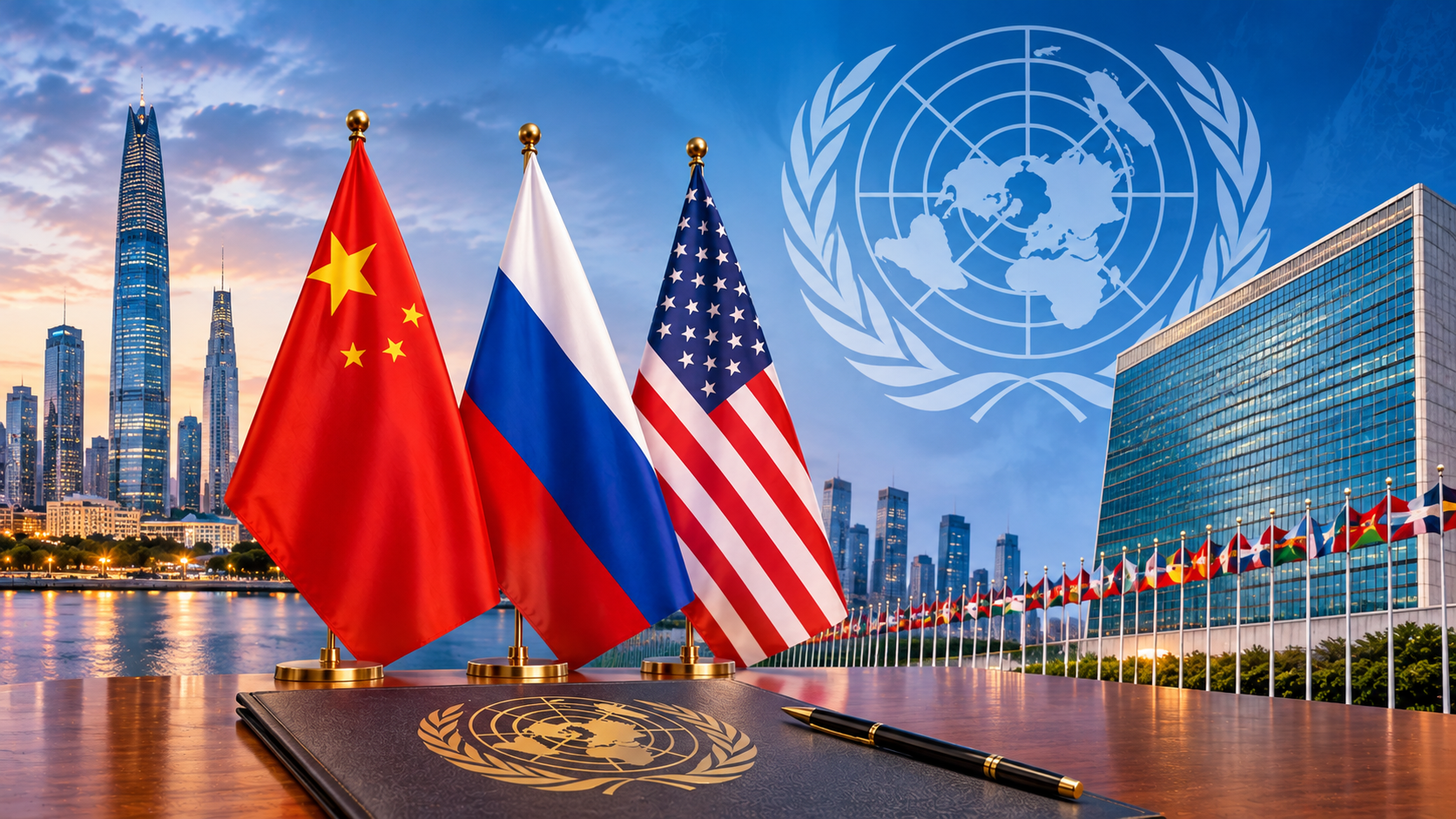
Read moreFor ninety minutes on 19 November, the three leaders who command the world's three largest economies and most of its nuclear warheads sat in one room in Shenzhen. It was the first time a Chinese, Russian and American president had ever met together, resulting in a four-point Peace Declaration. It outlines four key areas of cooperation among the three powers: reforming the United Nations, energy cooperation, international law and state sovereignty, and nuclear security.
The first commits China, Russia and the United States, "as permanent members of the United Nations Security Council", to reform the UN so that it can "respond more effectively to global challenges" and conform to its founding mission of peace and security. The second commits them to raising the production and supply of refined petroleum products "for the benefit of all nations" and to keeping global energy flows stable. The remaining two points deal with the jurisdiction of the International Criminal Court and with nuclear risk.
If you read the first two points carefully, you will see that they set out, in the language of a communiqué issued by major powers, two arguments that Azerbaijan has been putting forward for many years at every available international platform.
Start with the mechanism everyone now agrees is broken. Four Security Council resolutions adopted in 1993 demanded the immediate, complete and unconditional withdrawal of Armenian forces from Azerbaijani territory. They sat on paper for thirty years. And what happened in the end? No sanctions followed. Azerbaijan restored its own sovereignty in 2020 and 2023, and the resolutions were finally satisfied by the party they were written against being defeated rather than by the body that passed them.
President Ilham Aliyev has told it so often, in so many places, that it has become the backbone of his case for institutional reform. In September 2025, he put it before the UN General Assembly in New York, in the room where the resolutions were adopted. In September 2026, he repeated it in Bishkek at the SCO Plus summit, with Secretary-General António Guterres sitting in the hall, adding the line that carries the real weight. The implementation of Security Council decisions within a short timeframe requires appropriate mechanisms. Build them, and the UN gains authority.
Azerbaijani president also touched upon reforms within the United Nations during his speech at the opening ceremony of the 4th Shusha Global Media Forum in 2026.
"With respect to the reforms of the United Nations Security Council, you know that this issue is being discussed from time to time, but without any visible progress. Azerbaijan has its own position on that. As the chair of the Non-Aligned Movement, we actually put forward our version of the reform because it must be inclusive and representative," the head of state noted.
He has made the same point at the seventh CICA summit in Baku, at party congresses, in interviews, in the careful, repetitive way of a man who understands that in multilateral diplomacy repetition is the only form of persistence that works.
So what did Shenzhen add? Something real, and something missing. Real, because three of the five veto holders have now put UN reform in writing at heads-of-state level, on the record, as a commitment rather than a talking point. When Washington, Beijing and Moscow agree that the institution needs fixing, the argument about whether it needs fixing is over. What is missing is the only part Baku ever insisted on. The text says "reform". However, it says nothing about how a resolution, once passed, is enforced. Three permanent members have endorsed the diagnosis while leaving the treatment unspecified.
The second point looks modest next to nuclear war, and is in fact the most operationally specific line in the document. After the US-Israeli strikes on Iran in February, Tehran moved against the Strait of Hormuz. Close to a billion barrels were drawn out of global inventories. American diesel prices hit records. In October Washington did what it had spent years warning others against and bought Russian diesel. Three weeks later the Republicans lost both houses of Congress, and the President himself conceded that fuel prices had done the damage. The world's problem was never a shortage of hydrocarbons underground. It was a shortage of the capacity to turn them into something a truck can burn.
Which is why the three leaders' promise to "increase the production and supply of refined petroleum products" is less a vision than a confession. Azerbaijan had already built its side of a great future. The Heydar Aliyev refinery in Baku, now producing Euro-5 diesel and gasoline, plans roughly 1.4 million tonnes of Euro-5 petrol and 2.3 million tonnes of diesel this year, with modernisation pushing throughput toward 7.5 million tonnes. Georgia, for instance, imported $234.2 million of Azerbaijani fuel in the first eight months of 2026, up 23 per cent, making Baku its second-largest supplier. Armenia now buys Azerbaijani petrol and diesel too, and its economy minister has said publicly that prices there would have climbed further without them.
It should be noted that the political argument underneath the commercial one has not changed since 12 November 2024, when President Ilham Aliyev opened COP29 in Baku by calling oil and gas, along with wind, sun and copper, a gift of God, and said countries should not be blamed for owning such resources or for bringing them to market, "because the market needs them." In June 2026, he opened Baku Energy Week with a sentence: "The world cannot live without fossil fuels." He thanked American President Donald Trump, in the same speech, for bringing the energy conversation back to normality. Later, in November, Donald Trump signed a declaration promising more refined products.
For years Azerbaijan was told, in various forms, that its complaints about international law were the grievances of a country with oil. This week, the same complaints appeared in a communiqué signed in Shenzhen by the leaders of the three largest superpowers. That is an acknowledgement that the principles Azerbaijan has consistently defended are not simply matters of national interest, but questions of international law and global order.
Here we are to serve you with news right now. It does not cost much, but worth your attention.
Choose to support open, independent, quality journalism and subscribe on a monthly basis.
By subscribing to our online newspaper, you can have full digital access to all news, analysis, and much more.
You can also follow AzerNEWS on Twitter @AzerNewsAz or Facebook @AzerNewsNewspaper
Thank you!