
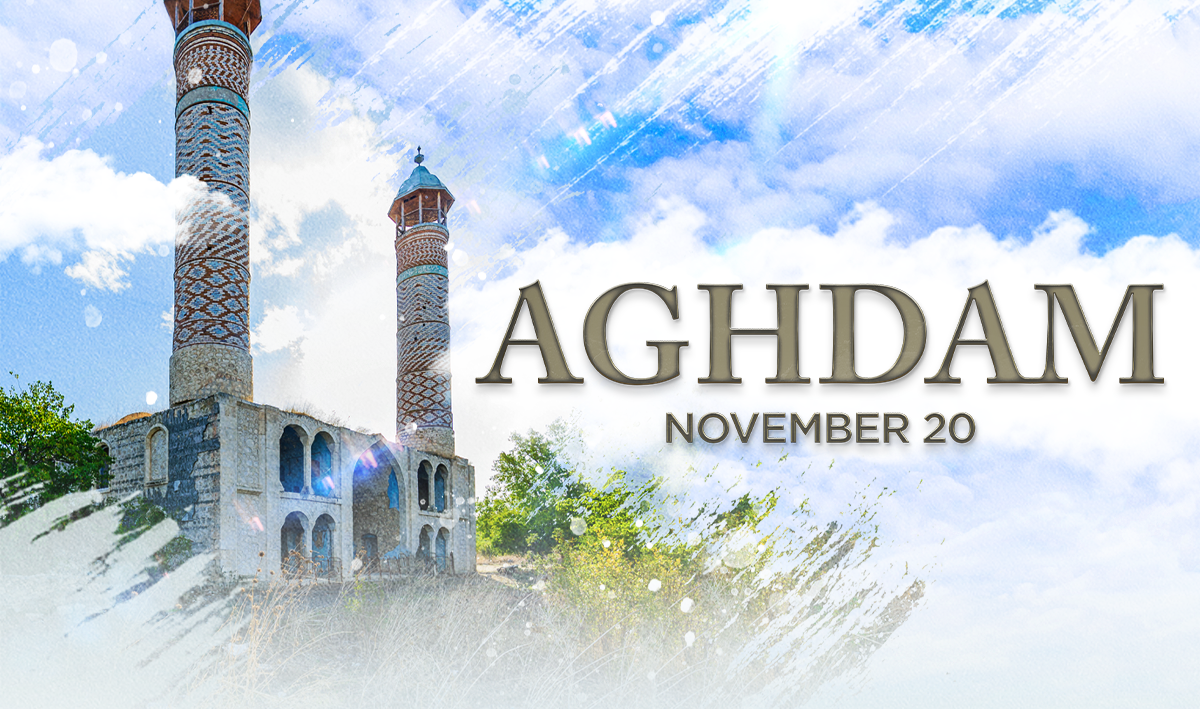
Aghdam City Day: celebration of return, resilience and Azerbaijan’s national identity

Qabil Ashirov
Read moreNovember 20 occupies a special place in Azerbaijan’s modern history. For Aghdam, a city that endured decades of occupation, destruction and displacement, the date represents a historic turning point and a powerful symbol of national resilience. Celebrated annually as Aghdam City Day, November 20 brings together historical memory, cultural heritage and the determination to rebuild a city that holds deep significance for Azerbaijan’s identity, territorial integrity and economic future.
The establishment of Aghdam City Day reflects the historical importance of November 20, 2020, when Aghdam District was returned to Azerbaijan under the trilateral statement signed by the leaders of Azerbaijan, Armenia and Russia on November 10, 2020. The decision to commemorate the occasion annually was formalised through a presidential decree signed by President Ilham Aliyev on July 31, 2023, designating November 20 as Aghdam City Day. The date has since become an important element of Azerbaijan’s national calendar, connecting the country's military victory with the broader process of reconstruction and the return of displaced communities.
Aghdam’s story stretches far beyond the events of 2020. Founded in the 18th century, the city developed into one of the principal urban, agricultural and commercial centres of the Karabakh region. Its geographical position, fertile agricultural lands and established infrastructure gave Aghdam considerable importance in the economic life of the region. It also possessed a distinctive cultural identity, shaped by its architectural heritage, religious monuments, traditional crafts, music and connection with Karabakh’s celebrated horse-breeding traditions.
The occupation of Aghdam in July 1993 marked a devastating chapter in the country's modern history. Armenian forces seized the city during the First Karabakh War, forcing residents to abandon their homes and livelihoods. The occupation triggered the displacement of a large population and transformed a once-vibrant urban centre into a symbol of the humanitarian consequences of the conflict. Residential buildings, schools, cultural institutions, industrial facilities and public infrastructure suffered extensive destruction. For hundreds of thousands of Azerbaijanis affected by the conflict, Aghdam became a powerful reminder of lost homes, interrupted lives and the enduring aspiration to return.
The events of November 2020 fundamentally changed this trajectory. Following Azerbaijan's victory in the 44-day Patriotic War, the trilateral statement established the framework for the return of several territories, including Aghdam. On November 20, Azerbaijani forces entered the district, bringing 27 years of occupation to an end and opening a new chapter in its history.
Economic revival has since become one of the most significant dimensions of Aghdam’s transformation. The latest available figures demonstrate the growing scale of economic activity. According to Azerbaijan's State Statistical Committee, industrial production in Aghdam reached 959.3 million manats in January–October 2026. Agricultural production added another 246.9 million manats during the first ten months of the year, including 159.1 million manats from crop production and 87.8 million manats from livestock farming. Meanwhile, 494.4 million manats was directed towards fixed-capital investment in the district during January–September 2026. These figures illustrate the emergence of a diversified economic base combining industrial manufacturing, agriculture and large-scale infrastructure development.
The Aghdam Industrial Park has become a central engine of this economic revival. Established by presidential decree on May 28, 2021, across 190 hectares, the industrial zone has attracted growing interest from domestic and international entrepreneurs. By December 2025, 32 business entities had received resident status, alongside five non-resident businesses. The total investment portfolio exceeded 312 million manats, while actual investments reached approximately 142 million manats. The park had generated nearly 970 permanent jobs, with local residents from Aghdam and neighbouring districts receiving employment opportunities.
The industrial park's production capacity has expanded rapidly. By December 2025, its enterprises had manufactured products worth approximately 945 million manats, including 39.5 million manats in exports. A subsequent report in August 2026 highlighted 1,230 permanent jobs created through investments exceeding 177 million manats. Twelve enterprises were operating, another 12 were under construction, and design work was underway for 10 additional facilities. During January–June 2026, reported product sales reached 976 million manats, including 42 million manats in exports.
The industrial portfolio covers construction materials, electrical equipment, footwear, railway systems, metal products, ventilation equipment and other manufacturing activities. Several factories inaugurated in recent years demonstrate the scale of industrial diversification. A footwear factory, for example, has an annual production target of 510,000 pairs, while a wallpaper manufacturing facility has a capacity of 2.1 million rolls annually. A metal electric pole production plant, commissioned in December 2025, is designed to manufacture 7,200 tonnes of products each year.
Agriculture represents another major pillar of Aghdam’s economic future. One of the most notable projects is the establishment of an extensive olive plantation covering 1,150 hectares, where more than 700,000 olive trees have been planted. The enterprise aims to produce 10,000 tonnes of olives or approximately 2,000 tonnes of olive oil annually. Such projects offer opportunities for agricultural processing, domestic supply chains and export-oriented production.
The return of former residents gives this transformation its deepest human meaning. The Great Return process in Aghdam began on March 27, 2025, creating the foundations for the restoration of permanent community life. New residential areas, schools, healthcare facilities, transport infrastructure and employment opportunities are essential components of this process. The Barda–Aghdam highway, railway and bus station complex, regional digital management centre and restored cultural facilities are contributing to the district's reintegration into Azerbaijan's national economy.
This year's Aghdam City Day celebrations reflect the connection between historical heritage and urban renewal. The programme opens with a procession of Karabakh horses through the city, followed by local product exhibitions, cultural performances, artistic activities and concerts. The celebrations symbolise the revival of a city whose identity remains closely connected with the wider history of Karabakh.
Ultimately, Aghdam City Day represents much more than the anniversary of a territorial handover. It commemorates the return of a historic Azerbaijani city, honours the endurance of displaced families and highlights the country's ambition to transform a landscape of destruction into a centre of industrial production, agricultural development and economic opportunity. With nearly 1 billion manats in industrial output during the first ten months of 2026, alongside substantial agricultural production and investment, Aghdam is increasingly becoming an important contributor to Azerbaijan's post-war economic development. Its journey from occupation to reconstruction has become a defining chapter in the country's national story — a story in which sovereignty, historical memory and economic revival converge.
Here we are to serve you with news right now. It does not cost much, but worth your attention.
Choose to support open, independent, quality journalism and subscribe on a monthly basis.
By subscribing to our online newspaper, you can have full digital access to all news, analysis, and much more.
You can also follow AzerNEWS on Twitter @AzerNewsAz or Facebook @AzerNewsNewspaper
Thank you!