
Azerbaijan’s cotton growth shifts focus from export volumes to industrial value

Qabil Ashirov
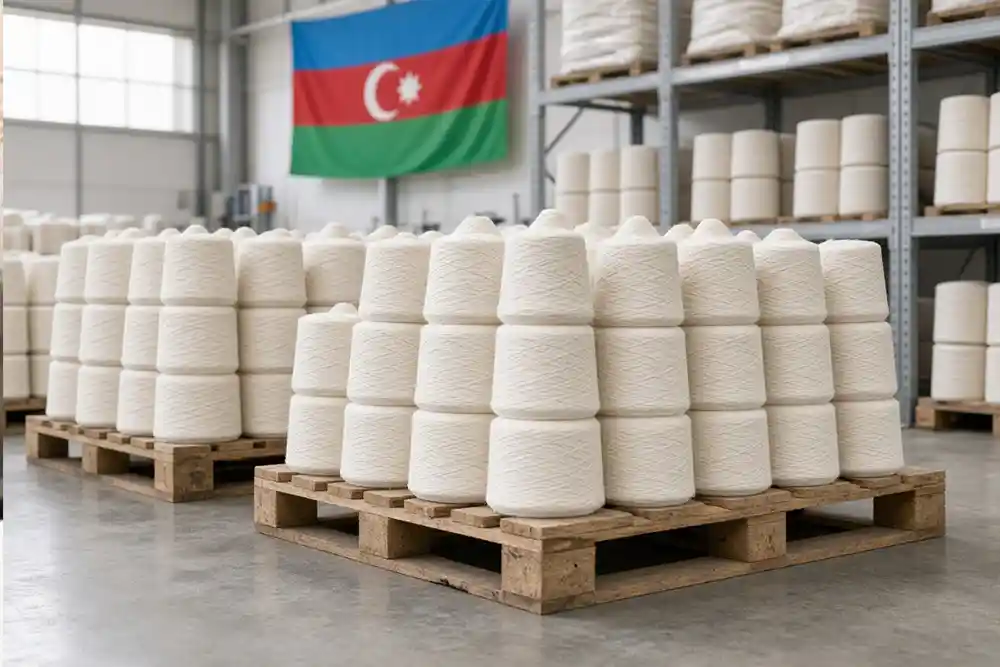
Read moreAzerbaijan exported 95.9 thousand tons of cotton fiber in the first seven months of 2026. During the same period last year, this figure stood at 72.7 thousand tons. As a result, cotton fiber exports increased by 31.9 percent, or 23.2 thousand tons, over the year. The value of exports also increased by 26.2 percent, from $108.1 million to $136.4 million. At the same time, the average export price of one ton of cotton fiber fell from $1,486 to $1,422.
These figures are particularly important for understanding the nature of the increase in cotton exports. Azerbaijan sold more cotton even though the average export price of cotton declined. This means that the main source of export growth was not the price, but the increase in the physical volume of the product. In other words, cotton exports recorded real growth. As an additional 23.2 thousand tons of product were sold on foreign markets, export revenues also increased by $28.3 million despite the decline in prices.
Cotton exports account for approximately 3 percent of Azerbaijan’s total non-oil exports. Azerbaijan’s non-oil sector exports amounted to $5.9 billion in January-July 2026, while cotton fiber and yarn accounted for approximately $167 million of this total.
These figures may appear relatively small at first sight, but the importance of cotton production for Azerbaijan is much greater and cannot be measured simply by its share of non-oil exports. One of the main reasons the government has continued to focus on cotton production in recent years is precisely the broader economic importance of the sector.
As we know, a significant share of Azerbaijan’s population lives in rural areas. According to the State Statistical Committee, as of July 1, 2026, 45.7 percent of the country’s population, or approximately 4.7 million people, lived in rural areas. The share of the urban population was 54.3 percent. The fact that such a large part of the population lives in rural areas makes increasing economic activity and employment in the regions an important issue for Azerbaijan. In this regard, cotton production has particular importance.
Cotton is more than a crop grown in the fields. It stands at the beginning of a large production and services chain. Land is cultivated, machinery and fuel are used, the crop is harvested, transported and delivered to collection points, and then processed at cotton plants and turned into cotton fiber. Each of these stages creates economic activity and employment in the regions.
In 2025, cotton was planted on more than 100,000 hectares in Azerbaijan, while more than 360,000 tons of raw cotton were harvested. These figures show that cotton production generates economic activity across a broad regional geography rather than being concentrated in only a few districts.
The future potential of cotton production is particularly important for Azerbaijan. The significance of the sector goes far beyond the export of raw cotton fiber, as cotton can serve as the foundation for the development of a much broader industrial chain. The textile industry is particularly important in this regard. As we know, textiles remain among the sectors with relatively high demand for human labor. For example, while automation in agriculture can allow five to 10 workers to manage hundreds of animals, the production of an ordinary T-shirt involves many different stages and workers. These include fiber processing, yarn production, weaving, dyeing, cutting, sewing, quality control, packaging and logistics.
Demand for human labor remains high across many of these activities.
This characteristic makes cotton production particularly relevant for Azerbaijan’s regions. Technological development in agriculture can reduce the need for labor in certain stages, while the industrial chain extending from cotton to textiles can create opportunities to employ some of that labor force in other stages of production. Textile and garment factories can be particularly important for expanding employment opportunities for women in the regions.
Moreover, the economic impact does not end with textiles. Cottonseed can be used to produce cottonseed oil and cottonseed cake, which is used in livestock farming. The expansion of the textile industry can also generate additional demand for related sectors such as dyes, buttons and accessories, packaging, logistics, warehousing and technical services.
Therefore, the economic importance of cotton extends far beyond $136 million in cotton fiber exports. The key issue is not limited to how many millions of dollars’ worth of cotton Azerbaijan exports. What matters is how much of that cotton is processed domestically and how much additional value and employment can be created around it.
If Azerbaijan can develop its cotton sector as the starting point of an economic chain connecting regional production, processing, textiles and logistics, rather than simply as a product exported directly from the fields to foreign markets, the sector’s impact on the national economy could become considerably larger than the figure visible in export statistics.
Here we are to serve you with news right now. It does not cost much, but worth your attention.
Choose to support open, independent, quality journalism and subscribe on a monthly basis.
By subscribing to our online newspaper, you can have full digital access to all news, analysis, and much more.
You can also follow AzerNEWS on Twitter @AzerNewsAz or Facebook @AzerNewsNewspaper
Thank you!