
New Muslim defence alliance taking shape - but how far will its members go?

Elnur Enveroglu
Read moreAgreements and documents signed to ensure security and promote joint action have always been of considerable importance. However, their substance has invariably mattered more than the grandeur surrounding the events and meetings at which they are concluded.
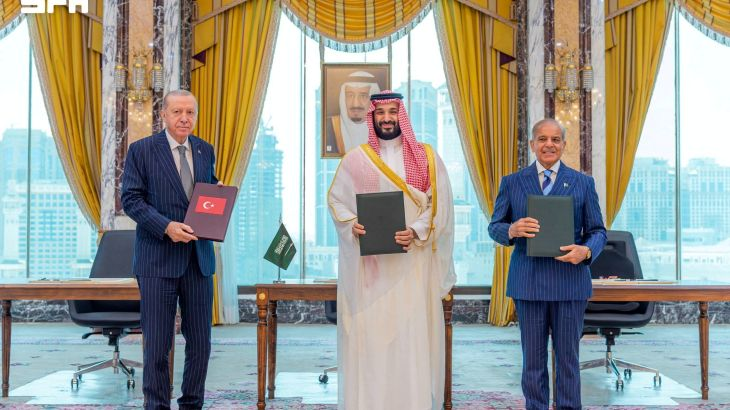
The signing of the Mecca Joint Defence Agreement between Saudi Arabia, Pakistan and Türkiye on 7 August attracted particular attention, both because of the scale and symbolism of the ceremony and because of the substance of the agreement itself.
In appearance, the agreement may evoke an “Arab Muslim version of NATO”, while strategically it appears to represent a sufficiently serious development. Nevertheless, it is clear that the agreement’s real strength will depend less on the language written on paper than on how far the parties are genuinely prepared to go when a crisis emerges. That, in turn, requires several important nuances to be examined.
First, let us consider the agreement through the eyes of senior officials at the state level. Pakistan’s Defence Minister Khawaja Asif has advocated a NATO-like collective defence arrangement among Muslim countries. Türkiye’s Foreign Minister Hakan Fidan went a step further, describing the Mecca agreement as technically comparable to Article 5 of NATO and discussing plans for a ministerial mechanism and a permanent secretariat in Saudi Arabia.
Riyadh has taken a more cautious approach, avoiding an official characterisation of the agreement as another NATO. This distinction is important. Although the three governments have reached a broad understanding on strengthening collective deterrence, they may not yet attach the same political or institutional meaning to the arrangement.
So, what does all this mean in broader terms?
Türkiye’s membership of NATO and its possession of a substantial military arsenal give it particular weight within the agreement. It is therefore reasonable to regard Türkiye as the strongest military pillar of this trilateral pact and as a partner capable of bringing a level of power and potential to the arrangement that could make it comparable, at least in certain respects, with NATO. Pakistan, meanwhile, can also be seen as a leading actor in this grouping, given its status as a South Asian nuclear-armed state with substantial offensive and defensive capabilities. As for Saudi Arabia, its advanced defence architecture and substantial arsenal likewise place it among the principal partners. However, there is a crucial nuance here, raising a fundamental question: to what extent would these states actually be able, or willing, to deploy their military capabilities on behalf of one another?
Suppose, for instance, that a confrontation were to emerge between Pakistan and India, both nuclear-armed states. Would Riyadh intervene directly? Or, amid continuing regional tensions, if Saudi Arabia were to find itself in direct confrontation with the Houthis, would Türkiye also enter the conflict?
First, when we examine the NATO Article 5 provision with which the Mecca agreement has been compared, we can see that there is indeed a degree of similarity between the two arrangements, as Hakan Fidan himself has suggested. Article 5 of the NATO treaty does not state that members are automatically obliged to enter a war. In other words, there is no requirement for an identical military response. Retired Turkish Brigadier General Yücel Karaüz takes a similar view and has offered some clarification on how the parties to the Mecca Joint Defence Agreement might respond in a critical situation. Describing the agreement as defensive rather than offensive in nature, Karaüz has also stressed that it does not contradict NATO provisions.
“If a direct confrontation emerges between Saudi Arabia and Iran, and Iran launches an armed attack against Saudi territory or assets, that attack would formally be considered an attack against all three countries. However, Türkiye would not be ‘automatically obliged to go to war against Iran’. The form and scale of the response would be determined through consultations among Ankara, Riyadh and Islamabad, as well as through a specific request from Saudi Arabia. Türkiye’s relations with Iran, its policy of maintaining the regional balance and its NATO membership would play an important role in that decision. The practical application of the previous Saudi-Pakistani bilateral defence agreement (2025) also shows that such provisions do not automatically lead to military intervention.”
The security expert also assessed the Houthi threats emerging against Saudi Arabia and other Gulf states amid the continuing tensions in the Middle East, while offering his assessment of whether Türkiye or Pakistan might jointly engage in armed operations against Iran’s proxy forces.
“I do not think this would happen automatically or compulsorily. Direct combat operations against the Houthis would require an official Saudi request, activation of the agreement and a political decision by all three parties. In my view, a joint response to asymmetric attacks involving drones and missiles could instead be implemented through the coordination of defence systems, intelligence and potential retaliatory strikes. A joint entry by the trilateral forces into a large-scale ground operation in Yemen, however, appears unlikely given the current statements and the agreement’s ‘ defence-oriented’ character,” Karaüz said.
Naturally, all of these views and scenarios are valuable, because in the absence of the full text of the signed agreement, assessments based solely on official statements and remarks by the leaders may, for the time being, remain speculative. In some cases, even provisions written on paper may fail to translate into the necessary political will. Ultimately, what matters is the initiative itself. And, above all, each partner’s willingness to assume and fulfil the obligations that come with it.
Here we are to serve you with news right now. It does not cost much, but worth your attention.
Choose to support open, independent, quality journalism and subscribe on a monthly basis.
By subscribing to our online newspaper, you can have full digital access to all news, analysis, and much more.
You can also follow AzerNEWS on Twitter @AzerNewsAz or Facebook @AzerNewsNewspaper
Thank you!