
Washington peace, one year on: What changed in South Caucasus?

Ulviyya Poladova
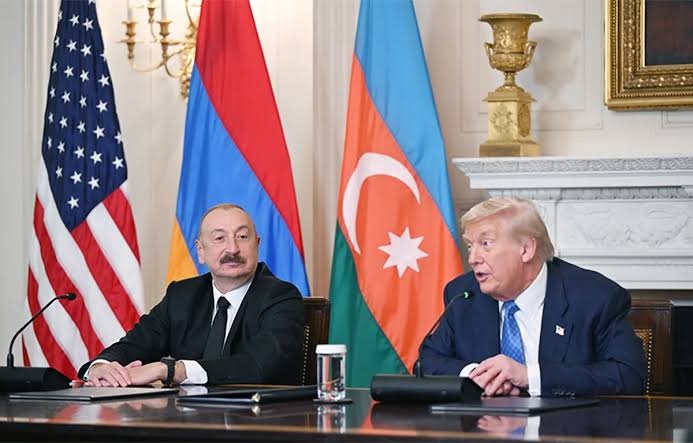
Read moreA year after the landmark Washington meeting between Azerbaijan and Armenia, the South Caucasus is beginning to look less like a geopolitical fault line and more like a region undergoing strategic reconfiguration. Although many recognise it as only the initialling of a peace agreement, the significance of the 8 August 2025 meeting, in fact, lies in the wider shift it set in motion: from conflict management towards connectivity, economic integration and a new balance of power.
First of all, for Azerbaijan, the process has helped consolidate the gains achieved since the 2020 war and the restoration of full sovereignty over Qarabag in 2023. The strategic challenge has since moved beyond the conflict itself. It is now about shaping the political and economic order that follows it. And certainly, that distinction matters.
Peace with Armenia potentially removes one of the main obstacles to Azerbaijan's deeper integration into regional transport and economic networks. Baku is already positioned at the intersection of the Caspian Sea, Central Asia, Türkiye and Europe. Its role in energy supplies and the Middle Corridor has given it growing importance as a bridge between East and West.
The opening of regional communications could strengthen that position further. The proposed route connecting Azerbaijan with Nakhchivan through Armenia, within the framework associated with the Washington process, has significance extending well beyond the movement of goods. It could become part of a broader east-west network linking China and Central Asia to the Caspian, Azerbaijan, Türkiye and European markets.
That is precisely where Washington's interests enter the equation.
The United States has little reason to view the South Caucasus solely through the lens of Armenian-Azerbaijani reconciliation. Russia's war in Ukraine has increased the strategic value of routes bypassing Russian territory, while competition with Iran has made alternative regional connectivity increasingly important.
A more integrated South Caucasus could therefore serve several American interests at once: reducing reliance on Russian transport networks, strengthening Central Asia's connections with Western markets, expanding alternative trade routes and limiting the strategic leverage that Iran derives from its geography.
The Middle Corridor consequently has a geopolitical dimension that goes well beyond commerce.
![South Caucasus in focus: Peace, Corridors and Competing Powers [ANALYSIS]](https://www.azernews.az/media/2025/07/15/turkiye_1.png)
The choice of Washington as the venue for the 2025 meeting was also significant. It demonstrated that the United States wants to play a more consequential role in determining the region's post-conflict architecture. The question for Washington is no longer simply how to secure peace between Baku and Yerevan, but what strategic order should emerge after peace.
However, there is an important distinction between American ambitions and American control.
Azerbaijan is not simply an instrument of Washington's strategy. Baku's importance derives from its own geographical position, infrastructure, energy resources and relationships with Türkiye, Central Asia and Europe. Any attempt to build a new regional connectivity architecture must take Azerbaijan's interests and influence into account.
This is perhaps the most important change of the past year. Azerbaijan's role has expanded from being a central party to a conflict settlement to becoming one of the principal actors in designing the region that follows it.
The South Caucasus is consequently entering a new phase. Russia remains an important power, Iran retains significant interests, and Türkiye's regional influence continues to grow. But the emergence of stronger east-west connections is creating new strategic possibilities.
One year after Washington, the central question is no longer simply whether peace can hold. It is who will shape the regional order that peace makes possible.
And on that question, Baku is increasingly difficult to bypass.
Here we are to serve you with news right now. It does not cost much, but worth your attention.
Choose to support open, independent, quality journalism and subscribe on a monthly basis.
By subscribing to our online newspaper, you can have full digital access to all news, analysis, and much more.
You can also follow AzerNEWS on Twitter @AzerNewsAz or Facebook @AzerNewsNewspaper
Thank you!