
UK's Starmer rejects Trump's Hormuz blockade plan, widening rift with Washington over Iran

Elnur Enveroglu
Read moreThe latest escalation in rhetoric surrounding the Strait of Hormuz has once again exposed the fragility of US-led security architecture in the Gulf. Donald Trump’s assertion that the United States could impose a blockade on one of the world’s most critical maritime arteries marks a sharp departure from the already strained framework of deterrence and diplomacy that has defined US-Iran relations in recent years. The response from Iran was swift and uncompromising, warning of severe consequences and reinforcing its long-standing position that control over the Strait remains a sovereign and strategic imperative.
The Strait of Hormuz is not merely a geopolitical flashpoint. It is a global economic chokepoint through which a significant share of the world’s oil and liquefied natural gas flows. Any disruption carries immediate consequences for energy markets, inflation trajectories and global trade stability. Against this backdrop, Trump’s remarks signal a willingness to use coercive maritime power in a manner that risks triggering direct confrontation. Reports of potential US military measures aimed at restricting Iranian movement further underline the seriousness of the escalation.
However, the diplomatic track appears no less fraught. Talks between the United States and Iran in Islamabad have delivered little in the way of tangible progress. Iranian officials have made clear that they do not view US assurances as credible, reflecting a deep reservoir of mistrust shaped by years of shifting policy positions and broken commitments. From Tehran’s perspective, the insistence on maintaining influence over Hormuz is not simply strategic posturing. It is a core component of national security doctrine.
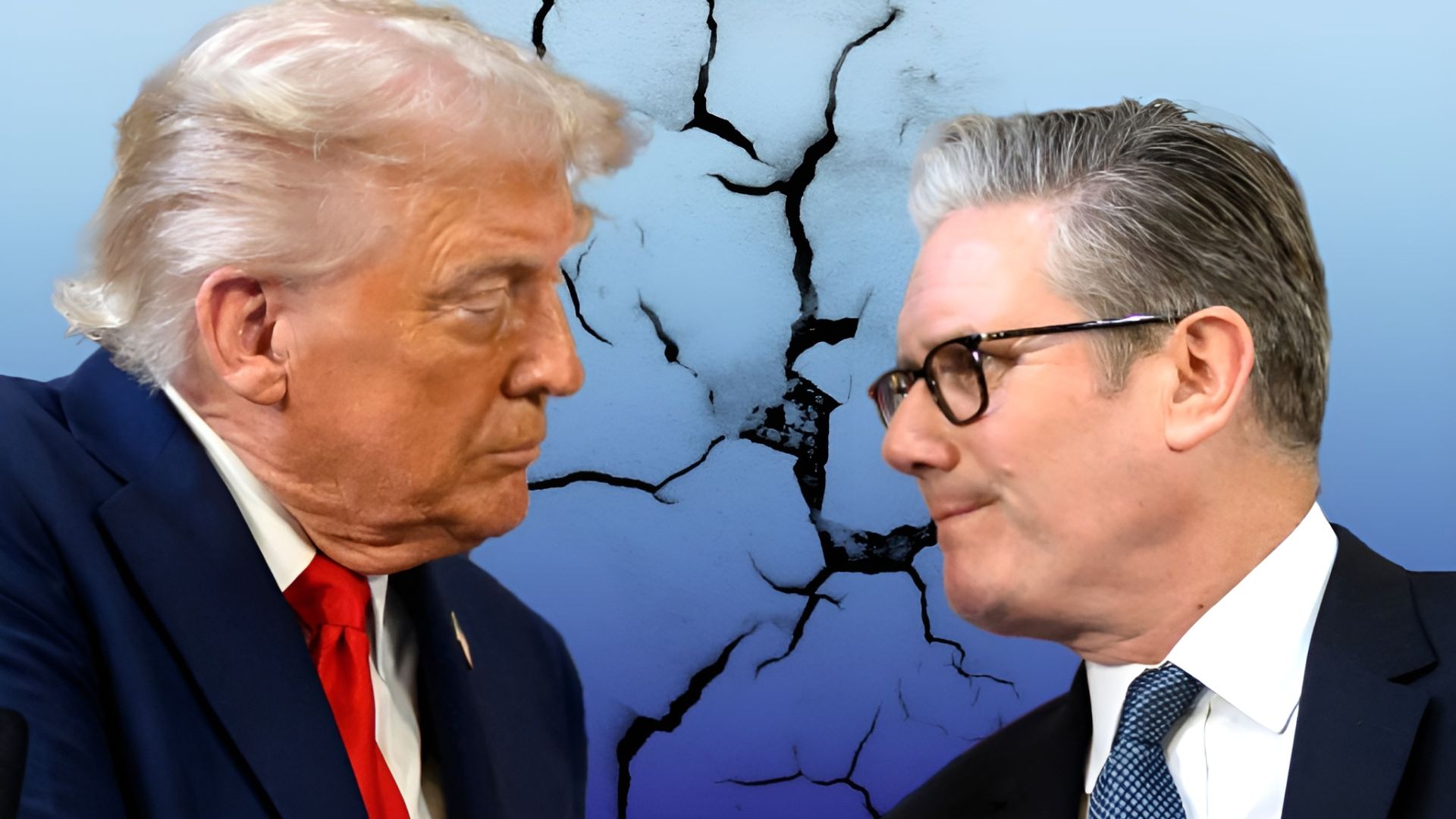
What is striking in this latest episode is not only the sharp exchange between Washington and Tehran, however also the visible divergence within the Western alliance. United Kingdom, traditionally one of Washington’s closest partners, has taken the unusual step of publicly distancing itself from the proposed blockade. Under the leadership of Keir Starmer, Britain has signalled a clear preference for diplomatic engagement over military escalation.
This stance has drawn open criticism from Trump, who has sought to frame the British position as a form of weakness, invoking historical comparisons that resonate deeply in British political culture. References to Neville Chamberlain and Winston Churchill are not incidental. They are designed to cast the current British leadership as hesitant in the face of perceived aggression. Such rhetoric reflects a broader attempt to pressure allies into alignment through public confrontation rather than private negotiation.
Britain’s refusal to endorse the blockade, however, is rooted in a more complex strategic thinking. First, there is a clear recognition in London that any military action in the Strait of Hormuz carries a high risk of rapid escalation. Unlike previous regional conflicts, a confrontation with Iran would likely extend beyond a contained theatre, drawing in proxy networks and destabilising multiple fronts across the Middle East. For the UK, which has already recalibrated its global posture in the aftermath of prolonged engagements in Iraq and Afghanistan, the appetite for another open-ended conflict is limited.
Second, the British approach reflects an assessment of economic vulnerability. As a major trading nation with significant exposure to global energy markets, the UK stands to suffer disproportionately from any disruption in Hormuz. A blockade, even if framed as a controlled measure, could trigger retaliatory actions that would send shockwaves through oil prices and supply chains. In this context, diplomacy is not merely a normative preference. It is an economic necessity.
Third, there is an emerging divergence in how Washington and London perceive the utility of coercive power. While the US appears prepared to leverage its naval dominance to impose strategic outcomes, the UK is increasingly aligned with European partners such as France in seeking multilateral solutions. Efforts to convene broader talks involving multiple stakeholders reflect a belief that sustainable security in the Gulf cannot be achieved through unilateral action.
Finally, domestic political considerations also play a role. Starmer’s government has positioned itself as cautious and rules-based in foreign policy, mindful of public scepticism towards military interventions. Aligning fully with a high-risk US initiative would carry significant political costs at home, particularly if it were perceived as undermining international law or exacerbating regional instability.
Taken together, Britain’s stance is less an act of defiance than a recalibration of alliance dynamics in an increasingly multipolar environment. The transatlantic relationship remains intact, however it is no longer characterised by automatic alignment. Instead, it is shaped by selective cooperation, strategic caution and, at times, open disagreement.
Trump’s Hormuz comments may have been intended to project strength, however they have also revealed the limits of US influence over its closest allies. As tensions with Iran continue to simmer, the question is no longer simply whether conflict can be avoided. It is whether the Western alliance can maintain coherence in the face of diverging strategic priorities.
Here we are to serve you with news right now. It does not cost much, but worth your attention.
Choose to support open, independent, quality journalism and subscribe on a monthly basis.
By subscribing to our online newspaper, you can have full digital access to all news, analysis, and much more.
You can also follow AzerNEWS on Twitter @AzerNewsAz or Facebook @AzerNewsNewspaper
Thank you!