
Russia and Iran’s declining influence reshapes South Caucasus

Qabil Ashirov
Read moreRussia’s full-scale invasion of Ukraine in 2022 marked a turning point not only for Europe’s security order, but also for Russia’s long-term geopolitical trajectory. More than four years into the war, the Kremlin continues to project resilience. Yet beneath that posture, structural constraints are increasingly visible. Even in a scenario where active hostilities were to end in the near term, Russia would not easily revert to its pre-war economic or political position. The combination of sanctions, capital restrictions, and technological isolation has reshaped its development path in ways that are unlikely to be quickly reversed.
The most immediate effect has been economic recalibration. Cut off from much of Western investment and advanced technology, Russia has become more dependent on a narrower set of partners and markets. Growth has not collapsed, but it has become less dynamic and more uneven. Over time, this has contributed to a broader erosion of Russia’s attractiveness as a destination for skilled labor and regional migration. Historically, Russia functioned as a key labor magnet for workers from Central Asia and the South Caucasus. That role is now increasingly contested, with labor flows diversifying toward Turkiye, parts of the Gulf, and, where possible, the European Union. This shift carries long-term geopolitical implications, since labor migration has also been one of Moscow’s quieter instruments of regional influence.
Iran, meanwhile, has suffered its own strategic setback. The confrontation with the United States and Israel reached its most dramatic stage in February 2026, when Supreme Leader Seyyed Ali Khamenei was killed in an airstrike. His death created a leadership vacuum that was quickly filled by his son, Mojtaba Khamenei, but the regime’s stability remains uncertain. Iran’s military and civilian infrastructure suffered heavy blows, and its ability to project power beyond its borders has been severely curtailed. For a country already under sanctions and international isolation, the prospect of recovery is distant.
In the South Caucasus, Iran’s leverage has diminished considerably. Its attempts to block the opening of the Zangezur corridor through military exercises along the Aras River now appear unsustainable. The destruction of Iran’s naval assets in the Caspian Sea further weakens its capacity to obstruct regional energy and transit projects. Tehran’s traditional role as a spoiler in regional geopolitics is fading, leaving countries in the region in a stronger position to advance their strategic interests.
The weakening of Russia and Iran opens new opportunities for the South Caucasus states. Azerbaijan, Georgia, and Armenia find themselves in a changing geopolitical landscape where traditional pressures are easing. For Azerbaijan, the prospects of expanded energy exports and deeper integration with Turkiye and Europe are particularly promising. The possibility of trans-Caspian energy projects, long obstructed by Moscow and Tehran, now appears more feasible. Georgia, though still grappling with unresolved territorial disputes, may find new openings as Russia’s grip loosens. Armenia faces the delicate task of reconciling with Azerbaijan while redefining its foreign policy orientation in a less Russia-centric environment.
The resolution of the Karabakh conflict has already reshaped the regional security environment. Russia’s inability to obstruct the process, distracted by its war in Ukraine, accelerated this outcome. Georgia’s territorial integrity remains unresolved, but Moscow’s weakening position may eventually create openings for progress, even though it still retains significant influence. Iran, meanwhile, finds its regional role diminished. Once adept at leveraging border tensions, sectarian ties, and economic channels to exert pressure in the South Caucasus, Tehran now struggles to maintain relevance. The destruction of its naval assets and the severe damage to military and civilian infrastructure have curtailed its ability to intervene meaningfully in Caspian energy projects or to act as a spoiler in regional negotiations. Where Iran once sought to counterbalance external actors and project itself as a decisive player, its reduced capacity leaves it increasingly sidelined in shaping the future of the South Caucasus.
The South Caucasus remains a region of unresolved challenges. Armenia and Azerbaijan have yet to finalize a peace treaty, Georgia continues to grapple with its occupied territories, and trans-Caspian energy projects face logistical and political hurdles. Yet the weakening of Russia and Iran alters the balance of power in ways that could favor regional stability and growth. Regional countries can diversify partnerships, reducing dependence on Moscow and Tehran, and pursue new strategies that align more closely with Western and Turkish interests.
Russia and Iran’s decline in influence is reshaping the South Caucasus. Their economic stagnation, military setbacks, and political vulnerabilities create openings for regional states to pursue new strategies. While risks remain, the erosion of Moscow and Tehran’s traditional levers of power offers the South Caucasus a rare opportunity to redefine its place in the global order. The extent to which these countries can seize the moment will determine whether the region moves toward lasting stability or remains trapped in cycles of uncertainty.
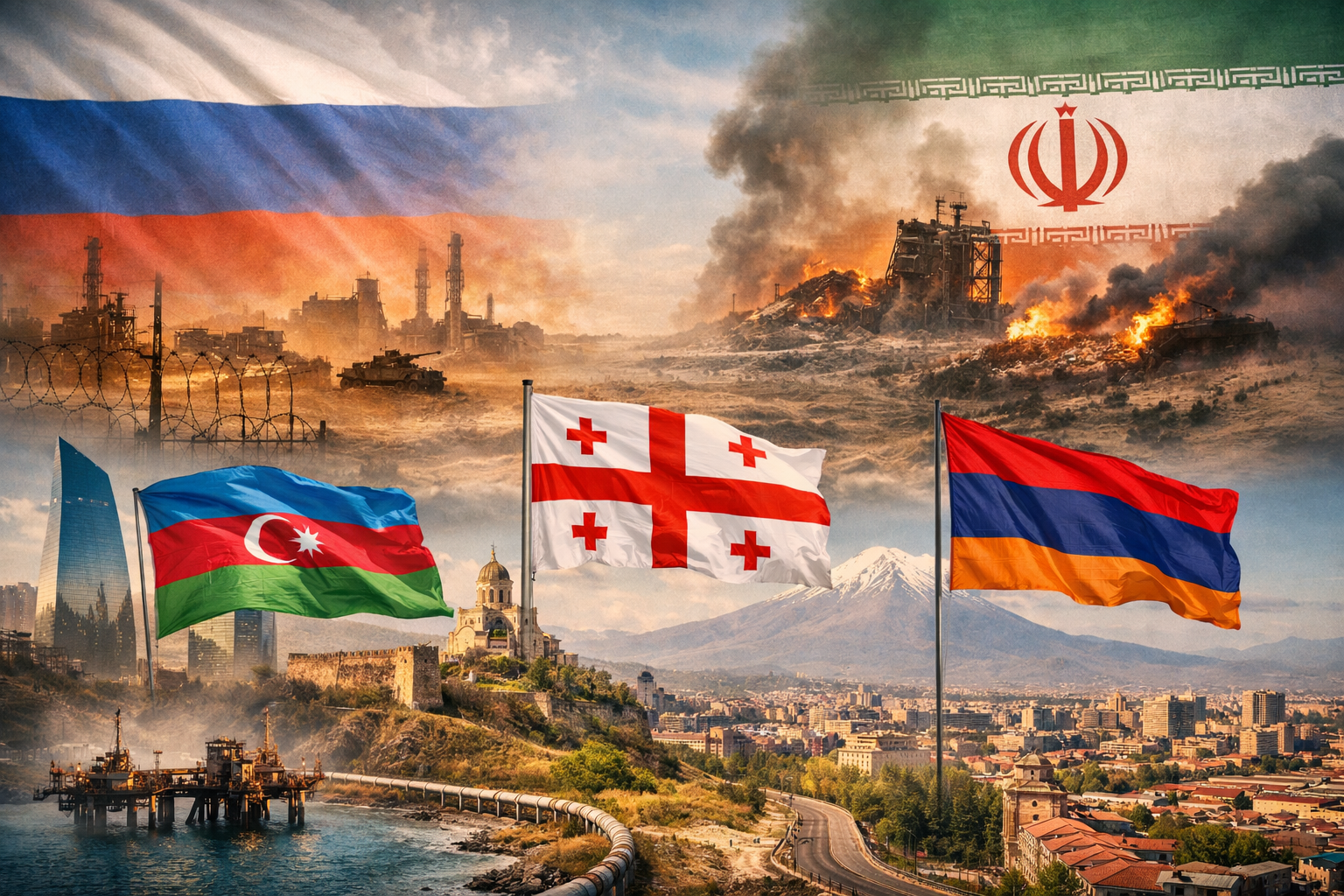
*Image is generated by Artificial Intelligence
Here we are to serve you with news right now. It does not cost much, but worth your attention.
Choose to support open, independent, quality journalism and subscribe on a monthly basis.
By subscribing to our online newspaper, you can have full digital access to all news, analysis, and much more.
You can also follow AzerNEWS on Twitter @AzerNewsAz or Facebook @AzerNewsNewspaper
Thank you!