
Orbán vs Magyar: Election that could shake Europe’s balance

Akbar Novruz
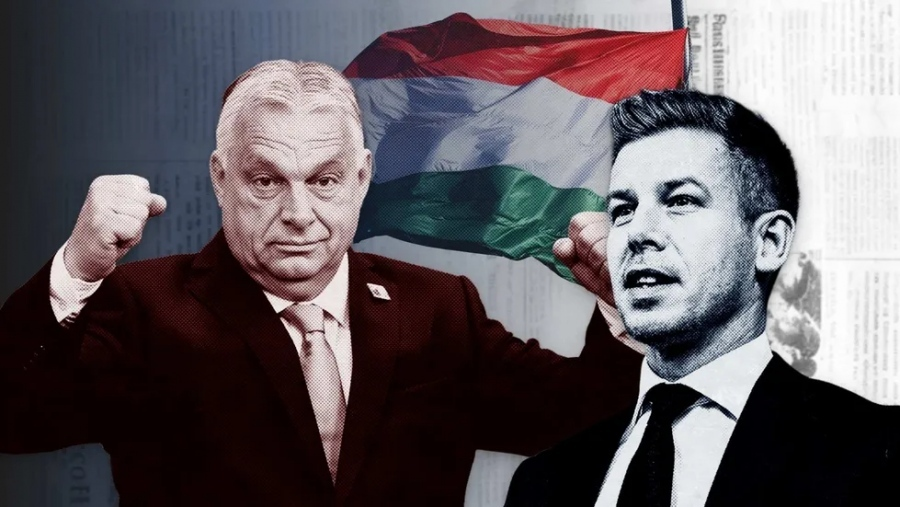
Read moreHungary stands at what could be a defining political turning point, as voters head to the polls in one of the most competitive elections the country has witnessed since Viktor Orbán consolidated power in 2010.
Following almost a decade of hegemony in Hungarian politics, Orban now finds himself facing a credible challenge to his rule, spearheaded by Péter Magyar, a rising star who embodies the changing political climate.
Viktor Orbán is more than just another national leader fighting for his position in the upcoming elections. Indeed, he has become an icon of opposition to centralization. Viktor Orbán has become the icon of patriotism in the face of the federalism of von der Leyen Unlimited. This is why a victory by Viktor Orbán will have consequences outside Hungary.
Indeed, the von der Leyen Commission is pushing to the limits the notion and idea of cooperation between European nations. Powers established under the treaties are being grossly abused. Indeed, the Union is now not only a military alliance but the abuse of competencies is evident in areas like education, health care, and social housing.
However, this upcoming election is unlikely to be characterized solely by normal election-related factors. Instead, there is an emerging trend towards a cyber battleground where disinformation, including the spread of fake news narratives and advanced use of technology such as AI-driven deepfakes, has played a prominent role.
Adding even more uncertainty is the issue of foreign interference. Sources suggest that certain Russian-linked groups are using social media to promote the spread of narratives that divide the electorate, especially those seeking to undermine pro-European views. However, the geopolitical aspect cannot be confined merely to Russia. It would seem that the United States is also interested in this election result and that there are some factions in Washington that support Orbán and his policies.
The unusual intersection of the two, the fact that both Russia and certain US parties agree, although for different reasons, is another issue to consider in relation to Europe.
Importantly, Péter Magyar has sought to position himself carefully within this complex landscape. Rejecting accusations from opponents that he represents a “pro-war” agenda, Magyar has instead emphasized a pragmatic approach, one that does not radically depart from Hungary’s current stance of non-intervention in external conflicts. Rather, his campaign has focused heavily on domestic concerns, including corruption, governance standards, and economic management, signaling continuity in foreign policy caution while promising change at home.
In an interview with AzerNEWS, Sebastian Schaeffer, Director at the Institute for the Danube Region and Central Europe (IDM), shared his insights on the political climate, the risks posed by disinformation, and the wider geopolitical implications of Hungary’s pivotal vote:
- What do the Hungarian elections mean for EU-Hungary relations, and consequently for US-EU relations?
- These elections are less about a sudden "turning point" and more about whether an entrenched pattern continues or begins to loosen. Under Viktor Orbán, EU-Hungary relations have been defined by persistent friction over rule of law, media pluralism, and Hungary's positioning on Russia. That would not disappear overnight even with a change in government, but it could become more manageable. If the current government remains, we should expect continued transactionalism. Budapest will keep leveraging veto power where possible, particularly on Ukraine-related decisions, while the EU will continue using conditionality instruments. That is a stable but dysfunctional equilibrium. For US-EU relations, Hungary has become a small but symbolic fault line. The idea that Washington and Brussels are aligned on Central Europe is no longer automatically true. However, I would be cautious about overstating this. Hungary is not the axis around which transatlantic relations turn. It is rather a stress test of how much divergence can be absorbed without broader fragmentation.
- How should we interpret the apparent US political interest in Hungary's electoral outcome?
- We should separate rhetoric from structural policy. There are clearly political actors in the US who view Viktor Orbán as an ideological ally, particularly on questions of sovereignty, migration, and cultural politics. That creates the impression of "support." But there is a deeper strategic interest at play: the US under the current administration needs Orbán to win. A Magyar victory would shatter the narrative of an unstoppable victory march of the far right across the West, and that myth has real political value in Washington's domestic politics. It is also worth naming the contradiction openly: the same actors who accuse the EU of interfering in sovereign democratic processes are actively campaigning for a specific outcome in a member state election. That double standard is not incidental. It is part of the playbook. That said, US policy is not monolithic. Institutional Washington has often been far more critical of Budapest than political messaging suggests. So rather than a coherent "US strategy" backing Orbán, what we see is a fragmented picture. Hungary has become part of US domestic political signalling as much as foreign policy. That matters, but it should not be mistaken for a fully aligned geopolitical position.
- Does US support for Orbán signal a deeper divergence between Washington and Brussels on democratic governance?
- There is some divergence, but it is uneven and often
overstated. The EU's relationship with Hungary is shaped by legal
mechanisms and financial conditionality, which gives Brussels a
very concrete toolkit. The US operates more through political
signalling, diplomatic pressure, and selective engagement.
Where divergence does exist is in emphasis. The EU treats
democratic backsliding as an internal structural issue that affects
the functioning of the Union. The US, depending on the political
constellation, may treat it more selectively or instrumentally. But
here is the critical lesson regardless of Sunday's outcome: the EU
cannot afford to lean back if Magyar wins, the way many did when
Biden defeated Trump in 2020, assuming the problem is solved and
returning to business as usual. A change in government in Budapest
is an opportunity, not a resolution. The EU must use it to overhaul
its instruments, starting with Article 7 of the TFEU, which has
proven essentially inoperable as a mechanism for addressing
systematic rule-of-law breaches. That reform conversation needs to
happen now, not after the next backsliding crisis.
The core transatlantic consensus on Russia, NATO, and security in
Central Europe still largely holds. Hungary is an outlier within
that consensus, not evidence of its collapse. But outliers, if left
unaddressed, have a way of becoming templates.
- What would a Magyar victory mean for Hungarian foreign policy, on the EU and Ukraine?
- A victory by Péter Magyar would likely lead to recalibration rather than rupture. Expectations of a rapid "return to Brussels" are probably too optimistic. Magyar's political appeal is strongly rooted in domestic governance issues: corruption, economic management, institutional integrity. That suggests continuity in parts of foreign policy, at least in the short term. Hungary's cautious stance on direct involvement in the Ukraine war is unlikely to shift dramatically overnight. Magyar has been consistent in rejecting the "pro-war" label, and he means it. His approach is pragmatic non-intervention with a different diplomatic texture, not Orbán's systematic obstruction, but not unconditional support for Kyiv either. On Ukraine's EU accession and sanctions, this could translate into less obstruction and more constructive ambiguity. Not a fully aligned Western position, but also not the consistent spoiler role we have come to expect from Budapest in the Council. In other words, the key difference in the first phase would not necessarily be policy substance, but political intent and credibility. And in EU politics, where trust, predictability, and good-faith engagement matter enormously, that alone can make a substantial difference.
Here we are to serve you with news right now. It does not cost much, but worth your attention.
Choose to support open, independent, quality journalism and subscribe on a monthly basis.
By subscribing to our online newspaper, you can have full digital access to all news, analysis, and much more.
You can also follow AzerNEWS on Twitter @AzerNewsAz or Facebook @AzerNewsNewspaper
Thank you!