
Robots free Chinese workers from factory jobs
by Alimat Aliyeva
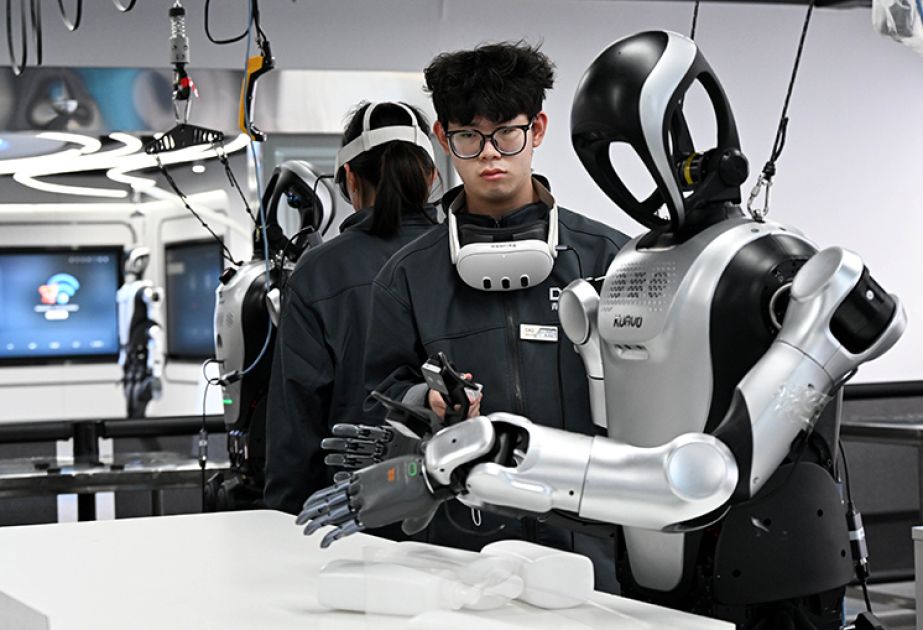
Robots are rapidly transforming Chinese factories, taking over dirty, dangerous, and monotonous tasks often referred to as the “3D” jobs (dirty, dangerous, and dull), and reshaping the country’s industrial workforce, AzerNEWS reports.
Zhong Junhao, Secretary-General of the Shanghai Association of the Artificial Intelligence Industry, noted that robots are increasingly handling labor-intensive and physically demanding operations, effectively freeing human workers from repetitive and routine tasks while allowing them to focus on higher-skilled roles.
A notable example comes from the Longcheer tablet manufacturing plant in Nanchang, where the production of high-precision 3C products (computers, communications, and consumer electronics) has reached what is described as the world’s first large-scale application of embodied intelligence in a smart factory setting, according to Yicai. This marks a significant step in integrating advanced robotics directly into complex manufacturing lines.
“Humans are smarter than machines, but they are more prone to errors,” said Yao Maoqing, Senior Vice President and President of Embodied Intelligence at Agibot. He emphasized that deploying robots for repetitive and time-consuming tasks improves both stability and consistency in production processes.
Yao also added that multiple Genie G2 robots are already operating stably on customer production lines, reflecting growing confidence in their industrial reliability.
The use of intelligent machines is not limited to electronics manufacturing. For instance, the Want Group factory in Hunan Province has introduced robotic dogs for routine inspections, according to He Chengbing, Deputy General Manager of the company’s equipment center and production operations division. These autonomous systems are designed to carry out continuous patrols, replacing human workers in complex and repetitive monitoring tasks.
He explained that robotic dogs can operate around the clock, improving both efficiency and accuracy in industrial safety management while also reducing risks for human personnel in hazardous environments.
Interestingly, this trend reflects a broader shift in China’s industrial strategy: factories are gradually moving toward “dark factories” — highly automated facilities that can operate with minimal or even zero human presence. While this boosts productivity and consistency, it also raises long-term questions about workforce transition, as millions of traditional manufacturing jobs are being reshaped or replaced by intelligent machines.
Here we are to serve you with news right now. It does not cost much, but worth your attention.
Choose to support open, independent, quality journalism and subscribe on a monthly basis.
By subscribing to our online newspaper, you can have full digital access to all news, analysis, and much more.
You can also follow AzerNEWS on Twitter @AzerNewsAz or Facebook @AzerNewsNewspaper
Thank you!