
Who was Ali Larijani, enigmatic strategist at heart of Iran’s power?
Akbar Novruz
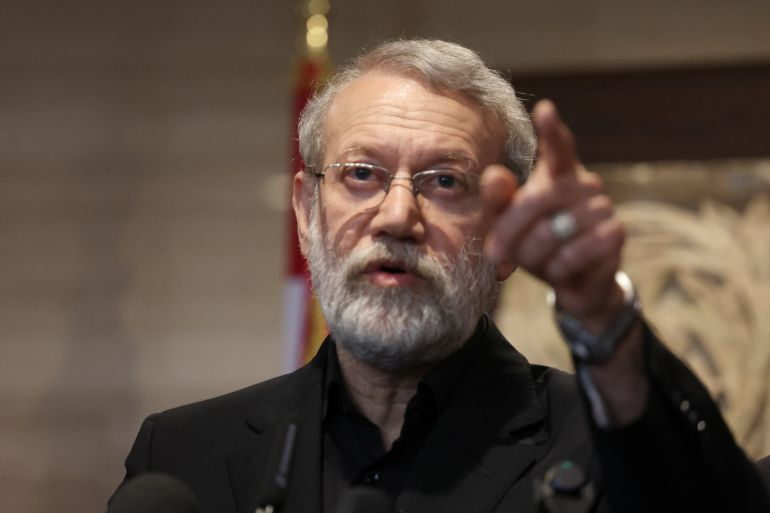
Read moreIsrael’s defence minister, Benny Gantz, has just claimed that Iran’s security chief Ali Larijani, has been killed, a report that has sent shockwaves through regional capitals and global capitals alike. Tehran has yet to comment, and details remain unconfirmed. But to grasp the potential significance of this claim, it helps to understand the man at its centre: a figure who embodied the complexities, contradictions, and intellectual currents of the Islamic Republic itself.
Larijani was a firebrand revolutionary or an ideologue of the hard right. He was a product of privilege and pedigree in a country where both heritage and political acumen matter profoundly. Born in 1958 in Najaf, Iraq, into one of Iran’s most influential families, he moved early into the heart of the Islamic Republic’s elite.
His family, sometimes described, with more than a touch of journalistic hyperbole, as the “Kennedys of Iran”, has woven itself through the fabric of the state for decades. His father was a high‑ranking Shiite cleric; his brothers have presided over judiciary, academic and policy institutions. One brother, Mohammad Javad Larijani, became a trusted presidential adviser and foreign policy voice; another, Sadiq, spent a decade leading the judiciary before becoming chairman of the advisory council; and yet another carved out influence in health and higher education.
His marriage, at the age of 20, to Farideh Motahari, daughter of a close confidant of Ayatollah Ruhollah Khomeini, anchored him deeper within the revolutionary elite. Larijani was, in every sense, bred for influence.
Yet his path to power was not purely dynastic. Unlike many peers whose credentials were forged only in the crucible of clerical seminaries, Larijani combined an aristocratic religious background with a rigorous secular education. He earned degrees in mathematics and computer science at Sharif University of Technology, Iran’s premier technical school, before turning to philosophy. His doctoral work, unusual among Iranian power‑brokers, focused on Immanuel Kant, and he later published extensively on Kant’s philosophy, exploring the relationship between mathematical proof, metaphysics and rational inquiry.
That intellectual curiosity was, to some Western observers, a paradox. Kant is a pillar of Enlightenment thought, a secular system that seems, at first glance, at odds with the theological foundations of the Islamic Republic. But Larijani’s philosophical work was not an exercise in Western emulation. Instead, he sought to reinterpret Kant through an Islamic lens, arguing that religious thought and science each pursue truth in their own domains and challenging rigid demarcations, such as the idea that only falsifiable scientific theories are meaningful.
This nuanced worldview echoed in his political career. After the 1979 revolution, he served in the Islamic Revolutionary Guard Corps before entering government. He held posts including culture minister and later director of the state broadcaster IRIB, positions that deepened his understanding of the interplay between ideology, media and power.
In 2005, Larijani became secretary of the Supreme National Security Council and Iran’s chief nuclear negotiator, a role in which he helped shape Tehran’s posture amid escalating tensions with the United States and Israel. Although he stepped down from that role in 2007, he re‑entered the political arena in 2008 as a member of parliament, quickly rising to become speaker, a position he held for three consecutive terms. During this time he was a key figure in securing parliamentary approval for the 2015 nuclear deal, a moment that underscored his reputation as a pragmatic operator willing to bridge hardline concerns with diplomatic engagement.
After a brief period away from frontline politics, he returned in August 2025 to lead the national security council again, a testament to his enduring influence and the regard in which he was held within Iran’s ruling circles.
Amid a region plagued by conflict and shifting alliances, Larijani’s death, if confirmed, would mark the end of a chapter in Tehran’s strategic calculus. He was, for decades, a bridge between Iran’s revolutionary ethos and its efforts to navigate a hostile international landscape, a thinker at ease both with complex philosophy and the raw realities of geopolitics.
And in a system often dominated by clerics and generals, he stood out as a measured intellect, a strategist shaped by logic, faith and a lifetime within the corridors of power.
Here we are to serve you with news right now. It does not cost much, but worth your attention.
Choose to support open, independent, quality journalism and subscribe on a monthly basis.
By subscribing to our online newspaper, you can have full digital access to all news, analysis, and much more.
You can also follow AzerNEWS on Twitter @AzerNewsAz or Facebook @AzerNewsNewspaper
Thank you!