
PUIC recognizes Khojaly massacre as genocide
By Sara Rajabova
Parliamentary Union of the Organization of Islamic Cooperation Member States (PUIC) has recognized the Khojaly tragedy as genocide.
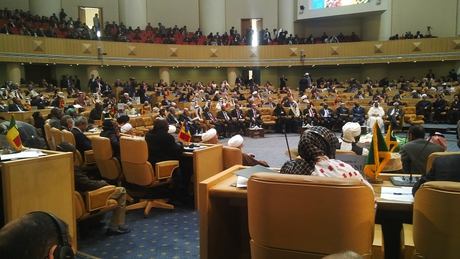
Fifty three members of PUIC gathered in Iran's capital Tehran to attend their 9th session on February 18-19.
During the session, the participants adopted a resolution calling the Armenians` massacre of hundreds of Azerbaijani civilians in 1992 "an act of genocide and a crime against humanity."
The draft resolution was submitted to PUIC as part of the Justice for Khojaly campaign initiated by Senior Coordinator of the Islamic Conference Youth Forum for Dialogue and Cooperation (ICYF-DC) Leyla Aliyeva.
The Khojaly tragedy was recognized as an act of genocide and a crime against humanity thanks to the five-year efforts at all levels within the Organization of Islamic Cooperation.
In 1992, the town of Khojaly, the second largest town in the Nagorno-Karabakh region of Azerbaijan, came under intense fire from the towns of Khankendi and Askeran already occupied by the Armenian armed forces.
613 civilians mostly women and children were killed in the massacre, and a total of 1,000 people were disabled. Eight families were exterminated, 25 children lost both parents, and 130 children lost one parent.
Moreover, 1,275 innocent people were taken hostage, and the fate of 150 of them remains unknown. Civilians were shot at close range, scalped, and burned alive. Some had their eyes gouged out and others were beheaded.
The parliaments of Pakistan, Mexico, Colombia, Romania, Serbia, Bosnia and Herzegovina, Czech Republic, Jordan, as well as legislative bodies of about 20 states of the Unites States, including Texas, New-Mexico, Arkansas, Oklahoma, Pennsylvania, Connecticut, Western Virginia, New-Jersey and Tennessee have adopted relevant documents.
The Organization of Islamic Cooperation (OIC) adopted a final Communiqué in Cairo back in February 2013, calling the Khojaly tragedy genocide against humanity. The Communiqué called on the international community to take a similar approach towards the genocide.
Armenia occupied over 20 percent of Azerbaijan's internationally recognized territory, including Nagorno-Karabakh and seven adjacent regions, after laying territorial claims against its South Caucasus neighbor that had caused a lengthy war in the early 1990s.
The UN Security Council has adopted four resolutions calling on Armenia to withdraw from the Azerbaijani territory, but they have not been implemented yet.
Here we are to serve you with news right now. It does not cost much, but worth your attention.
Choose to support open, independent, quality journalism and subscribe on a monthly basis.
By subscribing to our online newspaper, you can have full digital access to all news, analysis, and much more.
You can also follow AzerNEWS on Twitter @AzerNewsAz or Facebook @AzerNewsNewspaper
Thank you!