
Mediating countries urge 'political will' to settle Karabakh conflict (UPDATE)
By Aynur Jafarova
The OSCE Minsk Group co-chair countries brokering settlement to the Armenia-Azerbaijan Nagorno-Karabakh conflict issued a joint statement at a ministerial in Dublin calling upon the parties to the long-standing dispute to demonstrate the political will needed to reach a peaceful settlement, Trend news agency reported referring to the OSCE website.
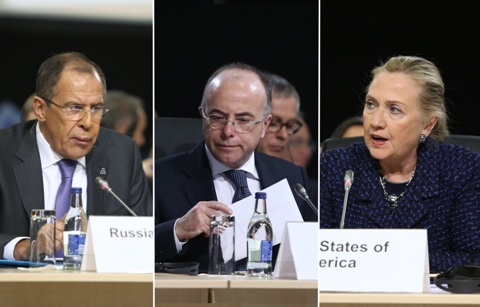
In the statement, released by the Heads of Delegation of the Minsk Group co-chair countries at the 19th meeting of OSCE Council of Foreign Ministers, Russian Foreign Minister Sergey Lavrov, US Secretary of State Hillary Clinton and France's Minister Delegate for European Affairs Bernard Cazeneuve, noted that the parties should be guided by the Helsinki principles, particularly those relating to the non-use of force, territorial integrity, and equal rights and self-determination of peoples.
"Recalling the statement of our presidents at Deauville in 2011, we again urge the parties to take decisive steps to reach a peaceful settlement," the document says. "We regret that the expectations of more rapid progress in the peace process, which were raised by the joint statement of the presidents of Armenia and Azerbaijan, with the president of the Russian Federation at Sochi on January 23, 2012, were not met. Instead, the parties have too often sought one-sided advantage in the negotiation process, rather than seeking to find agreement, based upon mutual understanding."
The parties to the Nagorno-Karabakh conflict were called to continue to respect the 1994 ceasefire. It was noted that the use of military force will not resolve the conflict.
"We urge the parties to refrain from actions and statements that foster feelings of enmity among their populations and have raised tensions in recent months. The leaders of the sides must prepare their populations for the day when they will live again as neighbors, not enemies, with full respect for each other's culture, history, and traditions," the statement says.
The delegation heads welcomed the readiness of the foreign ministers of Azerbaijan and Armenia to meet jointly with the co-chairs early in 2013 to continue these discussions. "Our countries continue to stand ready to do whatever we can to assist the parties, but the responsibility for putting an end to the Nagorno-Karabakh conflict remains with them," they said.
The Nagorno-Karabakh conflict emerged in 1988 when Armenia made territorial claims against Azerbaijan. The two South Caucasus neighbors fought a lengthy war that ended with the signing of a precarious cease-fire in 1994. Armenian armed forces have since occupied over 20 percent of Azerbaijan's internationally recognized territory. OSCE-brokered peace talks have been largely fruitless so far. Armenia has not yet implemented the four UN resolutions on a pullout from Nagorno-Karabakh and the seven surrounding regions.
The 19th Meeting of the OSCE Ministerial Council was held in the Irish capital on December 6-7 with the participation of foreign ministers of the 57 OSCE participating states and 11 partner countries.
OSCE Chairperson Eamon Gilmore said at the ministerial conference in Dublin on Thursday that tensions on the contact line between Azerbaijani and Armenian armed forces necessitate prompt response to the settlement of the conflict, which is harmful to regional nations.
Azerbaijani Foreign Minister Elmar Mammadyarov, who also took the floor at the OSCE ministerial, said Armenia is strengthening the status quo in the occupied territories, using force to keep control over the occupied land, and prevents refugees displaced during the 1990s war from returning home. Mammadyarov also said long-running peace talks have yielded no result to date. But he said Azerbaijan was interested in rapid continuation of the talks on a peaceful settlement, supports intensifying the mediating OSCE Minsk Group's activity and is ready to begin drafting a comprehensive peace agreement that would lead to a phased conflict settlement.
EU foreign policy chief Catherine Ashton in turn said problems facing the OSCE member states, including the Nagorno-Karabakh conflict, hamper economic development of the region, while Russian Foreign Minister Sergei Lavrov during his speech said Russia will continue promoting a rapprochement in the positions of the parties to the conflict jointly with the other Minsk Group co-chairs - the United States and France. Lavrov added that Moscow sees no other option of resolving the Nagorno-Karabakh conflict except peace negotiations.
Here we are to serve you with news right now. It does not cost much, but worth your attention.
Choose to support open, independent, quality journalism and subscribe on a monthly basis.
By subscribing to our online newspaper, you can have full digital access to all news, analysis, and much more.
You can also follow AzerNEWS on Twitter @AzerNewsAz or Facebook @AzerNewsNewspaper
Thank you!