
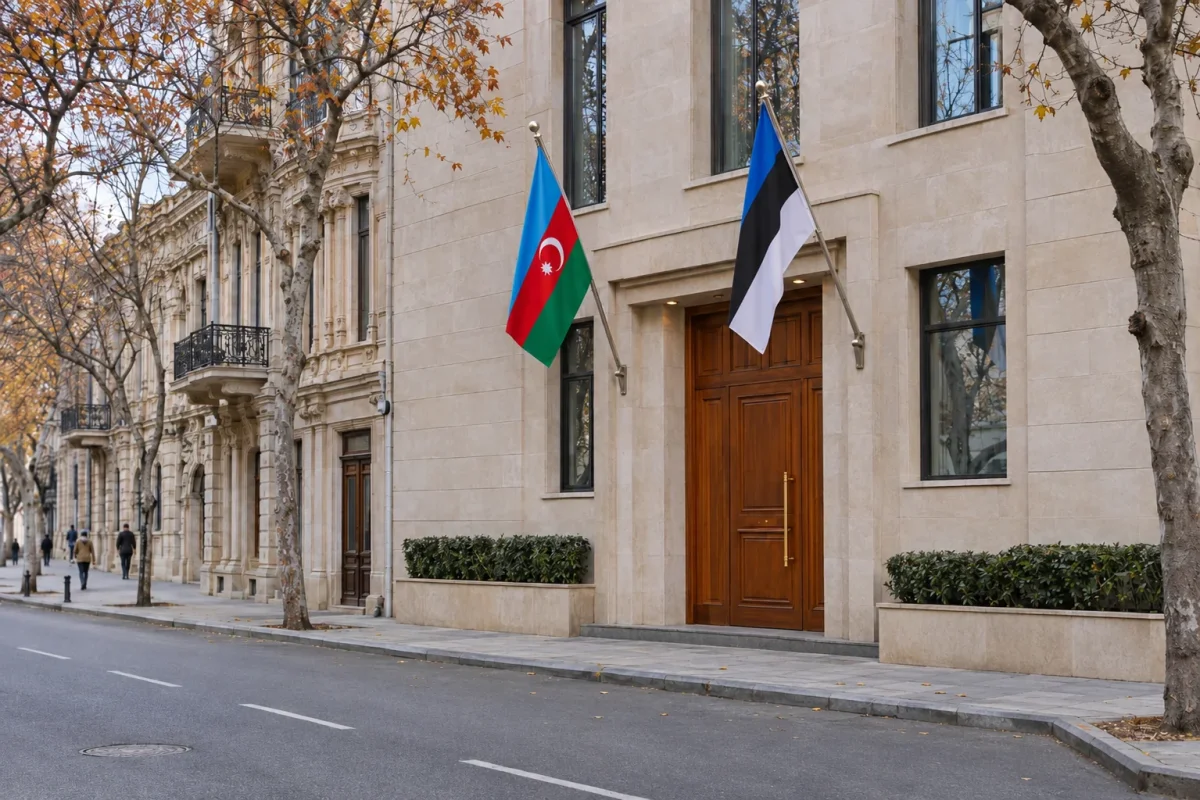
Estonia’s new Baku embassy looks promising for technology, investment and trade

Qabil Ashirov
Read moreEstonia’s decision to establish a permanent diplomatic presence in Baku comes with an economic opportunity that extends beyond stronger political relations. As Azerbaijan looks to diversify its economy, attract European investment and establish itself as a regional hub for technology and transport, the Baltic country brings expertise in digital governance, innovation and business development that could help advance those ambitions. The official opening of Estonia’s embassy on November 27 therefore offers a platform to turn diplomatic engagement into more substantial commercial ties.
The potential is considerable, although the existing business relationship remains relatively small. Bilateral trade turnover reached approximately $32 million last year, while Estonian investments in Azerbaijan totalled $25 million, according to Azerbaijani Foreign Minister Jeyhun Bayramov. Of the 72 Estonian companies registered in the country, 48 are currently operating. These figures suggest that a commercial foundation already exists, but also reveal how much room there is for expansion. The challenge now is to translate the opening of a permanent embassy into new investment, stronger business connections and projects that deliver measurable economic returns.
For both countries, the immediate priority will be to give commercial relations greater momentum. Regular business forums, investment conferences and direct contacts between companies could help identify opportunities in manufacturing, agriculture, technology, logistics and financial services. The two governments are also working on eight additional bilateral agreements designed to broaden the legal framework for cooperation. If completed, these arrangements could provide businesses with a more predictable institutional environment and make it easier to develop joint projects.
Digital transformation is perhaps where the partnership has the greatest potential. Estonia has become one of the world's leading examples of digital government, building an extensive system around electronic identification, digital signatures, cybersecurity and online public administration. Its experience could prove valuable for Azerbaijan, which has been investing in the modernisation of public services and the development of its information and communications technology sector.
Azerbaijan is not starting from scratch. The ASAN Service model and the expansion of electronic government platforms have already established important foundations for digital public administration. The next challenge is to move towards more sophisticated infrastructure, improve the integration of government databases and create a competitive environment for technology businesses. Estonian expertise could support this transition, particularly in cybersecurity, digital identity management, financial technology and secure data exchange.
There is also a commercial dimension to this cooperation. Joint initiatives involving Estonian technology companies and Azerbaijani institutions could encourage technology transfer, strengthen local startups and create opportunities for highly skilled professionals. Rather than limiting cooperation to the exchange of experience, the two countries could pursue practical projects that bring together Estonian technological expertise and Azerbaijan's growing domestic market.
Investment offers another avenue for closer economic relations. Estonia's technology-oriented business environment could provide opportunities for Azerbaijani companies seeking partnerships with European firms, while Estonian investors could explore Azerbaijan's expanding digital services market, industrial modernisation programmes and emerging technology sectors. A permanent diplomatic mission in Baku should make it easier for businesses to establish contacts, navigate regulatory requirements and engage with government institutions.
Azerbaijan's position as a potential gateway to wider regional markets adds to its appeal. The country's geographical location, energy infrastructure and transport connections offer opportunities for companies looking beyond the domestic market. For Estonian businesses, partnerships in Azerbaijan could provide access to the South Caucasus and Central Asia, while Azerbaijani companies could use stronger connections with Estonian firms to expand their presence in Northern Europe.
Access to the European market is another important consideration. As an EU member, Estonia operates within the bloc's common regulatory and commercial framework. Closer cooperation with Estonian businesses could help Azerbaijani exporters better understand European standards, identify distribution partners and explore opportunities in the Baltic region. Agricultural products, processed food, industrial materials and technology services are among the sectors that could benefit from more systematic commercial promotion.
Transport and logistics could provide the partnership with a broader strategic dimension. Azerbaijan is seeking to strengthen its role along the Middle Corridor, the trade route connecting China and Central Asia with European markets through the Caspian Sea and the South Caucasus. Estonia, meanwhile, has established Baltic Sea ports and developed logistics infrastructure that could make it a useful partner in connecting Caspian and Baltic commercial networks.
The opportunities are not limited to conventional transport links. Cooperation in port management, digital cargo tracking, customs procedures and multimodal transportation could improve the efficiency of trade between the two regions. Azerbaijan's investments in the Port of Baku, railway infrastructure and regional connectivity projects offer a foundation for such cooperation. Estonia's experience in digital logistics could help streamline operations, improve the movement of goods and strengthen the competitiveness of transport routes linking Asia and Europe.
Education and workforce development are equally important if the partnership is to produce lasting economic benefits. According to Estonia's Foreign Ministry, the number of Azerbaijani students enrolled at Estonian universities has increased from approximately 30 to 200 over the past five years. Five Estonian universities have cooperation agreements with Azerbaijani universities, providing an existing institutional network for expanding academic exchanges and research partnerships.
These connections could become particularly valuable as Azerbaijan seeks to develop a workforce capable of supporting its ambitions in information technology, engineering, finance and innovation. Joint research programmes, professional training and closer university-industry partnerships could help bridge the gap between academic education and the practical requirements of the private sector. They could also create a longer-term network of professionals and entrepreneurs familiar with both markets.
The opening of Estonia's embassy also carries political significance. As a member of both the European Union and NATO, Estonia offers Azerbaijan another channel for engagement with Northern Europe and European institutions. More frequent diplomatic consultations and high-level exchanges could provide opportunities to discuss energy security, regional stability, economic connectivity and the changing political and commercial landscape of Eurasia.
However, the success of the new diplomatic presence should ultimately be measured in economic rather than ceremonial terms. The existing trade volume of approximately $32 million, Estonian investment of $25 million and the presence of 48 operating Estonian companies provide a starting point, but they also underline the scale of the untapped potential.
For Azerbaijan, the most valuable outcome would be to turn Estonia's technological experience into practical cooperation, attract investment into higher value-added sectors and build stronger commercial connections with European markets. For Estonia, Azerbaijan offers a potential partner at the intersection of the South Caucasus, Central Asia and the expanding trade networks linking Asia with Europe.
The embassy provides the institutional infrastructure for this relationship to grow. Whether it becomes a meaningful economic bridge between the Baltic and Caspian regions will depend on how quickly diplomatic engagement translates into investment decisions, technology partnerships and new commercial opportunities.
Here we are to serve you with news right now. It does not cost much, but worth your attention.
Choose to support open, independent, quality journalism and subscribe on a monthly basis.
By subscribing to our online newspaper, you can have full digital access to all news, analysis, and much more.
You can also follow AzerNEWS on Twitter @AzerNewsAz or Facebook @AzerNewsNewspaper
Thank you!