
Azerbaijan’s gas corridor nears dividend breakthrough despite ageing fields

Akbar Novruz
Read moreAzerbaijan took most of a decade to develop the Southern Gas Corridor. The more interesting question now, having invested billions of dollars in it, is what Azerbaijan will gain from it. A pipeline designed for the purpose of ensuring Europe’s access to the Caspian gas supply has reached another important point, when its state-owned holding may start paying dividends in 2027.
It became clear after a Fitch Ratings review released on November 25. The agency reaffirmed the Southern Gas Corridor CJSC (SGC) at investment grade BBB− with a stable outlook and projected net cash through 2029 for the firm. The implications go beyond the solid financial standing of the company. It means that one of the biggest strategic projects in Azerbaijan is moving from construction and financing towards income generation. The infrastructure is working and becoming increasingly predictable from a financial standpoint. However, the gas fields are ageing, energy policy in Europe is evolving, and Azerbaijan will still be the ultimate guarantee for the company’s commitment to the project.
SGC was founded back in 2014 in order to handle all of Azerbaijan’s interests within the chain from the Shah Deniz oil and gas field to Europe. State funding amounted to $2.4bn, with $2.5bn being issued in corporate bonds, which were later repaid in 2024. It entailed huge funding even when the financial feasibility of the venture had yet to be verified with its regular output.
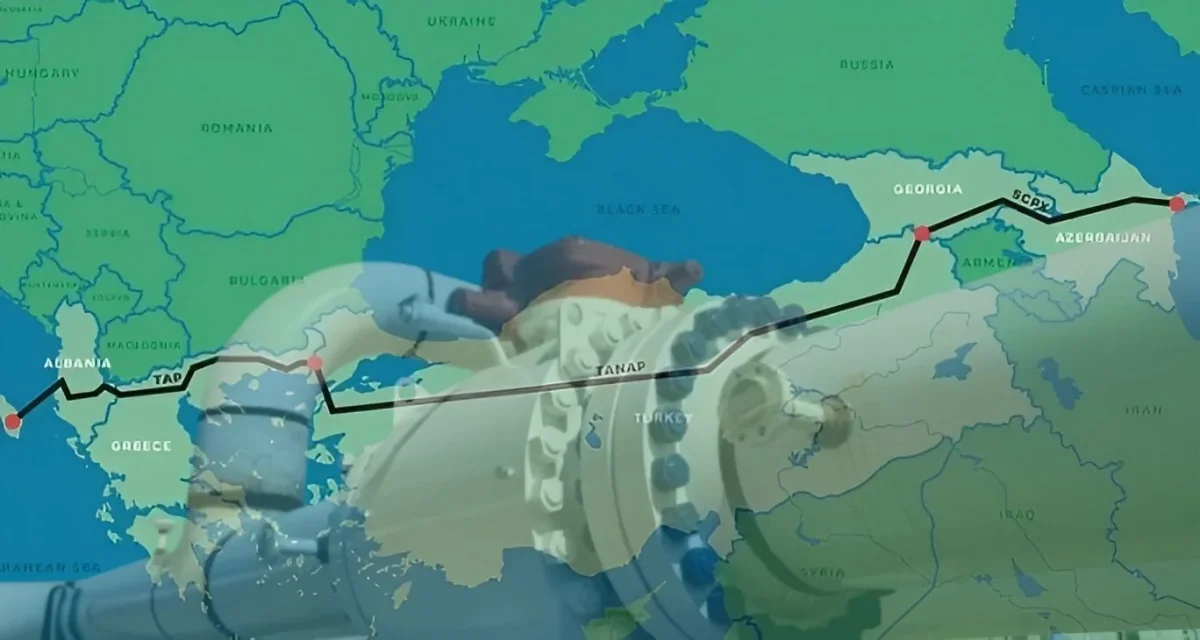
The system is now about 3,500km long, passing through Georgia and Türkiye, further on into Greece and Albania and terminating in Italy. These links consist of the South Caucasus Pipeline, the TANAP and the TAP, as well as oil and gas extraction from the Shah Deniz field. For Europe, it became one more way of importing resources. For Baku, it became a source of income that depended not only on molecules sold, but also on their delivery.
The balance sheets demonstrate the signs of maturity. SGC achieved revenues of $3bn and net profits of $1.6bn in 2025, with consolidated equity at $9.1bn, as stated in its announcement on audited results. It had cash and bank deposits of $3.4bn against some $1.4bn of development bank loans at the end of October 2026. Eurobonds were fully paid off in March; remaining development bank maturities range between 2032 and 2046.
Fitch projects capex of only $200mn per year on average during 2026–29 and loan principal payoffs of roughly $120mn per year in the near term. According to the projections, the firm will be able to finance its activities and make dividends starting from 2027. Nevertheless, figures are just projections, not announcements of dividend payments. Furthermore, not every penny of consolidated cash will be available for distribution.
Business now shifts towards the pipes
Another change occurs with respect to the nature of the profits. Fitch foresees an increase in the share of gas transportation in SGC’s EBITDA from about 60% in 2025 to 80% in 2028. It seems to be a significant growth in the profitability of the pipeline business, however, the agency anticipates stability in the income from transportation in absolute values. One reason for this growth in share is the drop in upstream earnings.
Natural depletion of production at Shah Deniz, where SGC owns 16.02%, will affect the upstream EBITDA of SGC. Fitch forecasts an upstream EBITDA of about $700mn in 2025, followed by a short-term increase in 2026 and further decline from 2027 onwards. The decline in forecasts for oil and gas prices adds to the burden. Thus, the company becomes more dependent on transportation revenues. It might also lead to a more stable mix of earnings. Ship-or-Pay clauses in the contracts signed by TANAP and TAP help secure the operator from any variations in the actual throughput, but do not shield against counterparty, regulatory, or operational risks. The significant difference in terms of policymakers here is that the corridor can be made more profitable without increasing the gas production in Azerbaijan. The only thing that will ensure the stability of profits over many years is enough gas supply, proper maintenance, and buyers of it.
The geopolitical market still retains considerable size. According to the European Commission, Azerbaijan delivered 11.4bn cubic meters of gas via the corridor in 2025. Deliveries to Germany and Austria started in January 2026, making the geography of shipments broader than in south-eastern Europe. At the same time, TAP increased annual transportation capacity by 1.2bn cubic meters in 2026 after a market test.
However, expanding geography cannot mean limitless growth. Azerbaijan delivered 8.6bn cubic meters of gas to Europe during the first nine months of 2026, according to its energy ministry, which represents an 8.5% decrease compared to the year before. Also, the International Energy Agency forecasts that TAP will operate at nearly full design capacity this winter. Any increase requires not only new customers but also commercially available gas and infrastructure. Europe's longer-term direction also complicates the investment case. Gas remains important to supply security after the reduction in Russian imports, but EU decarbonisation policies will constrain the horizon for new fossil-fuel infrastructure. An existing, contracted pipeline may therefore be more attractive financially than an expensive speculative expansion.
What a dividend does, and does not, prove - respectfully
During September, the investment vehicle of ADNOC called XRG from the United Arab Emirates of Abu Dhabi purchased 12.5% of SGC. SOCAR holds 51%, while 36.5% is controlled by Azerbaijan's Ministry of Economy. This deal shows foreign interest in an experienced regional player while keeping strategic control in Baku. However, alone, it does not show what revenues the funds will be allocated to for future expansion.
The Azerbaijani government can decrease its expenditures on supporting a project previously financed with the help of the public budget due to the dividends received. However, it is not diversification from hydrocarbons because the revenue is generated from gas production and transportation. Moreover, the country remains fiscally exposed, according to Fitch, which directly connects the BBB− rating of the company with the sovereign rating of Azerbaijan, as all of its debt is guaranteed by the state. That is the real investment equation, per se. Azerbaijan has financed an energy corridor with strategic value, paid down much of its debt, and attracted an external shareholder. It is now approaching the stage when those assets may send cash back to their owners.
Here we are to serve you with news right now. It does not cost much, but worth your attention.
Choose to support open, independent, quality journalism and subscribe on a monthly basis.
By subscribing to our online newspaper, you can have full digital access to all news, analysis, and much more.
You can also follow AzerNEWS on Twitter @AzerNewsAz or Facebook @AzerNewsNewspaper
Thank you!