
Armenia’s peace process faces pressure from an unresolved political legacy
Akbar Novruz
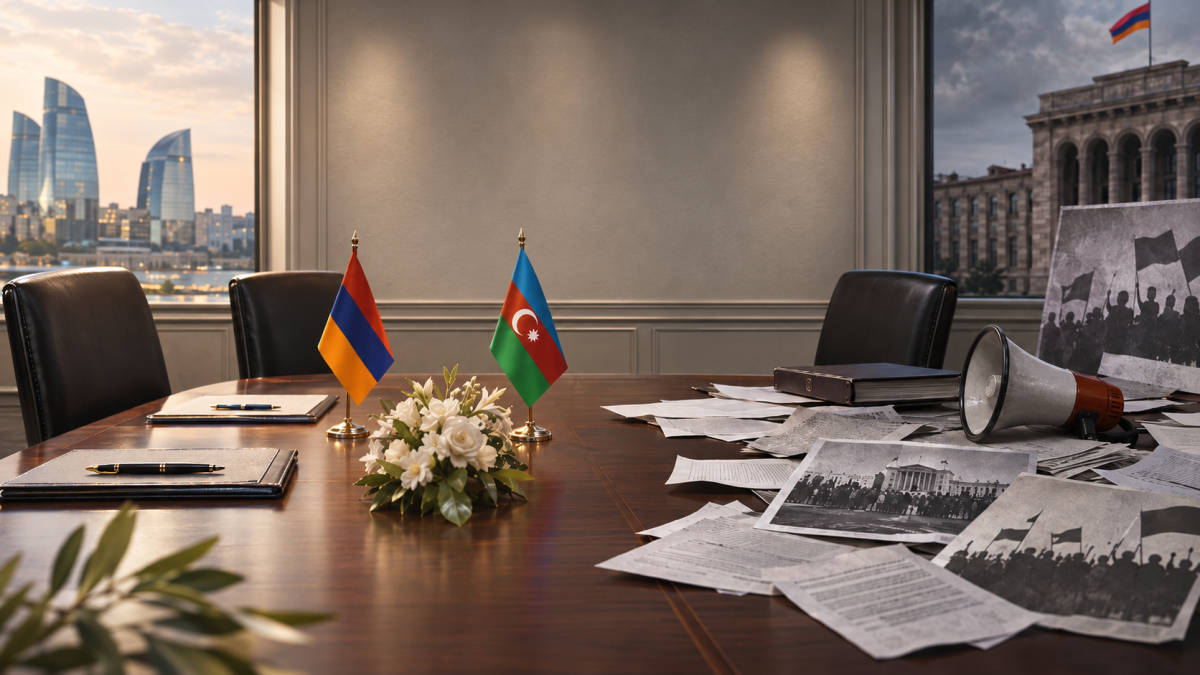
Read moreAs Azerbaijan and Armenia continue efforts towards normalising relations, a renewed attempt by Armenian nationalist circles to bring the Karabakh question back onto the international agenda has raised concerns about the political obstacles that could still complicate the peace process.
On November 17, the Armenian National Committee–International, also known as the Hay Dat Central Council and affiliated with the Armenian Revolutionary Federation (ARF Dashnaktsutyun), published an updated version of its policy document, Unresolved: The Conflict Over Artsakh. The publication revises an earlier document issued in March 2025 and presents 13 demands addressed to Azerbaijan, Armenia and the international community.
Among its principal demands are the establishment of a new internationally mandated negotiating framework under the OSCE or United Nations, the return of displaced Karabakh Armenians under international guarantees, and renewed international involvement in questions concerning detainees, property and cultural heritage. The document also criticises the Armenian government for its recognition of Azerbaijan's territorial integrity and its approach to the ongoing peace process.
The timing is particularly significant. More than a year has passed since the August 8, 2025, Washington summit, where Azerbaijan and Armenia initialled the text of a peace agreement and agreed to seek the closure of the OSCE Minsk Process. The latter was formally closed on November 30, 2025, bringing an end to the decades-old international mediation framework.
While official Baku considers the Karabakh conflict resolved following the restoration of Azerbaijan's sovereignty in September 2023, the Hay Dat initiative challenges that position and seeks to return the issue to international negotiations.
The development raises a broader political question: is the renewed campaign primarily aimed at influencing international diplomacy, or is Karabakh becoming an instrument of domestic political mobilisation against Armenian Prime Minister Nikol Pashinyan?
Speaking to AzerNEWS, Armenian activist and public figure Ishkhan Verdyan argued that the continued promotion of the so-called Artsakh political agenda represents a challenge not only to the normalisation process but also to Armenia's evolving political landscape. According to Verdyan, the idea of maintaining Karabakh as a separate political entity capable of influencing Armenia's internal affairs should gradually lose its place in the country's political discourse:
"At this point, the very idea that so-called Artsakh could or should act as a political entity, one possessing political weight and influence over processes within Armenia, ought to gradually become unacceptable within the Armenian political landscape. While such assertions are currently dismissed as marginal fantasies, this does not, in my view, mean that the issue of Artsakh has been definitively removed from Armenia’s political agenda. Moreover, even if Nikol Pashinyan does not currently grasp that he will eventually have to address this matter directly, I am convinced that doing so will become an inevitable next step in his policy. This is because Artsakh, in its present form, poses a threat to Azerbaijan’s national security. We cannot know what measures Azerbaijan might take to eliminate this threat—and heaven forbid we ever have to find out."
Turning to the domestic political motivations behind the Hay Dat document, Verdyan suggested that the Karabakh issue has become one of the remaining instruments through which Pashinyan's opponents seek to preserve their influence.
"In this sense, so-called Artsakh likely remains the final political argument to which Pashinyan’s opponents cling. Their former ideological framework, rooted in the notion of an eternal enmity between Armenians and Turks, is steadily losing its relevance and persuasiveness. With the prospect of opening the Armenian-Turkish border, establishing diplomatic relations, and the gradual emergence of a new regional reality, such rhetoric no longer carries its former power to mobilize support. It is precisely for this reason that Artsakh has become, for them, a final instrument of political leverage, a focal point around which they attempt to preserve their ideological construct and rally their followers."
The activist further suggested that the opposition's renewed emphasis on Karabakh may be intended to strengthen its political position ahead of potential changes in the Armenian government's approach to the issue.
"They may well realize that, in the foreseeable future, Nikol Pashinyan will be forced to confront this political agenda, and they are therefore seeking to preemptively strengthen their own positions in this arena."
Addressing the possible implications for Azerbaijan-Armenia normalisation, Verdyan described the publication as an explicit rejection of the direction taken by the two governments in their efforts to achieve a settlement.
"Be that as it may, the publication of such a document serves to directly torpedo the peace agenda. This is, in effect, a declaration of a position: we do not agree with the processes currently underway, we do not accept the prevailing logic of the settlement, and we intend to continue insisting on our own vision for the future."
Concluding his assessment, Verdyan framed the dispute as a broader contest over Armenia's political direction, contrasting an approach centred on state sovereignty and regional peace with the ideological priorities promoted by Dashnaktsutyun.
"And here, in my view, arises the only truly fundamental question: which will prove stronger—an Armenian statehood oriented toward its own interests, sovereignty, security, and a peaceful future, or the Dashnaktsutyun’s vision of what the future of Armenia and the region should be?"
Here we are to serve you with news right now. It does not cost much, but worth your attention.
Choose to support open, independent, quality journalism and subscribe on a monthly basis.
By subscribing to our online newspaper, you can have full digital access to all news, analysis, and much more.
You can also follow AzerNEWS on Twitter @AzerNewsAz or Facebook @AzerNewsNewspaper
Thank you!